
After Losing $5.5 Billion in 15 Minutes, Why Did "Meme Coin" OM Experience a 4x Surge?


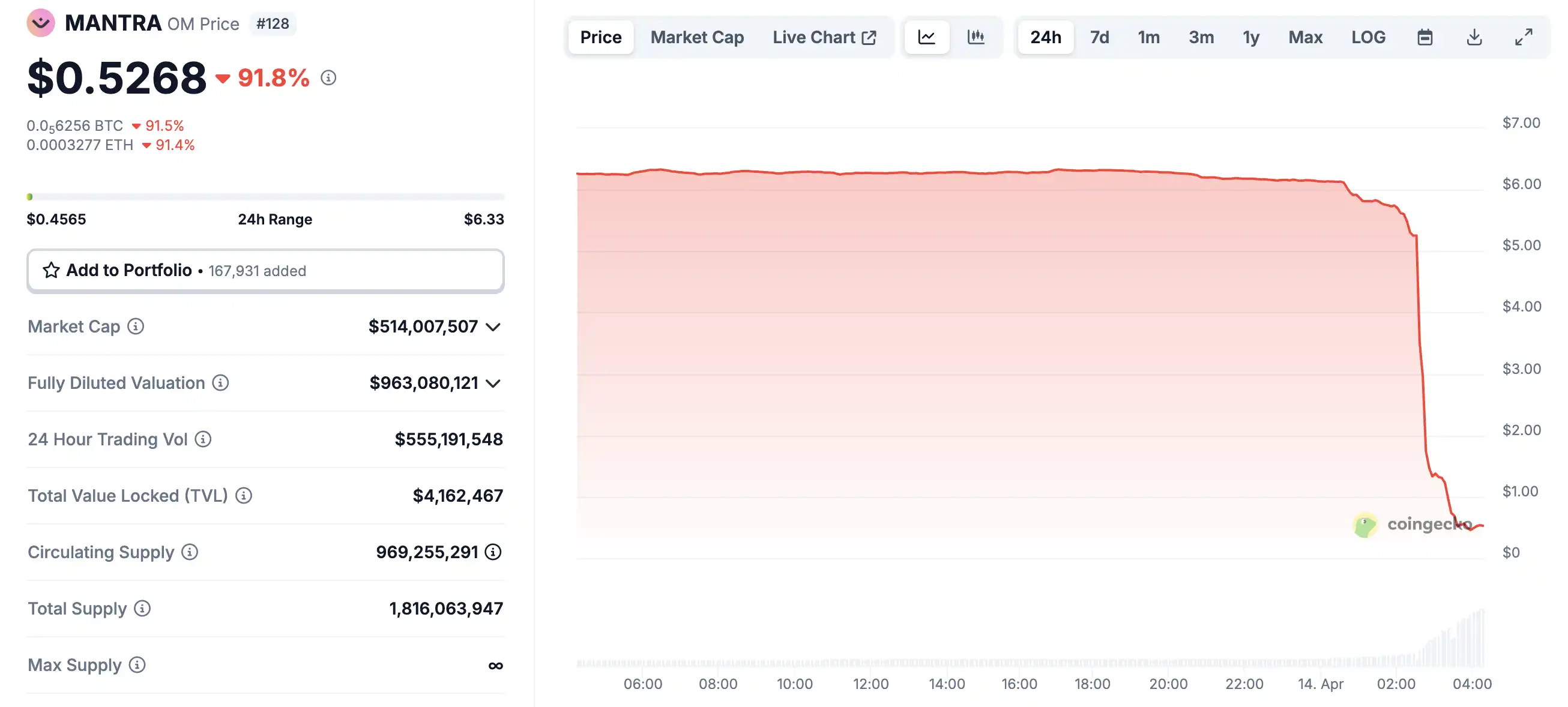
In the early hours, the RWA sector project MANTRA (OM) experienced a rapid 90% drop, plummeting from $6 to $0.5, causing its market capitalization to shrink by over $5.5 billion.
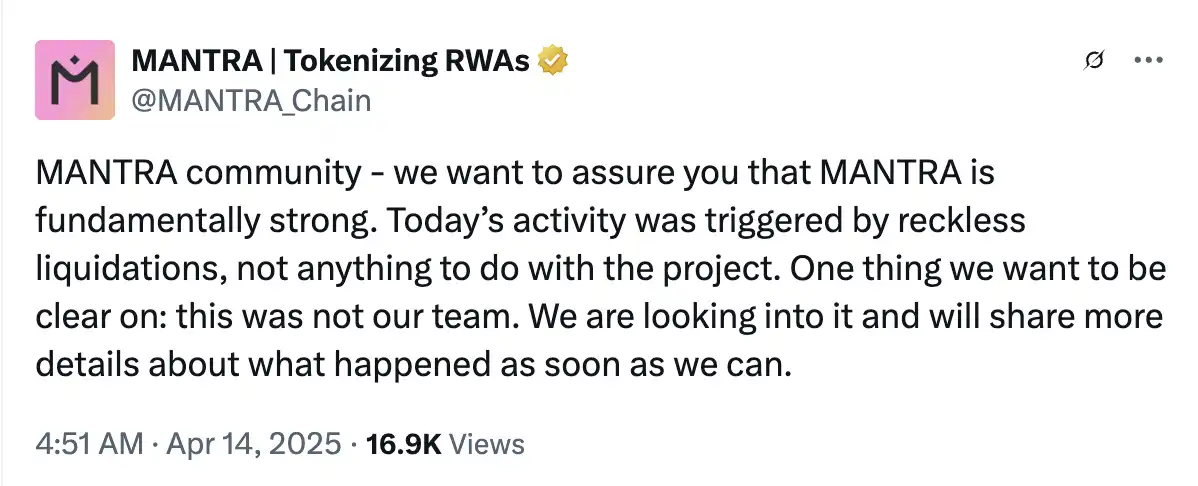
Three hours later, the MANTRA team released a statement attributing the sharp decline to an irrational liquidation event unrelated to the project itself, affirming that it was not initiated by the team.
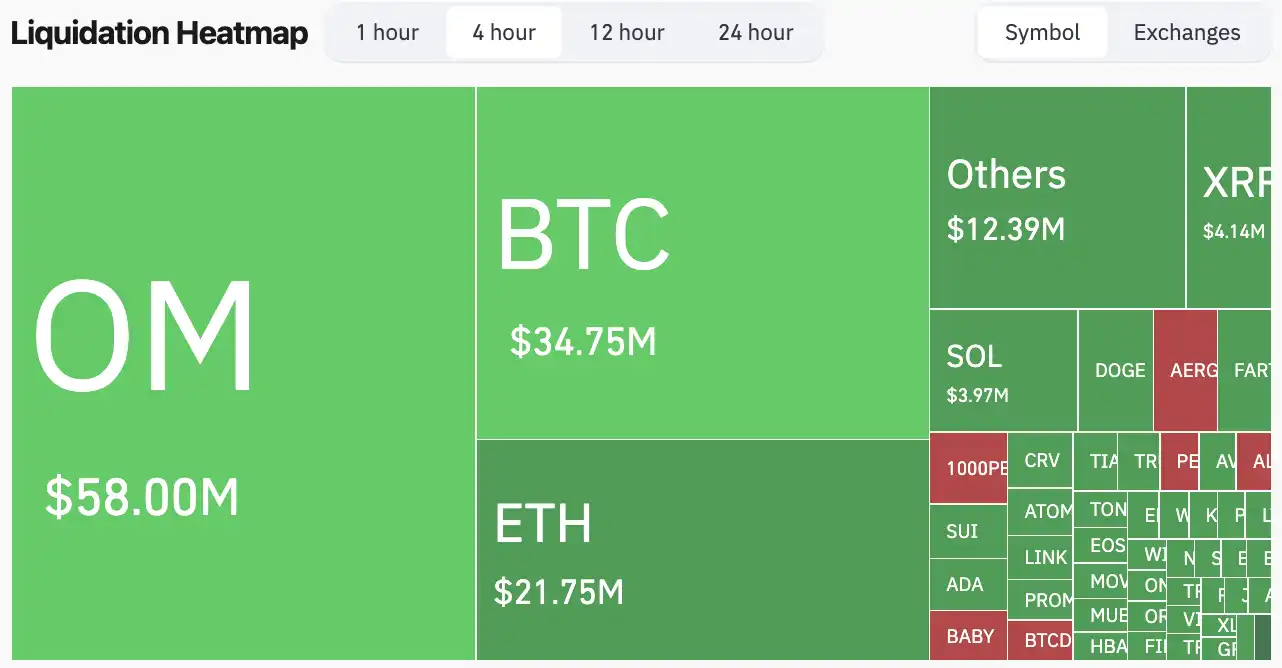
Subsequently, OM surged from around $0.5 to $1.2, experiencing a brief pump. According to Coinglass data, within just four hours, the OM contract saw liquidations totaling $58 million.
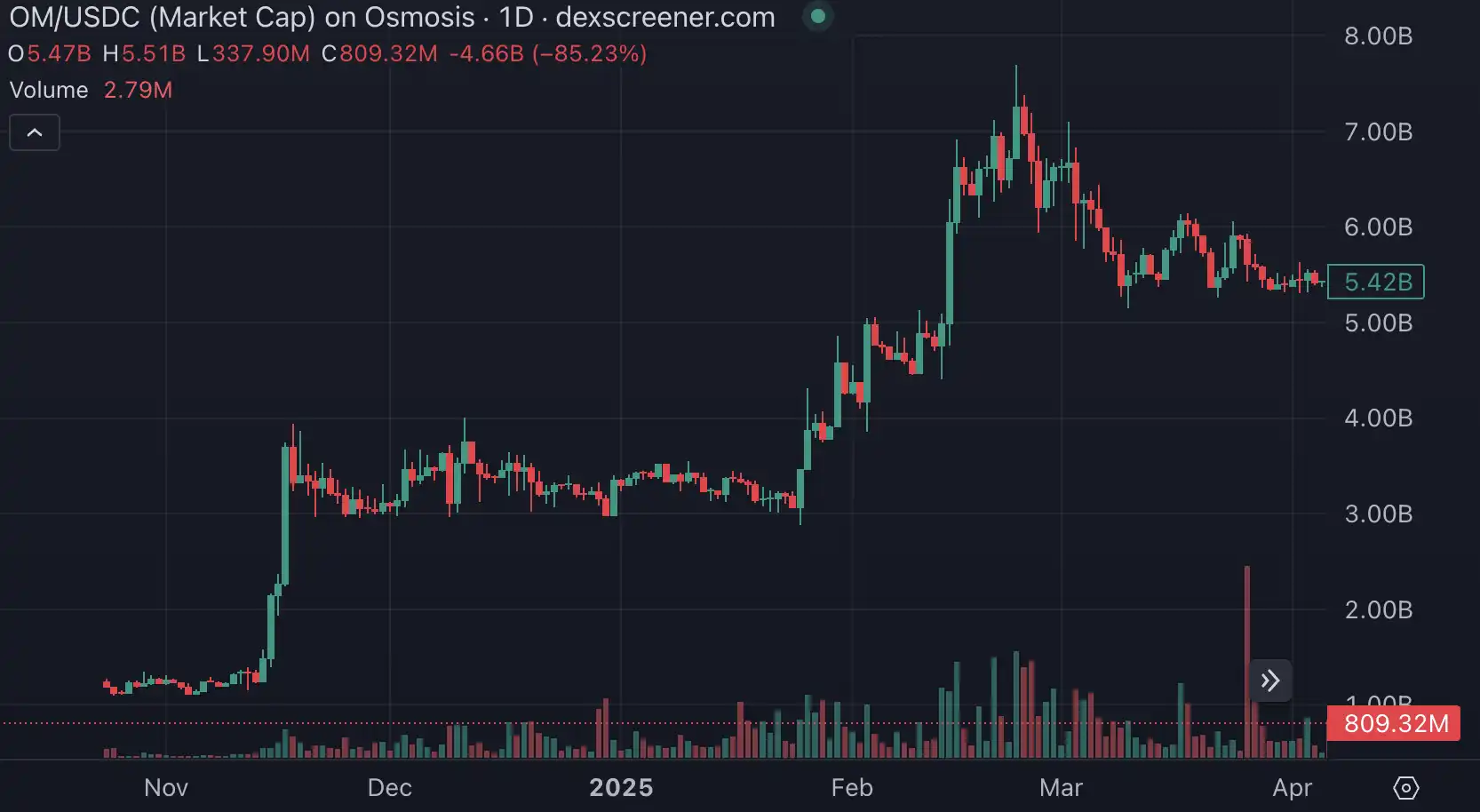
Prior to this crash, OM had gone through multiple violent upswing phases since November last year, earning the nickname "Strong Pump Shitcoin" from the community.
OTC Trading or Team Dump? The Turbulent Life of OM's Whale-Dominated Supply
Recently, the community and various data tracking tools reported that whale addresses of OM had been withdrawing and sending funds to exchanges, with rumors suggesting that several off-exchange trades at a 50% discount or higher had been completed. When large holders start dumping, off-exchange buyers also panic sell.
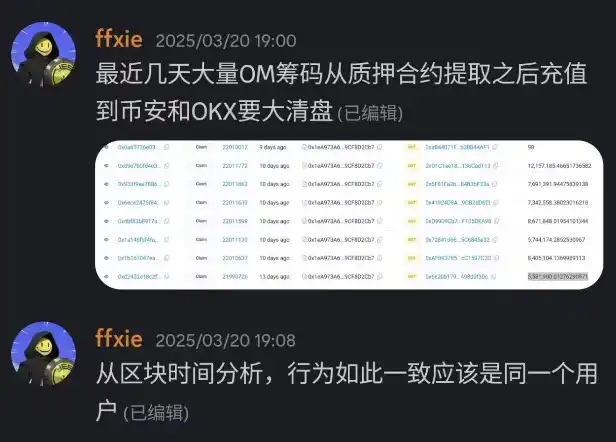
On March 25, according to TheDataNerd's monitoring, the investment firm Laser Digital's address of MANTRA deposited 1.7 million OM to Binance, worth $11.49 million. The wallet had accumulated a total of 27 million OM last year and still holds 6.756 million OM, valued at $45.67 million.
Yesterday, as per Arkham's tracking, the address 0xA8...A84f withdrew 776,000 OM from Polygon's StakedOM contract, approximately worth $5.84 million.
Additionally, as observed by Genç Trader, the wallet address 0x9a…1a28 transferred around $20 million worth of OM to OKX 23 hours ago. Looking at past records, this address had withdrawn about $40 million worth of OM from Binance just a month ago and was one of the whales that had previously pumped the coin's price.
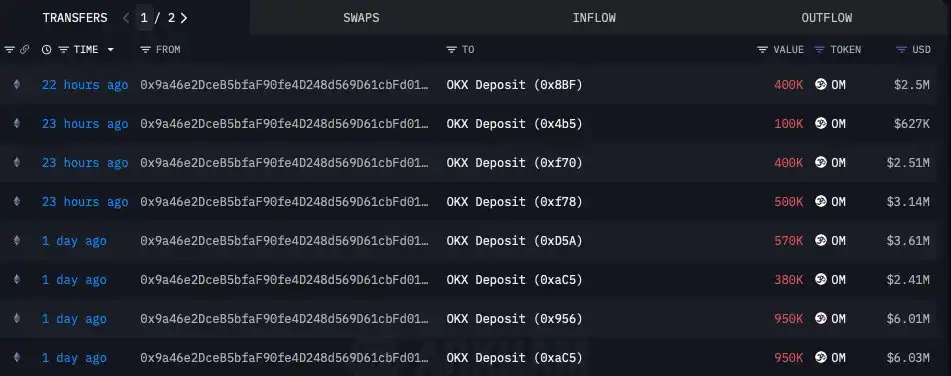
The dumping of OM by several whales is believed to be the direct cause of this recent crash, but some in the community speculate that it may have been premeditated.
PUA Airdrop
Last November, MANTRA announced a change to its airdrop rules, shifting from the previous "3-month cliff period followed by initial liquidity distribution and 9-month linear unlock" to "shortening the cliff period to 1 month, followed by an 11-month linear unlock," triggering strong community dissatisfaction.
Initially, MANTRA used high-profile expectation management to spark user participation, claiming to distribute 50 million OM tokens and promising a 20% immediate unlock on listing, with the airdrop to be completed within a month.
However, in actual implementation, MANTRA successively amended the airdrop rules, first changing the "immediate unlock on listing" to "start of linear release after one month," further delaying it to "10% initial release, with the rest vesting over three years." Simultaneously, with several mechanism changes such as roadmap adjustments and token distribution structures, MANTRA effectively transformed community traffic into a long-term lock-up tool by continually extending the vesting period.
When user sentiment rebounded, the project team introduced a governance voting mechanism to shift responsibility under the guise of "community consensus." However, in practice, the voting rights were concentrated in the hands of the project team or affiliated parties, resulting in high controllability. Finally, some early participants were excluded from the airdrop list, with the project team freezing their stakes citing a "Sybil attack" without disclosing detailed justifications.
High Token Control
The reason OM has been continuously pumped over the past six months is due to its team's significant token control. According to KOL @nihaovand, it usually involves coordinating three waves of community buy-ins at different price ranges to collectively drive up the token price. At the same time, the project team arranges an off-chain exit path for holders. The funds obtained from these exits are then used to boost the coin's price, laying the groundwork for the next wave of off-chain capital influx.
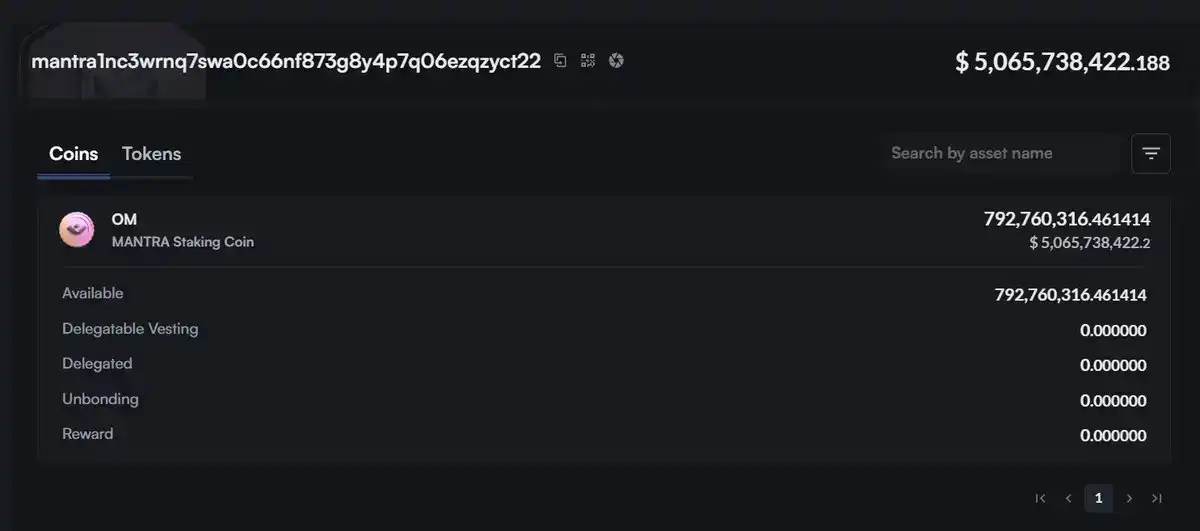
Previously, there were multiple reports alleging that the MANTRA team held 90% of the OM token's supply. Crypto analyst Mosi once wrote an article analyzing how a project with only a $4 million TVL could have over a $10 billion FDV, with the answer being that the team controlled most of the OM circulating supply. The MANTRA team holds 792M OM in a single wallet (90% of the supply), with the team even being too lazy to spread this supply across multiple wallets.
Related reading: "False Circulating Supply, High-profile Pump and Dump: Exposing the Manipulation of High FDV Tokens"
What Is the Actual Circulating Supply of OM?
According to Mosi's analysis, the actual circulating supply of OM = 980 million OM (circulating supply) - 792 million OM (team-controlled portion) = 188 million OM
However, this number may not be accurate either. The team still controls a significant portion of OM, using these tokens to perform a rug pull on their own airdrop, further draining liquidity, and continuing to control the circulating supply. They deployed around 100 million OM for a rug pull on their own airdrop, so this portion of tokens also needs to be deducted from the actual circulating supply.
Ultimately, the actual circulating supply of OM may be only 88 million OM, and the lower actual circulating supply makes it easy to manipulate the price of OM and easily liquidate any short positions. Traders should be wary of shorting OM as the team holds a large portion of the circulating supply, allowing them to easily pump or dump the price.
Mosi believes that Tritaurian Capital may be involved behind OM—this company borrowed $1.5 million from @SOMA_finance (@jp_mullin888 is a co-founder of SOMA, while Tritaurian is owned by Jim Preissler, former CEO of JP Morgan at Trade.io)—as well as some funds and market makers from the Middle East. These operations further compress the actual circulating supply, making its calculation more challenging.
This may also explain why they are unwilling to release the airdrop and have decided to implement a lock-up period. If they did carry out the airdrop, the actual circulating supply would significantly increase, potentially leading to a sharp price drop.
This is not some complex financial engineering, but it seems to be a deliberate plan aimed at reducing the token's actual circulating supply and easily pumping or dumping the price of OM.
You may also like

The impossible triangle is simply a pseudo problem

Stablecoins Finally Find Real Returns: On-Chain Reinsurance Re Explained | Interview with Re Founder Karan Saroya

The AI gamble of mining companies: Valuations enter a phase of differentiation, and it's hard to turn the tide

A letter from Alliance to entrepreneurs: Written on the occasion of Cursor selling for 60 billion dollars

Will MicroStrategy fall into a death spiral? What will the macro trend be in the second half of the year?

Blockchain Capital Partner: The Core Secret of Arbitrage

STRC unanchored by 11%, can the perpetual motion machine of Strategy still operate?

Bitcoin Market Analysis 2026: Can BTC Reach $150K by Year-End?

Bitcoin ETF Outflows Hit a Record $4.4 Billion: What Are Traders Doing With Their Cash?

WEEX App Just Got Smarter – New Tabs for Faster Trades & Easy Asset Management

WEEX All-New Search Features: Find, Trade & Earn Faster Than Ever

Morning Report | Illinois signs the strictest digital asset tax law in the U.S.; RWA tokenization market size surpasses $43 billion, institutions accelerate the migration of on-chain assets

Full version of the debut Q&A! Federal Reserve Chairman Waller: Sticking to the 2% inflation target, establishing five special working groups, individual did not submit the dot plot

From Disruptor to Shadow Market: The Crypto Market is Becoming a Colony of Traditional Finance
Dalio's important long article: How to position in the current market environment?
OKX Star analyzes Binance's competitive advantages: when regulation levels the playing field, competition has just begun

New gameplay for participating in initial offerings on cryptocurrency exchanges
Why Is Bitcoin Down Today? What the Hawkish FOMC Means for SpaceX, Gold and Nasdaq
The impossible triangle is simply a pseudo problem
Stablecoins Finally Find Real Returns: On-Chain Reinsurance Re Explained | Interview with Re Founder Karan Saroya
The AI gamble of mining companies: Valuations enter a phase of differentiation, and it's hard to turn the tide
A letter from Alliance to entrepreneurs: Written on the occasion of Cursor selling for 60 billion dollars
Will MicroStrategy fall into a death spiral? What will the macro trend be in the second half of the year?
Blockchain Capital Partner: The Core Secret of Arbitrage


