
After April 2, What Will the Crypto Market Look Like? | Trader's Insight


April 2, 2025, is destined to be a key milestone in the global financial markets. President Trump of the United States is expected to announce corresponding tariff measures in the White House Rose Garden on Wednesday afternoon at 3 p.m. (3:00 a.m. Beijing time the next day).
Due to concerns about the imposition of heavy tariffs, the US stock market experienced a sharp decline on March 28. In recent days, tech stocks led the plunge, with the market capitalization of seven tech giants (including Apple, Microsoft, Amazon, etc.) evaporating by around $505 billion. The Philadelphia Semiconductor Index fell by 2.95%. This is the largest single-day drop since the U.S. stock market crash on March 10, marking a sharp adjustment at the end of the first quarter of 2025.
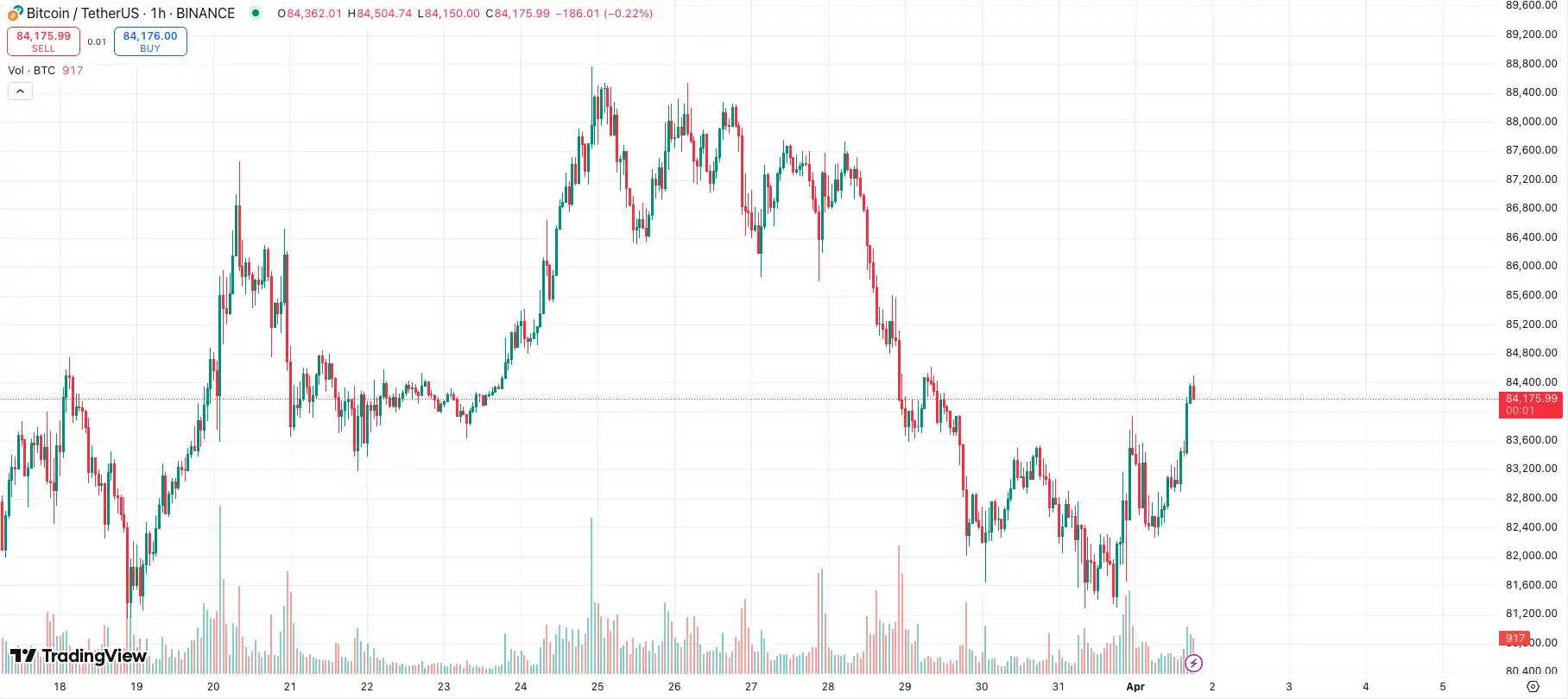
Transmitting to the crypto space, Bitcoin dropped from $84,000 in the afternoon of March 29 to $81,644 in 8 hours, a drop of over 3%. It then rebounded to $83,536 at 6 p.m. on March 30 but failed to sustain the upward momentum, falling to $81,565 by 6 a.m. on March 31. The total cryptocurrency market cap fell from a peak of $3.9 trillion to $2.9 trillion, a 25% decline, and the trading volume shrank from $126 billion after the November 5 election to $35 billion, contracting by about 70%.
Whether in public or private conversations, Trump has claimed that tariffs are a "win-win" policy that can bring manufacturing jobs back to the U.S. and generate trillions of dollars in new revenue for the federal government. He has also stated that allowing advisors to dissuade him from implementing higher tariffs during his first term was a mistake. He now believes that imposing a simple, uniform tariff rate on most imported goods helps avoid exemptions that would weaken the tariff's effectiveness.
Trump has publicly praised the benefits of import taxes, even calling "tariff" the "most beautiful word" in the dictionary, and stated that the 19th-century tariff policy brought the economic peak in U.S. history. Some allies have even proposed making April 2, the anniversary of the tariffs, a federal holiday. Trump's former chief strategist in the first term, Steve Bannon, even suggested, "Rather than celebrating Trump's birthday, it is better to establish 'Liberation Day' as a national holiday to pay tribute to the jobs, skills, and trade that have returned to America and its workers."
The most likely option to be adopted is the proposal publicly made this month by Treasury Secretary Scott Bennett: imposing tariffs on 15% of countries identified by the White House as the worst trading partners, which account for almost 90% of U.S. imports. In addition, Trump has also advanced other tariff policies that cover all countries but only target specific industries. He imposed a 25% tariff on all car imports on Wednesday and hinted at similar measures for industries such as pharmaceuticals and lumber.
However, what the market is most concerned about is the continued uncertainty brought about by policy flip-flops. This kind of "blunt knife cutting flesh" risk is forcing traders to reevaluate their investment logic for the second quarter. BlockBeast has compiled analysts' analyses from various dimensions such as macro games, technical patterns, policy variables, etc. These analyses, combined with long and short chip conversion signals and historical structural replication paths, reveal potential trading opportunities and traps in the eye of the storm.
Macro Analysis
1. Whether Value-Added Tax is Included (Bearish if included, Bullish if not included)
If the equivalent tariff previously mentioned considered the value-added tax, then the equivalent tariff rate will be higher than expected.
2. Whether Mexico has Tariff Exemptions (Bullish if yes, Bearish if no)
As previously mentioned, in Lutnick's tariff system, Mexico's tariffs are an extension of domestic policy, hoping they will cooperate to promote North American domestic circulation and engage in dialogue. Mexico is the US's No. 2 trading partner, and if they can be exempted, the stagflation pressure will be slightly reduced.
3. How the Dollar Index Reacts
The tariff triggers supply-side-driven inflation, and supply-side inflation will interact with the strength of the dollar—a rebound in DXY counteracts some of the tariff effects; a continued decline in DXY will increase future inflation pressures.
The strength of the dollar is an amplifier of supply-side inflation, and if the dollar appreciates, stagflation pressure will relatively weaken.
4. Expected Changes
The macro environment in Q1 was not bad, with no liquidity tightness, QT easing, and a decline in the 10-year yield and DXY. However, starting in February, along with changes in policy expectations, the crypto market has experienced multiple "Black Mondays" during US stock futures trading hours, from DeepSeek valuation squeezing to a weekend unexpected retaliatory Mexican tariff, to recession expectation trading. Overall, there are only three expected changes:
① The "reinflation expectation" brought about by tariffs
② The "recession expectation" caused by softening economic data and Fed observation leading to stagflation
③ The "adjustment expectation" that valuations are too high in the post-epidemic era
Personally, in trading, I believe that if these three expectations cannot be reversed, it is difficult to reverse the price range of 78,000-91,000 set in the chart earlier. I have not seen any concessions on tariffs yet. Therefore, if it surpasses, I will look for divergences to countertrade.
A bullish opportunity for 2025 may arise from the implementation of tariff impacts + the expected reversal from tax reduction bills (there are no signs of tax reduction bills yet; we will wait patiently).
In fact, the safe-haven sentiment for Bitcoin has improved a lot by now. After the opening of the morning US stock index futures, they all fell sharply together, mainly because the 2nd is approaching. Faced with the uncertainty of tariffs, many investors chose safe-haven assets. Currently, the Nasdaq futures have fallen by more than 1.2%, while the S&P 500 futures have fallen by 0.75%. Asian market investors are taking precautions.
Now the market is waiting for the final implementation of Trump's tariffs. What the market is most worried about is not one-time tariffs, but Trump's repeated adjustments to tariffs, which may make the market feel even more at risk.
But it is important to note that increasing difficulty does not necessarily mean a decline, as it is still event-driven. You never know when Trump might reverse course again, so this is the difficulty. The second quarter may be more challenging than the first quarter, with inflation, tariffs, the Fed maintaining interest rates, and Japan raising interest rates likely to affect the risk market. The April tariffs will be the main reason for the increasing difficulty in the risk market. It is not possible to simply comment on the pros and cons of tariffs in one sentence; it is more about "game theory."
This is the ASR-VC daily channel during the long-term oscillation before the last bull market turned bearish, which does have some similarities with the current situation;
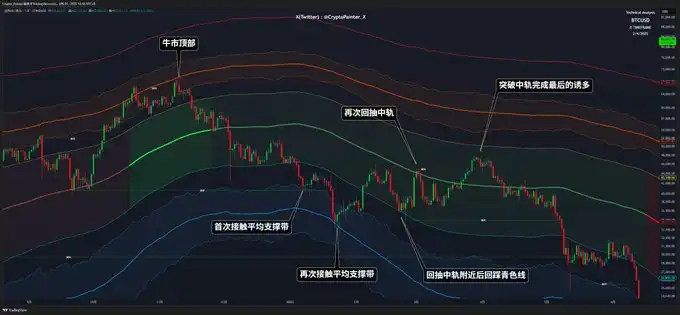
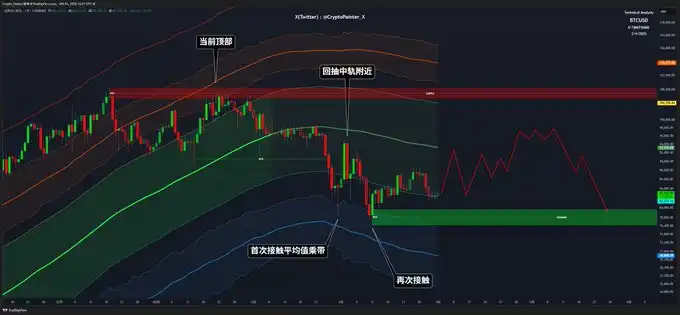
I have drawn on the chart a potential path for a similar structure to reoccur, the general idea being that if this is the final stage of a bull to bear conversion, then we still need to wait for one finalbull trap.
Still, it is not recommended to only rely on induction. The effect of syllogism in the market is not good. However, understanding the previous structural trends and their reasons, applying the same logic deduction to the present situation is still possible.
Technical Analysis
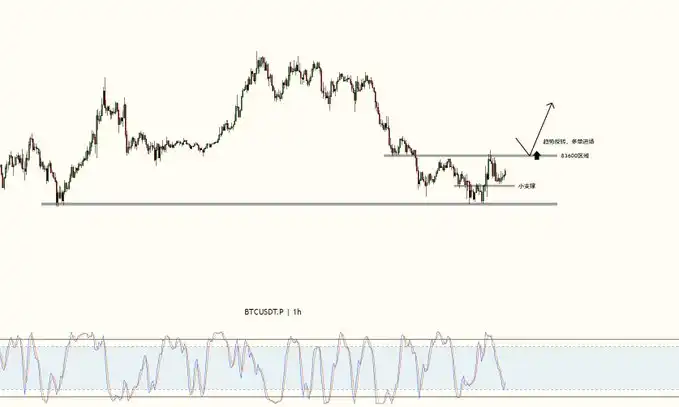
Currently, the overall 1-hour chart is in a downtrend channel, but there is a short-term reversal structure within the channel. Along with the indicator crossover, we are looking back towards the 83600 area first and observing the situation if resistance continues.
The next opportunity for a long position has been marked on the chart, which falls under "breakout retest rebound."
BTC continues its short-term downtrend, with a false breakout above the 83000 resistance level on the 4-hour chart, followed by a retreat. The short cycle is expected to form the first bottom around 79.5 and then bounce back after the tariff implementation on Wednesday, creating a sense of an upcoming rise, leading to a double bottom formation around 78k. Refer to the chart below for the trend.
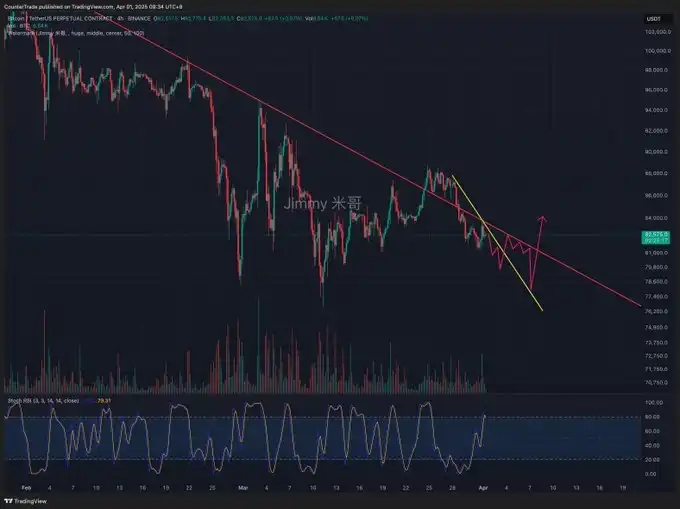
1. Channels represent weak structures meant to be broken, based on my experience;
2. If we consider the drop from 109000 to 76000 as the first stage of the entire downtrend, the rebound from 76000 to date is incomplete, as shown in the chart:
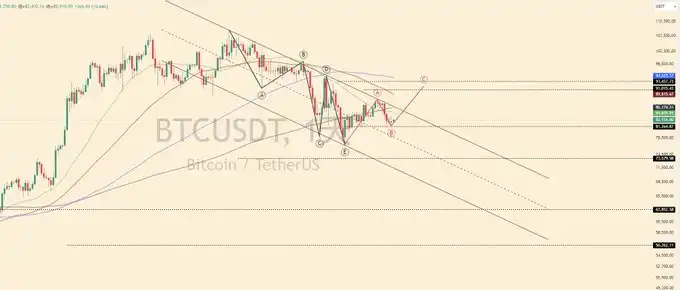
3. Continuous selling pressure has created a need for technical indicators to be reset.
Speculative Hypothesis:
1. The current hype is driven by expectations of inflation due to tariffs and the impending recession, rather than an actual recession. As I mentioned in my previous posts, it's crucial to observe price action before the April 2nd event. When emotions and prices reach a critical point, look for opportunities to take a contrarian stance;
2. Fact 1: A shift from long to short positions is currently underway, with daily moving averages turning downward, forming a bearish alignment with MA30, MA60, and MA120. From both a technical and macroeconomic perspective, there is no possibility of a bullish reversal. Fact 2: If this correction targets the significant rise from 15476 to 109000, the adjustment will be substantial, characterized by back-and-forth movements rather than a continuous decline. Therefore, no reversal does not imply no rebound;
3. Exit Strategy Hypothesis: In a scenario where there is insufficient capital to support downward movements and a small amount of capital can control market sentiment, main players can reduce control costs. The tug-of-war situation is advantageous for raising the average exit price of major players, allowing altcoins to stagnate and exit weakly. However, high-quality assets like Bitcoin have the confidence to exit at a high level.
The next price action has two possible scenarios.
The first is another dip below 81200, causing the indicator to fully resonate, confirming a major bottom. The second is to start bouncing from here, with 81200 as the bottom (although not a strong resonance, the occurrence of two resonances also indicates a bottoming pattern).
Considering the fundamental news, I believe that after the tariff settlement on April 2nd, we can more definitively determine the direction (final dip vs. bottoming bounce). Given that this is the first time the Acc indicator has turned green since March 11th, it is definitely not advisable to be completely in cash at this point.
You may also like

Bitcoin Market Analysis 2026: Can BTC Reach $150K by Year-End?

STRC unanchored by 11%, can the perpetual motion machine of Strategy still operate?

Bitcoin ETF Outflows Hit a Record $4.4 Billion: What Are Traders Doing With Their Cash?

WEEX App Just Got Smarter – New Tabs for Faster Trades & Easy Asset Management

Blockchain Capital Partner: The Core Secret of Arbitrage

WEEX All-New Search Features: Find, Trade & Earn Faster Than Ever

Will MicroStrategy fall into a death spiral? What will the macro trend be in the second half of the year?

Morning Report | Illinois signs the strictest digital asset tax law in the U.S.; RWA tokenization market size surpasses $43 billion, institutions accelerate the migration of on-chain assets

Full version of the debut Q&A! Federal Reserve Chairman Waller: Sticking to the 2% inflation target, establishing five special working groups, individual did not submit the dot plot

From Disruptor to Shadow Market: The Crypto Market is Becoming a Colony of Traditional Finance
Dalio's important long article: How to position in the current market environment?

OKX Star analyzes Binance's competitive advantages: when regulation levels the playing field, competition has just begun

New gameplay for participating in initial offerings on cryptocurrency exchanges
Why Is Bitcoin Down Today? What the Hawkish FOMC Means for SpaceX, Gold and Nasdaq

DeepSeek Financing Story

Morning Report | DeepSeek completes over $7 billion in financing, with a valuation exceeding $50 billion; Musk's personal wealth has surpassed the total market value of Bitcoin
Cursor, why did you get on Musk's spaceship?
In the name of charity, for the benefit of the family: How the Trump family turned charity into profit?
Bitcoin Market Analysis 2026: Can BTC Reach $150K by Year-End?
STRC unanchored by 11%, can the perpetual motion machine of Strategy still operate?
Bitcoin ETF Outflows Hit a Record $4.4 Billion: What Are Traders Doing With Their Cash?
WEEX App Just Got Smarter – New Tabs for Faster Trades & Easy Asset Management
Blockchain Capital Partner: The Core Secret of Arbitrage
WEEX All-New Search Features: Find, Trade & Earn Faster Than Ever


