
 Buy Crypto
- Markets
 Futures
- Spot
- Copy Trade
- Earn
- More
a16z: 5 Key Metrics to Understand Crypto Industry Development

Original Article Title: 5 metrics to watch in 2025
Original Article Author: Daren Matsuoka, a16z crypto Partner
Original Article Translation: Luffy, Foresight News
2024 was an exciting year in the history of the crypto industry. Cryptocurrency activity and usage reached an all-time high, blockchain infrastructure saw significant improvements, transaction fees decreased, stablecoins found product-market fit, the intersection of cryptocurrency and artificial intelligence became clearer, Bitcoin and Ethereum ETFs were approved, and the legislative and regulatory environment has now paved a positive path for the crypto industry. All of this sets the stage for another exciting year.
When considering the next steps for cryptocurrency, here are five metrics we will be closely watching to track the industry's continued progress.
Monthly Mobile Wallet Users
To kickstart the next wave of cryptocurrency user growth, we need to make the user experience more akin to Web2 applications. Mobile wallets will play a key role: there are billions of "passive" cryptocurrency holders (those who own cryptocurrency but do not regularly engage in on-chain transactions) who could be converted into active users. To achieve this, developers need to continue building new consumer applications, and consumers need wallets to participate.
Last month, the number of mobile wallet users reached a historical high, surpassing 35 million for the first time. This growth was driven by the increasing user numbers of popular wallets like Coinbase Wallet, MetaMask, and Trust Wallet, as well as the momentum from some new entrants like Phantom and World App.
For developers, consumer wallets pose some of the industry's most challenging issues, as finding the right balance between security, privacy, and usability is not easy. But now that blockchain infrastructure is capable of supporting hundreds of millions, if not billions, of people conducting on-chain operations, it is the perfect time to build the next generation of mobile wallets. In 2025, we will closely monitor these development trends.
You can track the monthly mobile wallet users here.
Adjusted Stablecoin Transaction Volume
As infrastructure has improved significantly, reducing transaction costs, stablecoin activity saw an increase in 2024. It's worth noting that stablecoins are used not only for cryptocurrency trading but also for cross-border payments and remittances, purchasing goods and services, and as a store of value in countries experiencing high inflation. Stablecoins have become the lowest-cost method of transferring dollars, and we expect more and more businesses to accept stablecoin payments.
Fueled by these favorable factors, blockchain-based value settlement should continue to grow in 2025. While we can easily measure this transaction volume using on-chain data, separating out the true usage of stablecoins is challenging. Transactions can be initiated either manually by end users or automatically by programmatic bots, and some on-chain transactions may not resemble traditional settlement methods.
Fortunately, Visa has created a clear and simple method that can both demonstrate the usage of stablecoins and eliminate the impact of non-organic activities caused by bots and other artificial inflation behaviors.
If stablecoin adoption—the most clear-cut use case for cryptocurrencies—takes off in 2025, this metric will be closely watched.
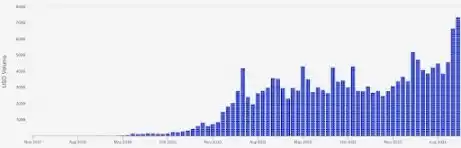
You can track stablecoin transaction volume here.
ETF Net Fund Flows
Last year, the U.S. Securities and Exchange Commission approved Bitcoin and Ethereum ETFs. This was a significant milestone that made it easier for retail and institutional investors to access cryptocurrency. However, activating distributors such as Goldman Sachs, JPMorgan Chase, and Bank of America to incorporate these products into institutional investor portfolios will take time.
One way to measure ETF activity is through "net fund flows," which represent the inflow or outflow of Bitcoin or Ethereum from ETFs. (Excluding products that previously existed, such as the Grayscale Bitcoin Trust and Ethereum Trust, which ultimately converted to ETFs.) So far, Bitcoin ETFs have seen a net inflow of 515,000 coins, while Ethereum ETFs have seen a net inflow of 611,000 coins.
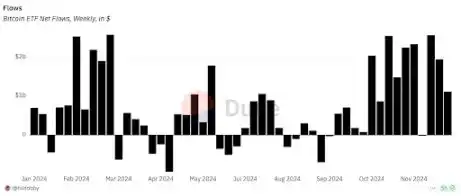
As more institutional investors seek to enter the cryptocurrency space, ETF net fund flows are expected to increase. By tracking on-chain deposits and withdrawals at addresses confirmed to be ETF custodians, we can monitor this data in real-time.
You can track ETF fund net inflows here and here.
Decentralized Exchange vs. Centralized Exchange Spot Trading Volume Comparison
As users flock to the blockchain space, we expect decentralized exchanges (DEXs) to see an increase in usage relative to centralized exchanges (CEXs) in cryptocurrency trading. After all, decentralization is at the core of cryptocurrency's value proposition in decentralized finance (DeFi). With the development of the DeFi ecosystem, the spot trading market share of DEXs has steadily grown to around 11% in recent years, and we expect this trend to continue into 2025.
Recently, with new users entering the space, trading volumes on chains like Coinbase's Base Chain and high-throughput chains like Solana have surged, driving DEX trading volumes to new highs.
With more new consumer applications coming online, DEX trading volumes may further increase.
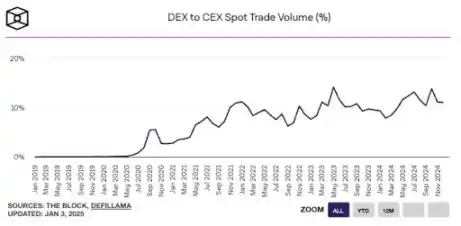
Monitoring the balance shift between decentralized native crypto activities and centralized crypto trading will be a key metric to watch.
You can track the spot trading volume comparison between DEX and CEX here.
Blockchain Total Transaction Fees
Total transaction fees (measured in USD) display the overall demand for block space on a specific blockchain, indicating real economic value.
However, this metric has its nuances as most projects are explicitly working to lower costs for users. This is why considering the unit transaction cost (i.e., the cost of a specific amount of blockchain resources) is also crucial. Ideally, overall demand (total transaction fees) increases while Gas fees (cost per unit of resource usage) remain low.
In November 2024, Solana's fees surpassed Ethereum's for the first time ever (see graph below). It is worth noting that this milestone occurred even though Solana's per transaction cost is much lower; sending a US dollar stablecoin (USDC) on Ethereum costs approximately $5, while on Solana, it is less than 1 cent. This is a significant milestone, and we will continue to monitor this development.
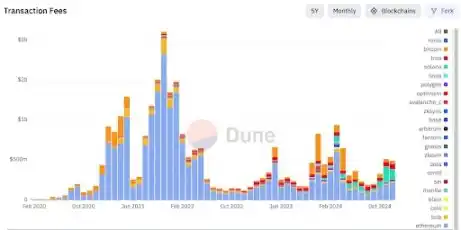
Many ecosystems and their related fee markets are maturing, making it a good time to begin measuring the economic value facilitated by various blockchains. In the long run, the demand for block space (measured in total fee dollar value paid) may be the single most important metric to track the progress of the crypto industry. Why? It reflects the level of participation in economically valuable activities and the willingness of users to pay for them.
You can track the demand for block space through transaction fees here.
Summary
We have tracked various metrics of the crypto industry, but this year we will closely monitor these five metrics. With widening investor access channels, mature infrastructure paving the way for new applications, and more popular products (such as stablecoins) emerging, the crypto industry is well-positioned to attract more users and developers. Let's see what new developments will emerge this year to ultimately drive changes in these metrics.
You may also like

Morning News | The Hong Kong Securities and Futures Commission announced the regulatory framework for secondary market trading of tokenized investment products; Strategy increased its holdings by 34,164 bitcoins last week; KAIO completed a strategic fi...

What Is an XRP Wallet? The Best Wallets to Store XRP (2026 Updated)
An XRP wallet lets you safely store, send, and receive XRP on the XRP Ledger. Learn what wallets support XRP and discover the best XRP wallets for beginners and long-term holders in 2026.

What are the Top AI Crypto Coins? Render vs. Akash: 5 Gems Solving the 2026 GPU Crisis
What are the best AI crypto coins for the 2026 cycle? Beyond the hype, we analyze top tokens like RNDR, AKT, and FET that provide real-world solutions to the global GPU shortage and the rise of autonomous agents.

What Is a Token in AI? What Is an AI Token + 3 Gems You Can't Miss in 2026
The era of AI hype has transitioned into an era of utility. As we move through Q2 2026, the market is no longer rewarding "narrative-only" projects. At WEEX Research, we are seeing a massive capital rotation into Decentralized Compute (DePIN) and Autonomous Agent coordination layers. This guide analyzes which AI tokens are capturing institutional liquidity and how to spot high-conviction setups in a maturing market.

Consumer-grade Crypto Global Survey: Users, Revenue, and Track Distribution

Prediction Markets Under Bias

Stolen: $290 million, Three Parties Refusing to Acknowledge, Who Should Foot the Bill for the KelpDAO Incident Resolution?

ASTEROID Pumped 10,000x in Three Days, Is Meme Season Back on Ethereum?

ChainCatcher Hong Kong Themed Forum Highlights: Decoding the Growth Engine Under the Integration of Crypto Assets and Smart Economy

Why can this institution still grow by 150% when the scale of leading crypto VCs has shrunk significantly?

Anthropic's $1 trillion, compared to DeepSeek's $100 billion

Geopolitical Risk Persists, Is Bitcoin Becoming a Key Barometer?

Annualized 11.5%, Wall Street Buzzing: Is MicroStrategy's STRC Bitcoin's Savior or Destroyer?
An Obscure Open Source AI Tool Alerted on Kelp DAO's $292 million Bug 12 Days Ago

Mixin has launched USTD-margined perpetual contracts, bringing derivative trading into the chat scene.
The privacy-focused crypto wallet Mixin announced today the launch of its U-based perpetual contract (a derivative priced in USDT). Unlike traditional exchanges, Mixin has taken a new approach by "liberating" derivative trading from isolated matching engines and embedding it into the instant messaging environment.
Users can directly open positions within the app with leverage of up to 200x, while sharing positions, discussing strategies, and copy trading within private communities. Trading, social interaction, and asset management are integrated into the same interface.
Based on its non-custodial architecture, Mixin has eliminated friction from the traditional onboarding process, allowing users to participate in perpetual contract trading without identity verification.
The trading process has been streamlined into five steps:
· Choose the trading asset
· Select long or short
· Input position size and leverage
· Confirm order details
· Confirm and open the position
The interface provides real-time visualization of price, position, and profit and loss (PnL), allowing users to complete trades without switching between multiple modules.
Mixin has directly integrated social features into the derivative trading environment. Users can create private trading communities and interact around real-time positions:
· End-to-end encrypted private groups supporting up to 1024 members
· End-to-end encrypted voice communication
· One-click position sharing
· One-click trade copying
On the execution side, Mixin aggregates liquidity from multiple sources and accesses decentralized protocol and external market liquidity through a unified trading interface.
By combining social interaction with trade execution, Mixin enables users to collaborate, share, and execute trading strategies instantly within the same environment.
Mixin has also introduced a referral incentive system based on trading behavior:
· Users can join with an invite code
· Up to 60% of trading fees as referral rewards
· Incentive mechanism designed for long-term, sustainable earnings
This model aims to drive user-driven network expansion and organic growth.
Mixin's derivative transactions are built on top of its existing self-custody wallet infrastructure, with core features including:
· Separation of transaction account and asset storage
· User full control over assets
· Platform does not custody user funds
· Built-in privacy mechanisms to reduce data exposure
The system aims to strike a balance between transaction efficiency, asset security, and privacy protection.
Against the background of perpetual contracts becoming a mainstream trading tool, Mixin is exploring a different development direction by lowering barriers, enhancing social and privacy attributes.
The platform does not only view transactions as execution actions but positions them as a networked activity: transactions have social attributes, strategies can be shared, and relationships between individuals also become part of the financial system.
Mixin's design is based on a user-initiated, user-controlled model. The platform neither custodies assets nor executes transactions on behalf of users.
This model aligns with a statement issued by the U.S. Securities and Exchange Commission (SEC) on April 13, 2026, titled "Staff Statement on Whether Partial User Interface Used in Preparing Cryptocurrency Securities Transactions May Require Broker-Dealer Registration."
The statement indicates that, under the premise where transactions are entirely initiated and controlled by users, non-custodial service providers that offer neutral interfaces may not need to register as broker-dealers or exchanges.
Mixin is a decentralized, self-custodial privacy wallet designed to provide secure and efficient digital asset management services.
Its core capabilities include:
· Aggregation: integrating multi-chain assets and routing between different transaction paths to simplify user operations
· High liquidity access: connecting to various liquidity sources, including decentralized protocols and external markets
· Decentralization: achieving full user control over assets without relying on custodial intermediaries
· Privacy protection: safeguarding assets and data through MPC, CryptoNote, and end-to-end encrypted communication
Mixin has been in operation for over 8 years, supporting over 40 blockchains and more than 10,000 assets, with a global user base exceeding 10 million and an on-chain self-custodied asset scale of over $1 billion.

$600 million stolen in 20 days, ushering in the era of AI hackers in the crypto world
Vitalik's 2026 Hong Kong Web3 Summit Speech: Ethereum's Ultimate Vision as the "World Computer" and Future Roadmap
On the same day Aave introduced rsETH, why did Spark decide to exit?
Morning News | The Hong Kong Securities and Futures Commission announced the regulatory framework for secondary market trading of tokenized investment products; Strategy increased its holdings by 34,164 bitcoins last week; KAIO completed a strategic fi...
What Is an XRP Wallet? The Best Wallets to Store XRP (2026 Updated)
An XRP wallet lets you safely store, send, and receive XRP on the XRP Ledger. Learn what wallets support XRP and discover the best XRP wallets for beginners and long-term holders in 2026.
What are the Top AI Crypto Coins? Render vs. Akash: 5 Gems Solving the 2026 GPU Crisis
What are the best AI crypto coins for the 2026 cycle? Beyond the hype, we analyze top tokens like RNDR, AKT, and FET that provide real-world solutions to the global GPU shortage and the rise of autonomous agents.
What Is a Token in AI? What Is an AI Token + 3 Gems You Can't Miss in 2026
The era of AI hype has transitioned into an era of utility. As we move through Q2 2026, the market is no longer rewarding "narrative-only" projects. At WEEX Research, we are seeing a massive capital rotation into Decentralized Compute (DePIN) and Autonomous Agent coordination layers. This guide analyzes which AI tokens are capturing institutional liquidity and how to spot high-conviction setups in a maturing market.



 App
App