
99% of Meme Coin Trades Are Doomed to Rekt, Whales Are the Real Winners

By: blockbeats|2025/02/20 15:15:03
0
Share
copy
Original Title: If you are still in the memecoin trenches, pivot to Casino.
Original Author: Foxi (DeFi / AI)
Original Translation: Deep Tide TechFlow

99% of Meme Coin Trades Are Doomed to Rekt, Whales Are the Real Winners


My Meme trading account is currently down by -60%. Am I a terrible trader? Yes, indeed I am. But it's not just due to bad decisions; I would rather believe I am not worse than an average gambler. So, where exactly is the problem? Inspired by @0xngmi's data (who pointed out that the returns from playing Memecoin are even worse than a casino), I decided to delve deeper to see what the root of the issue is.

Firstly, I Admit: I Am a Terrible Meme Trader

Like many newcomers, I've been led by the market hype and emotions, chasing highs, selling lows, frequent trading leading to slippage, and even unknowingly handing money to insider traders in the market.

While this is not my first time in the cryptocurrency market, this experience made me feel like I was playing an unfair game. Worse still, the rules of this game seem to be constantly changing and always favoring those with more information.

@0xngmi calculated the comparison between the expected return (EV) of playing roulette in a casino and the expected return of Memecoin speculation (based solely on transaction fees).
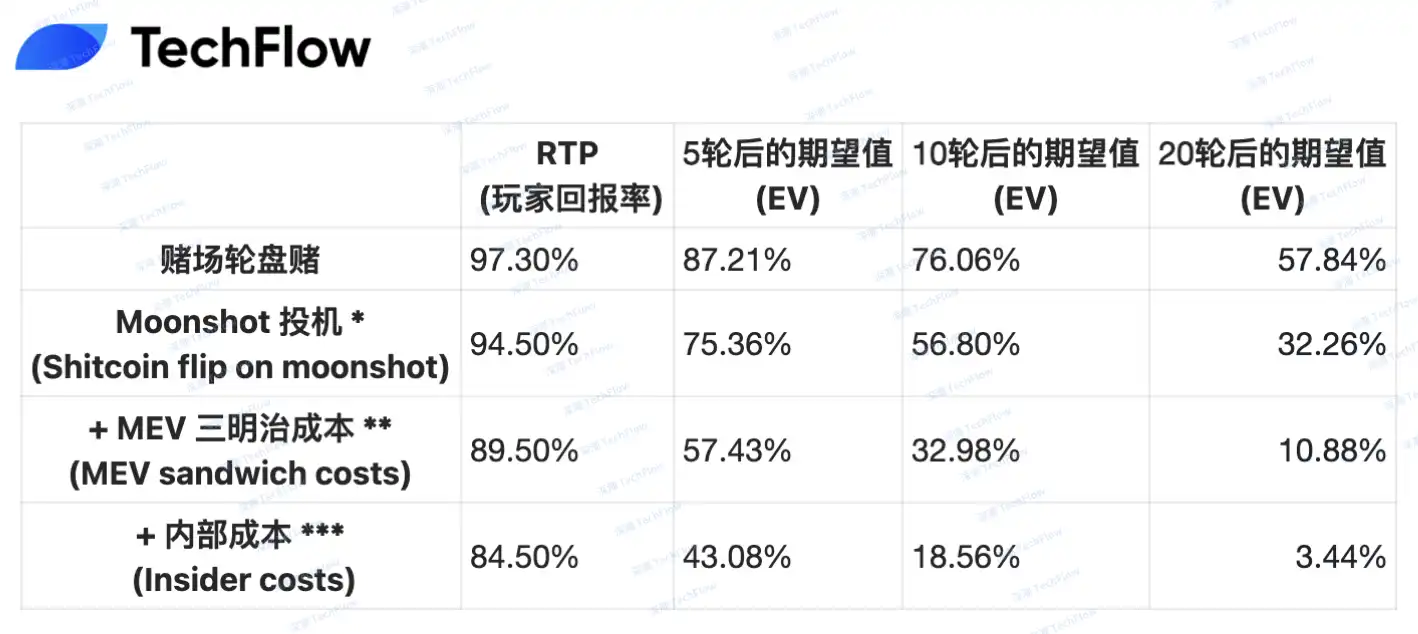
(Original image from @0xngmi, translated by Deep Tide TechFlow)

· The fee for small trades is 2.5%, while Raydium's fee is 0.25%. A speculation requires two transactions, so the fee must be multiplied by 2.

·  Moonshot's default slippage is set at 5%, taking half of this as an estimate for average sandwich attacks.

·  It is difficult to estimate precisely due to significant differences between tokens, assuming a 2.5% cost for each transaction.

This got me thinking: How does Meme speculation compare to actual gambling? Are their odds equally terrible? Or even worse? More importantly, are Meme traders merely casino gamblers disguised as "investors," or are there more complex, more insidious mechanisms at play behind the scenes? According to @0xngmi's analysis, putting money into a casino seems to be a wiser choice than playing with Memes.

True Odds: Memecoin vs. Casino

We need to talk about Expected Value (EV), which is a core concept in both gambling and trading. It tells us, on average, how much money you can expect to win or lose with each bet over time.

Casino games have a kind of "fair unfairness" mathematically. Over the long run, you can always predict how much you will lose. Let's take a closer look:
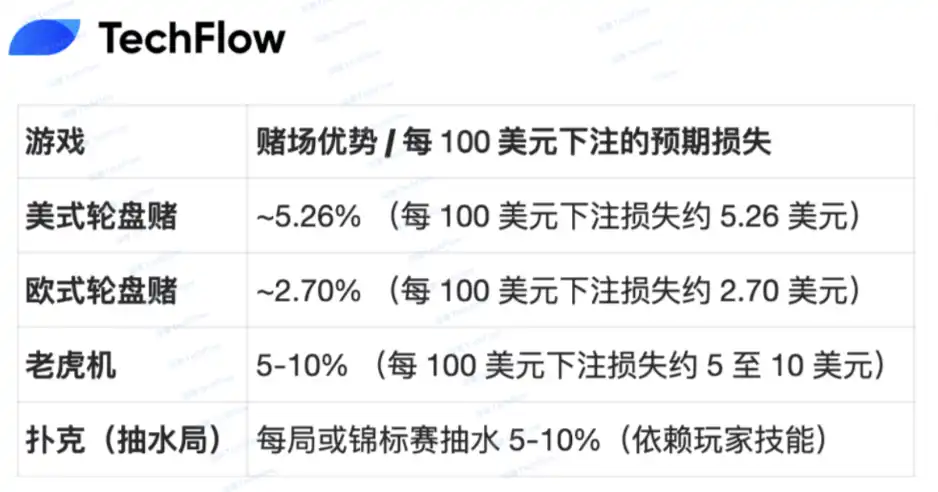
(Original image by Foxi (DeFi / AI), compiled by Deep Tide TechFlow)

In traditional gambling, the casino profits in a slow and predictable manner. Whether it's each spin of the roulette wheel or each pull of the slot machine's lever, it follows a known probability model. For example, in American roulette, if you bet on red, you have a 47.37% chance of winning and a 52.63% chance of losing. Over time, the casino always wins, but it does not cheat—it simply leverages probability to its advantage. However, to protect gamblers, some jurisdictions mandate a minimum return percentage. For instance, in Ontario, the RTP (Return to Player) of a slot machine must be at least 85%, meaning the casino's edge (i.e., house edge) is at most 15%.

Why 99% of People Lose Money in Memecoin Trading

Unlike the casino, Memecoin trading appears to be a "game of opportunity," but the issue is that you don't even know who the real players are. While the Memecoin market doesn't have a clear "House Edge," through transaction fees, slippage, insider trading, and market manipulation, your funds will still be slowly eroded. Moreover, this erosion is often insidious and challenging to quantify.

Here are the three main reasons that lead to widespread losses among Memecoin investors:

· Transaction Fee

· Slippage

· Market Manipulation

1. Transaction Fee: The Hidden "Maker's Fee"

Every transaction incurs a fee. Whether you are on a centralized exchange (CEX, such as @bitgetglobal or @MEXC_Official), a decentralized exchange (DEX, such as @RaydiumProtocol), or using a trading bot (like @gmgnai, which most people are using), these fees will gradually erode your profits.

CEX Fee: Approximately 0.1% per transaction (buying + selling = 0.2% round-trip fee)

DEX Fee: Approximately 0.3% per transaction, plus Gas fees (each transaction could cost $5-$50+)

Trading Bot Fee: Approximately 1% per transaction, plus priority fees (which could be 4 times the regular DEX fee)

Memecoin Tax: Some projects extract 5%-10% from each transaction as part of a redistribution or burn mechanism. For example, @aipool_tee charges a 10% fee on sell transactions.

These trading bots are earning substantial amounts from retail users. Although the number of people trading Memes has decreased as of now (February 17), daily revenue can still exceed $700,000.

On the surface, 0.2%-1% transaction fees may not seem high, but when you trade frequently every day, these fees quickly add up. Making 10 trades in a day could potentially consume 2%-6% of your principal, which is even more severe than losses from playing European roulette.

2. Slippage (MEV Cost)

Slippage refers to the difference between the expected price of a trade and the actual execution price due to market fluctuations. In Memecoin trading, slippage is particularly severe, especially in cases of low liquidity or high market volatility.

· Example: You try to buy a Memecoin with $100, but due to insufficient liquidity, you actually receive tokens worth $95, resulting in a 5% loss.

· When selling, a similar situation occurs. You plan to sell for $200, but slippage causes you to only receive $190.

· Total slippage loss: approximately 10% of the round-trip transaction cost.
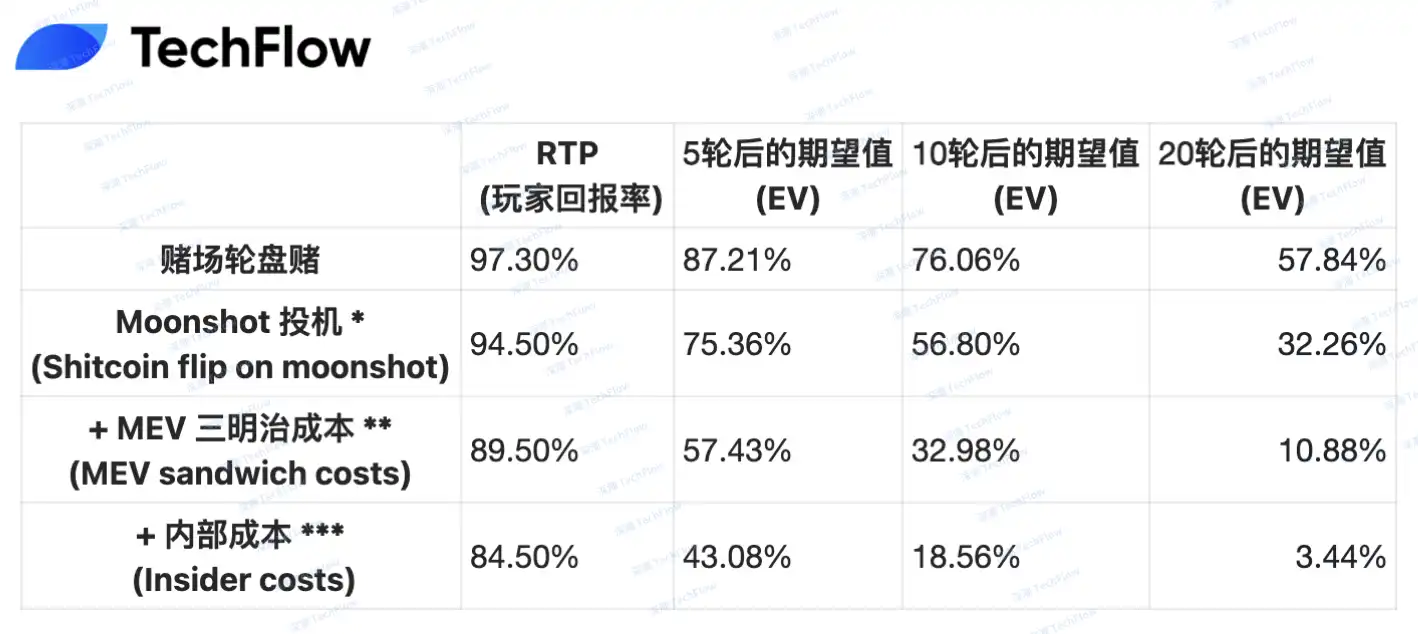
@0xngmi mentioned that about 2.5% of the transaction fee is consumed due to MEV (Sandwich Attack cost), and on the BNB Chain, this cost could be over 5%, attributed to its inferior infrastructure.

A more robust blockchain infrastructure can significantly reduce MEV costs. This is also why many believe Solana is superior to the BNB Chain (I fully agree on this). If @cz_binance wants to promote Meme culture on the BNB Chain, the primary task should be to reduce MEV costs, thereby increasing Memecoin players' expected value (EV).

However, even on Solana, a 2.5%-5% MEV cost is still more severe than losses in a casino game. If you find the house edge on a slot machine to be as high as 10%, you might be furious. But in the Memecoin market, this is not even the worst part.

3. Insider Trading and Market Manipulation

On this point, little needs to be said. Unlike a casino, which has clear rules, the Meme market is entirely skewed towards insiders. No regulation can prevent team wallets, developers, or influencers from conducting "Pump and Dump" schemes to exploit retail traders. For example, the following cases:

· $LIBRA: Took off with tokens worth over $107 million

· $MELANIA: Is it related to Meteroa?

· $CAR: Africa Rugged event

· $CUBA: Another Country's Rugged Event

· $GANG: @mrpunkdoteth Cash Out $10 Million via Fans

· $Broccoli: Manipulated by Scammers and Insiders for Profit

These are just the tip of the iceberg. It can be said that unless you are an insider like @frankdegods, you have virtually no advantage to participate in these Memecoins. In a casino, at least you know what the house edge is, while in the Memecoin market, you don't even know who the house is, but they are definitely taking your money.

Final Comparison: Memecoin Speculation vs. Gambling Expectation Value (EV)
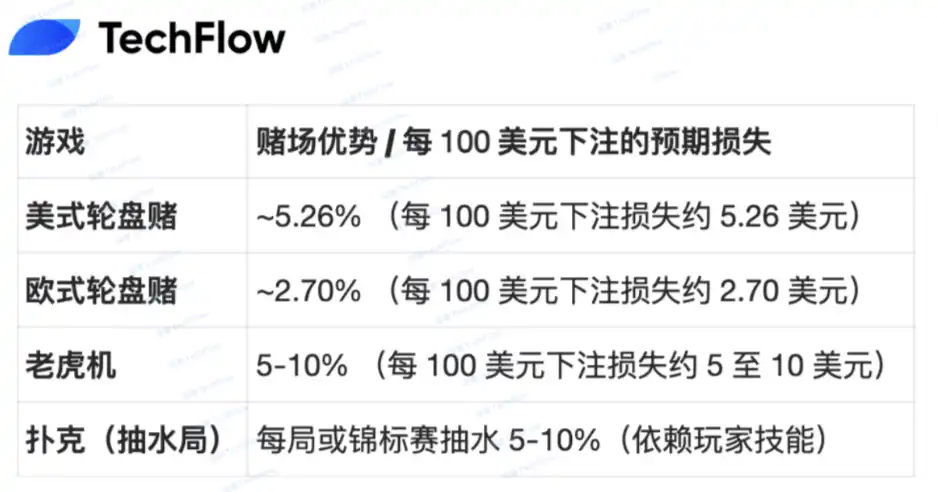
Casino games will slowly drain your funds over time, while Memecoin speculation is much more brutal. One wrong trade could wipe out weeks of gains in an instant. The only motivation to keep participating is the occasional 100x return. However, the actual likelihood of achieving a 100x return is approximately 1/25,000, even lower than the odds of winning the lottery.

People often believe they are "special" or "skilled" (yes, I'm that self-delusional person), but ultimately, they get rekt.

What makes Memecoin not like gambling is that it gives people a sense of illusory control—a misconception that one can make money through research, timing, and skill. Indeed, some traders can profit, but they are the minority, much like professional poker players. The majority of traders, like most gamblers, will ultimately lose.

Advice to On-Chain

If you want to attract users and increase on-chain transaction volume, make sure traders' MEV costs are low enough, and try to reduce transaction fees through cooperation or fund subsidies. Casinos can operate in the long run because gamblers are willing to continue participating.

Advice to Investors

If you are engaging in Memecoin speculation, remember, the house always wins. And you will only realize who the house is when it's too late. If you find yourself unable to disengage, you may already be in a state of gambling addiction.

Original Post Link

You may also like

MYX Case Analysis: The Complete Harvesting Tactics Behind the Fake Surge of Cryptocurrency Tokens

MYX Case Analysis: The Complete Harvesting Tactics Behind the Fake Surge of Cryptocurrency Tokens

Gate founder Dr. Han: The crypto winter drives structural reshaping, and everything on-chain will become a new paradigm in finance

Gate CEO Dr. Han appeared at the Hong Kong Web3 Carnival, emphasizing that "everything will be on-chain" will reshape the future of finance, and announced the acceleration of building an integrated trading hub that connects crypto and traditional assets.

Is XRP a Good Investment in 2026? Why Is It Stuck at $1.45

XRP is up 6.7% this week, but exchange reserves remain high. Is a volatility spike imminent? We analyze price trend, ETF inflows, whale activity, and regulatory catalysts to answer: will XRP go up, why is XRP dropping, and is XRP a good investment right now?

TL; DR

What is XRP: XRP is a digital asset built for fast, low-cost international payments. It runs on the XRP Ledger and is used by Ripple for its On-Demand Liquidity (ODL) service. Unlike Bitcoin, XRP settles transactions in 3-5 seconds with near-zero fees.Why is XRP Dropping: XRP is not actively dropping, but it is struggling to rise. On the monthly chart, XRP has seen six consecutive months of decline. Currently, the price faces an additional supply wall at $1.45. About 1.24 billion XRP were bought in that range, and those holders sell when the price approaches, creating selling pressure that prevents a recovery.Will XRP Go Up: Potentially yes. XRP is trading near $1.43 and showing its best weekly performance since September 2025. If the price breaks above the $1.45 resistance, analysts expect a move toward $1.90, supported by strong institutional demand.Is XRP a Good Investment: The answer is not simple. Short-term traders may see opportunity in the coming volatility spike. Long-term investors face a bigger question that depends on one key regulatory event. However, the data reveals a surprising signal that most retail buyers are missing right now. To understand whether XRP is a smart buy or a trap at $1.43, you will need to read the full analysis below.What is XRP? A Digital Asset for Global Settlement

Before analyzing the charts, it is crucial to understand the asset in question. What is XRP? Unlike Bitcoin, which was designed as a decentralized digital gold, XRP operates on the XRP Ledger (XRPL). It was created to facilitate fast, low-cost international payments. Traditional bank transfers take days and incur high fees. XRP transactions settle in 3-5 seconds, costing fractions of a penny.

Ripple, the company associated with XRP, uses this asset for its "On-Demand Liquidity" (ODL) service. Banks and financial institutions use ODL to source liquidity during cross-border transactions without pre-funding accounts. This utility is the primary driver for institutional interest. Recently, the network hit a milestone of over 8 million active wallets, signaling growing usage despite recent price stagnation . Furthermore, Ripple is proactively preparing for the future, releasing a four-stage roadmap to make the XRPL "quantum-resistant," aiming to secure the ledger against future quantum computing threats by 2028 .

XRP Price Analysis: The Battle for $1.45

The XRP price trend over the last month tells a story of exhaustion followed by cautious recovery. On the monthly chart, XRP experienced six consecutive months of decline. However, April shows signs of a bottoming process. Weekly charts reinforce this view: after four weeks of lower closes, the last two weeks have seen small rebounds.

According to data from April 22, 2026, XRP is trading at approximately $1.44. Over the last seven days, XRP has outperformed both Bitcoin and Ethereum, rising 6.7% while the broader market rose only 3.2%. Spot trading volume surged 23% to $3.79 billion, and derivative markets saw $40 billion in futures volume on a single day.

Despite this, the price remains 60% below its July 2025 high of $3.65. The current technical picture shows a "low volatility grind" higher. The 20-day EMA is at $1.3924, and the 50-day EMA is at $1.4119, both acting as support . However, the immediate hurdle is the $1.45 resistance level. This price point has rejected every rally attempt in 2026.

Why is XRP Dropping? And Will XRP Go Up?

The primary reason for the recent "drop" (or lack of upward momentum) is not active selling, but rather the "supply wall." Data indicates that roughly 1.24 billion XRP tokens were purchased by investors in the $1.45 to $1.47 range. These investors have been waiting months to "break even." Every time the price approaches $1.45, these holders sell to exit their positions, creating a massive wall that retail buying cannot easily absorb.

However, the underlying momentum is shifting. Analysts suggest a xrp volatility spike imminent because the absorption capacity of buyers is increasing. Historically, when exchange reserves are high but the price refuses to drop significantly, it signals that buyers are absorbing the supply. The price has held above $1.39 despite the overhang, which is a sign of relative strength.

So, will XRP go up? Yes, potentially. But it needs a catalyst, if the price closes a daily candle above $1.45. If that happens, the next targets are $1.60 to $1.65, and eventually $1.90 .

XRP Exchange Netflow and XRP ETF Netflow: A Tale of Two Markets

The current market dynamic is best understood by looking at two opposing data streams: XRP Exchange netflow and XRP ETF flows.

Exchange Dynamics (Retail / Whales):

Data shows a complex pattern of "large inflows and increasing reserves." Recently, a Ripple-associated wallet moved 75 million XRP (approx. $108 million) to Coinbase. This initially looks like a dump, but context matters. These transfers are likely to provide liquidity for Ripple’s ODL business, not necessarily spot market selling. However, the result is that exchange reserves have climbed to 2.76 billion XRP .

The Good News: While reserves are high, the rate of increase is slowing. Specifically, "whale" transfers to exchanges have dropped 98% from their April 11 peak. The Binance reserve has slightly decreased from 27.7 to 27.6 billion. The aggressive selling from large holders appears to have stopped.

Institutional Dynamics (ETF):

While whales were sending coins to exchanges, institutions were buying XRP ETF products. XRP ETF net flow is strongly positive.

US-listed XRP ETFs recorded four consecutive days of inflows totaling $38.86 million recently .The weekly inflow for mid-April hit $119.6 million, a multi-month high .Cumulative net inflows stand at $12.8 billion, with Assets Under Management (AUM) at roughly $10.8 billion.Analyzing the Divergence: Why Both Flows Are Positive

It seems contradictory that exchange reserves are high (suggesting selling) while ETFs are buying (suggesting buying). However, this phenomenon reveals the current market structure.

Different Investor Profiles: The exchange inflows likely come from short-term traders, market makers, or Ripple itself providing ODL liquidity. These are "hot" coins ready to be sold. The ETF inflows represent "sticky" capital. Institutions buying ETFs are typically long-term holders (LTHs) or asset managers who do not day-trade. They are removing liquidity from the spot market by buying through custodians.The "De-risking" Trade: Sophisticated funds might be engaging in basis trading. They buy the ETF (taking a long position) while simultaneously shorting XRP futures or selling spot inventory to capture the funding rate. This keeps the price stable while volume increases.Absorption: The most likely scenario is that the market is simply absorbing the excess supply. The fact that the price is stable ($1.43) and not collapsing to $1.20 despite 2.76 billion coins sitting on exchanges is a massive win for the bulls. The ETF inflows are acting as a sponge, soaking up the selling pressure from the ODL wallets.The Regulatory Catalyst: The SEC and the CLARITY Act

Fundamentally, the recent price action cannot be separated from regulation. For years, the primary answer was the SEC lawsuit. That narrative is dying.

Ripple CEO Brad Garlinghouse recently praised SEC Chair Paul Atkins as "a breath of fresh air and sanity" . This regulatory thaw is critical. The SEC is reportedly considering dropping the long-standing lawsuit, and five XRP ETF applications are awaiting review.

The major catalyst on the horizon is the CLARITY Act. A Senate markup is expected before the end of April. Standard Chartered analysts project that if the bill advances, it could unlock $4 to $8 billion in institutional flows . Polymarket gives the bill a 60-66% chance of passing in 2026. If the CLARITY Act classifies XRP as a non-security (commodity), the institutional floodgates will open, likely overwhelming the $1.45 supply wall instantly.

Is XRP a Good Investment in 2026?

Given all this data, is XRP a good investment? The answer depends entirely on your risk tolerance and time horizon.

The Bull Case (Why it is a good investment): The risk/reward ratio is asymmetrical to the upside. The price is near multi-year lows relative to its utility. Whale selling has stopped, ETF demand is rising, and the network is expanding (8 million wallets, quantum resistance roadmap). If the CLARITY Act passes, XRP could realistically trade between $1.60 and $1.80 in the short term, with a potential run to $3.00+ if the lawsuit is officially dropped.The Risk Case (Why it is NOT a good investment): There is a clear resistance wall at $1.45. If the CLARITY Act fails or is delayed past May (due to midterm election dynamics), the "buy the rumor, sell the news" dynamic could reverse. If the price fails to break $1.45 and loses support at $1.33, a drop back to $1.15 is technically possible .

Verdict: XRP is a speculative buy for traders looking for a volatility spike. It is a hold for current investors. For new investors, it is only a good investment if you believe in regulatory clarity within the next 30 days. Technically, waiting for a confirmed break above $1.55 (to avoid the fakeout) is safer than buying at $1.43.

FAQ

Q: Will XRP go up if the CLARITY Act passes?

A: Yes, historically. Analysts predict that if the CLARITY Act passes, signaling that XRP is a commodity, it would remove the regulatory overhang. This could trigger a surge in institutional buying, pushing the price from the current $1.43 range to test the $1.80 - $2.00 resistance levels quickly.

Q: Why is XRP dropping when Bitcoin is going up?

A: XRP has specific supply dynamics. Unlike Bitcoin, which has a fixed supply issuance, XRP faces periodic sell-pressure from Ripple's treasury wallets used to fund ODL (liquidity) services. Additionally, the $1.45 "break-even" wall causes XRP to drop relative to BTC when short-term traders exit.

Q: Is a volatility spike imminent for XRP?

A: Yes. The Bollinger Bands on the daily chart are squeezing. The price is stuck between support at $1.33 and resistance at $1.45. Historically, when XRP volume surges 23% in a week (as it did on April 21), it precedes a violent move. The direction depends on whether the $1.45 resistance breaks.

Q: What is the XRP ETF netflow status?

A: As of late April 2026, XRP ETFs are seeing positive netflows. The US ETFs recorded a single week inflow of $119.6 million in mid-April. Cumulative inflows are strong at $12.8 billion, indicating that institutions are accumulating during this dip, which is a long-term bullish signal for price stabilization.

Q: Is XRP a good investment for beginners?

A: XRP is less volatile than "meme coins" but more volatile than Bitcoin. For beginners, it is a moderate-risk investment. Its value is tied to real utility (bank payments). However, beginners should wait to see if the price can close a weekly candle above $1.55 before entering, to avoid buying into the current resistance wall.

Disclaimer: None of the information in this article constitutes, or is intended to constitute, investment advice. Trading cryptocurrencies carries a high level of risk and may not be suitable for all investors. Always do your own research.

About WEEX

Founded in 2018, WEEX has developed into a global crypto exchange with over 6.2 million users across more than 150 countries. The platform emphasizes security, liquidity, and usability, providing over 1,200 spot trading pairs and offering up to 400x leverage in crypto futures trading. In addition to the traditional spot and derivatives markets, WEEX is expanding rapidly in the AI era — delivering real-time AI news, empowering users with AI trading tools, and exploring innovative trade-to-earn models that make intelligent trading more accessible to everyone. Its 1,000 BTC Protection Fund further strengthens asset safety and transparency, while features such as copy trading and advanced trading tools allow users to follow professional traders and experience a more efficient, intelligent trading journey.

Follow WEEX on social media

X: @WEEX_Official 

Instagram: @WEEX Exchange 

Tiktok: @weex_global 

Youtube: @WEEX_Official 

Discord: WEEX Community 

Telegram: WeexGlobal Group

FC Barcelona vs Celta Vigo: Can Anyone Stop Barcelona at Home?

FC Barcelona vs Celta Vigo lineups, standings, and stats for April 22, 2026. FC Barcelona need a win to stay on track for the La Liga title. Full preview inside.

Carl Moon & WEEX Head to Mugello: The Crypto Trader's Ferrari Challenge

Forget the sidelines. WEEX is hitting the 300km/h mark at Mugello this weekend. Witness Carl Moon’s transformation from a supermarket cashier to a Ferrari racer, and discover why the world’s fastest trading floor belongs on the world’s most technical track at the official Ferrari Challenge.

How to Become a Pro Crypto Trader: WEEX Interview with Ferrari Racer Carl Moon

Ferrari racer Carl Moon on mastering crypto trading: 80/20 rule, AI tools, Bitcoin at $95K, and risk lessons from the track.

Popular coins

Latest Crypto News

Read more