
- Buy Crypto
- Markets
- Futures
- Spot
- Copy Trade
 Earn
Earn- More
2 Days 20x, How Big Can the Legendary Golden Dog Snowball's "Auto-Compound" Snowball Grow?

Original Title: "2 Days 20x, Quick Look at the Automatic Market Maker of the New Gold Dog snowball"
Original Author: David, Shenzhen TechFlow
The crypto market in December is as cold as the weather.
On-chain transactions have been dormant for a long time, and a new narrative has also been difficult to produce. Just look at the arguments and gossip in the Chinese CT community in recent days, and you will know that there are hardly any people playing in this market anymore.
But the English community has been discussing something new in the past few days.
A meme coin called Snowball, launched on December 18 on pump.fun, saw its market capitalization surge to $10 million in just four days, reaching a new all-time high; yet hardly anyone in the Chinese community mentioned it.
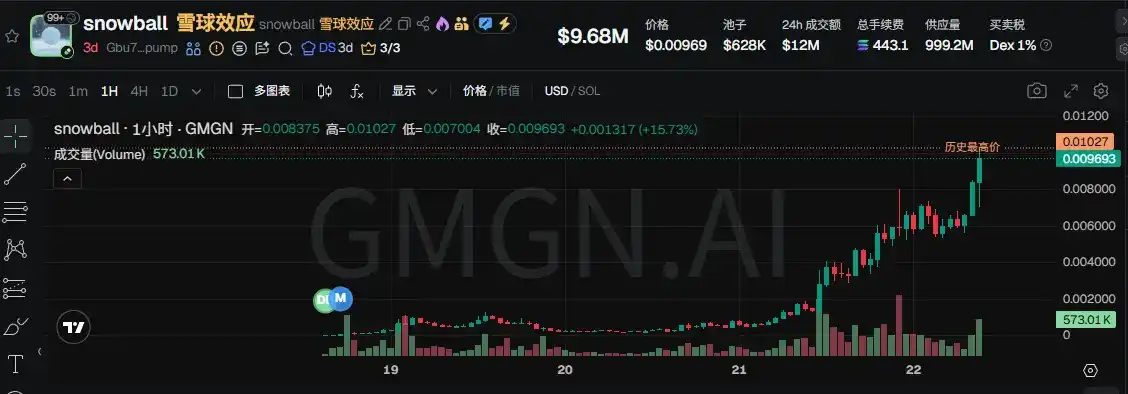
In the current environment where there are no new narratives and even meme coins are not attracting interest, this is one of the few things that have caught people's attention, displaying a kind of localized wealth effect.
And the name Snowball itself translates to the "snowball effect," which is the story it aims to tell:
A mechanism that allows the token to "grow bigger on its own as it rolls."
Turning Transaction Fees into Buybacks, Snowball Market Rolling
To understand what Snowball is doing, you first need to know how tokens on pump.fun typically make money.
On pump.fun, anyone can spend a few minutes creating a token. Token creators can set a "creator fee," which is essentially a percentage taken from each transaction and sent to their own wallet, usually between 0.5% and 1%.
This money can theoretically be used for community development and marketing, but in practice, most Devs' choice is: exit scam when they have accumulated enough.
This is also part of the typical life cycle of meme coins. Launch, pump, harvest fees, exit. Investors are not betting on the token itself but on the developer's conscience.
Snowball's approach is to not take this creator fee money.
More precisely, 100% of the creator fee does not go into anyone's wallet but is automatically transferred to an on-chain market-making bot.
This bot performs three actions at regular intervals:
First, use the accumulated funds to buy tokens on the market, creating buying pressure;
Second, add the purchased tokens and corresponding SOL to the liquidity pool to improve trading depth;
Third, burn 0.1% of the tokens on each operation to create deflation.
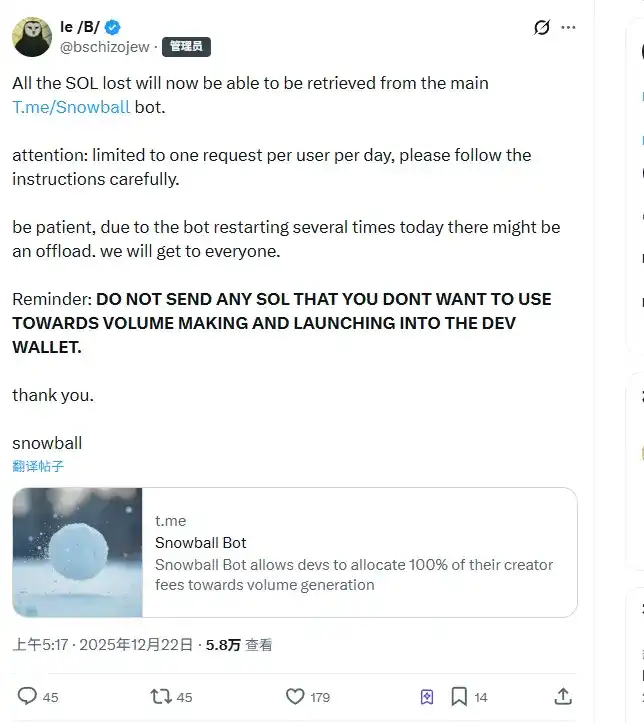
At the same time, the proportion of creator fees collected by this token is not fixed and will fluctuate between 0.05% and 0.95% based on market capitalization.
When the market capitalization is low, a higher fee is charged to rapidly accumulate ammunition for bots; when the market capitalization is high, the fee is reduced to minimize trading friction.
To summarize the logic of this mechanism in one sentence, every time you trade, some money automatically becomes buying pressure and liquidity, rather than going into the developer's pocket.
Therefore, it is easy to understand the snowball effect:
Trading generates fees → Fees become buying pressure → Buying pressure drives up the price → Price attracts more trading → More fees... theoretically, it can roll on its own.
On-Chain Data
Now that the mechanism is explained, let's look at the on-chain data.
Snowball was launched on December 18 and has been four days since then. The market cap surged from zero to $10 million, with a 24-hour trading volume exceeding $11 million.
For a meme coin on pump.fun, this performance is already considered long-standing in the current environment.
In terms of token distribution, there are currently 7270 holder addresses. The top ten holders together own about 20% of the total supply, with the largest single holder owning 4.65%.
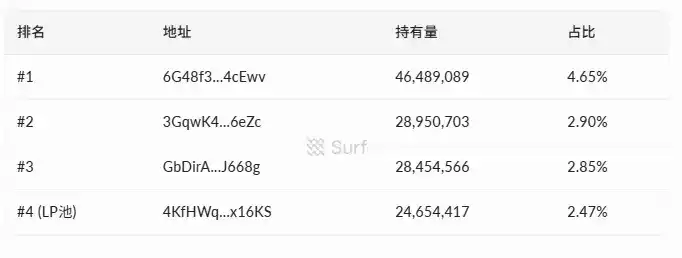
(Data Source: surf.ai)
No single address holds a significant share of two or three, indicating a relatively decentralized distribution.
Regarding transaction data, there have been over 58,000 transactions since launch, including 33,000 buys and 24,000 sells. The total buy amount is $4.4 million, sells amount to $4.3 million, with a net inflow of approximately $100,000. Buys and sells are roughly balanced, with no significant selling pressure.
There is approximately $380,000 in the liquidity pool, half in one token and half in SOL. For this market cap size, the depth is not considered deep, so large orders in and out will still experience significant slippage.
Another point worth noting is that shortly after the launch, Bybit Alpha announced the listing of the token in less than 96 hours, which to some extent also confirms its short-term popularity.
Perpetual Motion Machine Meets Bear Market
After taking a look around, it can be seen that the English community's discussion of Snowball mainly focuses on the mechanism itself. Supporters' logic is very straightforward:
This is the first meme coin that locks 100% of creator fees into the protocol, so developers cannot rug pull. At least structurally, it is more secure than other meme coins.
The Dev is also in line with this narrative. The developer wallet, liquidity pool bot wallet, and transaction logs are all public, emphasizing "on-chain verifiability."
@bschizojew labels himself as "on-chain schizophrenia, 4chan special forces, first-generation meme coin veteran," exuding a self-deprecating degenerate vibe that is very much in line with the taste of the crypto-native community.

But mechanism security and profit-making are two different things.
The premise of the Snowball effect is to have enough trading volume to continuously generate fees, which are then fed to the bot to execute buybacks. The more the transactions, the stronger the bot's ammunition, the stronger the buy pressure, the higher the price, attracting more people to trade...
This is also the ideal state for any meme coin's buyback flywheel to start spinning in a bull market.
However, the flywheel needs external power to start.
What is the current state of the crypto market? On-chain activity is low, overall interest in meme coins is declining, and funds willing to ape into meme coins are already scarce. In this context, if new buy pressure cannot keep up, trading volume shrinks, the bot receives less and less in fees, the buyback strength weakens, price support diminishes, and trading interest further declines.
The flywheel can spin forward but also backward.
More realistically, the mechanism addresses only the risk of "developer rug pulls," but meme coins face risks far beyond that.
Whale dumping, insufficient liquidity, narrative fatigue — if any of these occur, the impact of 100% fee buyback is very limited.
Everyone is scared of being rugged. A prominent figure in the Chinese community summarized it well:
Play around, but don't get too involved.
More Than One Snowball Rolling
Snowball is not the only project talking about this automated market-making story.
Also in the pump.fun ecosystem, there is a token called FIREBALL doing a similar thing: automatic buyback and burn, packaging it as a protocol that other tokens can plug into. But its market cap is much smaller than Snowball's.

This indicates that the market is currently responsive to the direction of "mechanism-based meme coins."
The traditional practices of shilling, pumping, and community hype are finding it increasingly challenging to attract funds. Telling a "structural security" story through mechanism design may be one of the recent strategies of meme coins.
However, when it comes to artificially creating a mechanism, it's not a new play.
In 2021, OlympusDAO's (3,3) is the most typical case, using game theory to package a staking mechanism, telling a story of "if everyone holds, everyone gains," with the peak market cap soaring to tens of billions of dollars. The eventual outcome, as everyone knows, was a downward spiral, with a drop of over 90%.
Going back a bit further, there is Safemoon's play of "taxing each transaction and distributing it to holders," which was also a narrative of mechanism innovation, but eventually led to an SEC lawsuit, with the founder being charged with fraud.
Mechanisms can be excellent narrative hooks, able to attract funds and attention in the short term, but mechanisms themselves do not create value.
When external funds cease to flow in, even the most intricate flywheel will come to a halt.
Finally, let's clarify what this little Shiba Inu is up to:
Turning the meme coin's creator fee into an "automated market-making robot." The mechanism itself is not complex, and the problem it solves is very clear: preventing developers from directly taking the money and running.
Developers not running away doesn't mean you will make money.
If you find this mechanism intriguing after reading and want to participate, remember one thing: it is first and foremost a meme coin, and secondly an experiment with a new mechanism.
You may also like

$H Project Team Withdraws Massive H Tokens from Exchanges
Key Takeaways $H project team removed H tokens worth $23.5 million from exchanges in 24 hours. The primary…

Suspected Insider Trades $NYC Token and Incurs Losses
Key Takeaways A wallet suspected of insider trading purchased $NYC tokens shortly before an official announcement by ex-NYC…

Deep Dive into Solana DEX: Who is Snagging the Order Flow, Who's Getting Sidelined?

LISA Token Plunges 76% Amid Rapid $170,000 Sell-Off
Key Takeaways The LISA token experienced a dramatic 76% decline in the past 24 hours due to significant…

Whale Transfers $12.54 Million in LINK to Multisig Wallets
Key Takeaways An unidentified whale or institution has transferred approximately $12.54 million worth of LINK tokens. These transfers…

Major Cryptocurrency Token Unlocks Expected Next Week
Key Takeaways A series of major token unlocks will take place next week, involving tokens like TRUMP, ONDO,…

Space Featured in Binance Research Ecosystem Report: Key Signals of the Predictive Market Leverage Layer are Emerging

2026 Top Transaction Themes: Trump's Sore-Loser Attitude, the End of the International Order

Most US debanking cases stem from government pressure, says report
Key Takeaways A report from the Cato Institute indicates that most debanking incidents in the US originate from…

South Korea to lift ban on corporate crypto investment: Report
Key Takeaways South Korea’s Financial Services Commission (FSC) is set to end a nine-year ban on corporate crypto…

UK Lawmakers Urge Ban on Political Donations in Crypto
Key Takeaways: A group of senior UK lawmakers is pushing for a legislative ban on political donations in…

Russia Targets Illegal Crypto Miners; India Advocates for CBDCs: A Global Overview
Key Takeaways Russia is intensifying efforts to regulate illegal cryptocurrency mining, proposing significant fines and penalties. India’s Reserve…

Crypto Rich Threaten to Depart California Amid New Tax Proposal
Key Takeaways Proposed California tax imposes a 5% assets tax on residents with over $1 billion, sparking debate…

Polygon Ecosystem Token Price Prediction – POL Price Anticipated to Fall to $ 0.132816 By Jan 16, 2026
Key Takeaways The Polygon Ecosystem Token is predicted to experience a significant price decrease to $ 0.132816 by January…

Crypto Crucial: Will Tax Threats Push California’s Wealthiest to Flee?
Crypto billionaires in California are contemplating relocation due to a proposed wealth tax targeting assets over $1 billion.…

Top UK Lawmakers Advocate for Ban on Crypto Political Donations
Key Takeaways Seven UK parliamentary committee chairs call for legislation to ban crypto donations, citing concerns over transparency…

UK Backbenchers Committee Demands Total Ban on Crypto Political Contributions
Key Takeaways: A group of senior Labour MPs are advocating for a total ban on cryptocurrency donations to…

World Liberty Financial Price Prediction: WLFI to Possibly Decline by January 2026
Key Takeaways World Liberty Financial (WLFI) is anticipated to drop by -23.19% over the next five days, reaching…
$H Project Team Withdraws Massive H Tokens from Exchanges
Key Takeaways $H project team removed H tokens worth $23.5 million from exchanges in 24 hours. The primary…
Suspected Insider Trades $NYC Token and Incurs Losses
Key Takeaways A wallet suspected of insider trading purchased $NYC tokens shortly before an official announcement by ex-NYC…
Deep Dive into Solana DEX: Who is Snagging the Order Flow, Who's Getting Sidelined?
LISA Token Plunges 76% Amid Rapid $170,000 Sell-Off
Key Takeaways The LISA token experienced a dramatic 76% decline in the past 24 hours due to significant…
Whale Transfers $12.54 Million in LINK to Multisig Wallets
Key Takeaways An unidentified whale or institution has transferred approximately $12.54 million worth of LINK tokens. These transfers…
Major Cryptocurrency Token Unlocks Expected Next Week
Key Takeaways A series of major token unlocks will take place next week, involving tokens like TRUMP, ONDO,…


 App
App