
2024 Cryptocurrency NFT News Revealed



Once again, the crypto community's annual meme news has arrived (skipped 2022 because, well, 2022 was just too tough), and this year has brought many remarkable moments that made everyone stand up. Wishing you all a happy new year and continued financial success in 2025.
Renzo's Statistics Graduate
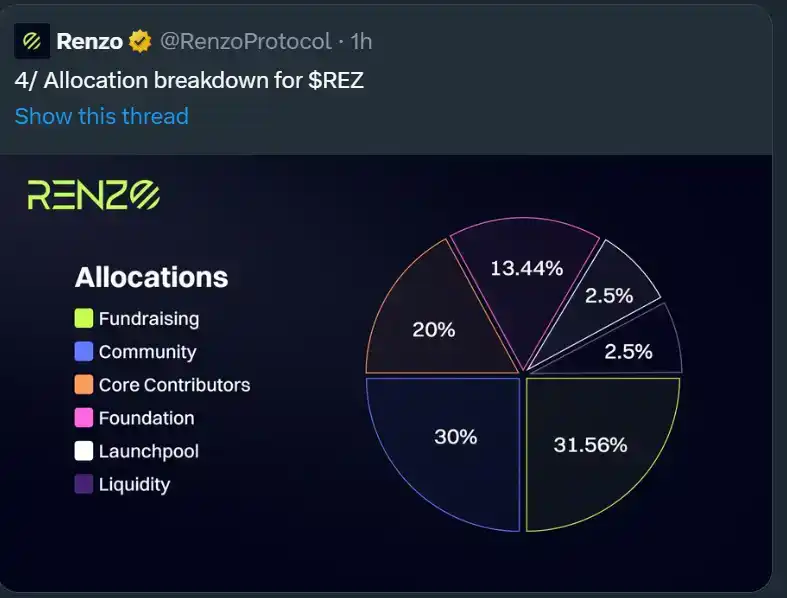
On April 23, the staking project Renzo announced its airdrop rules. In Renzo's initial announcement, the token distribution pie chart resembled a statistics textbook. The allocation to Binance Launchpool and Liquidity, two 2.5% shares, was almost indistinguishable from the 20%, while the "half" at the bottom was 62%. The community bluntly stated that this was "chart crime, no different from tokenomics fraud."
Major S-Named Project Launches Epic Candlestick Chart
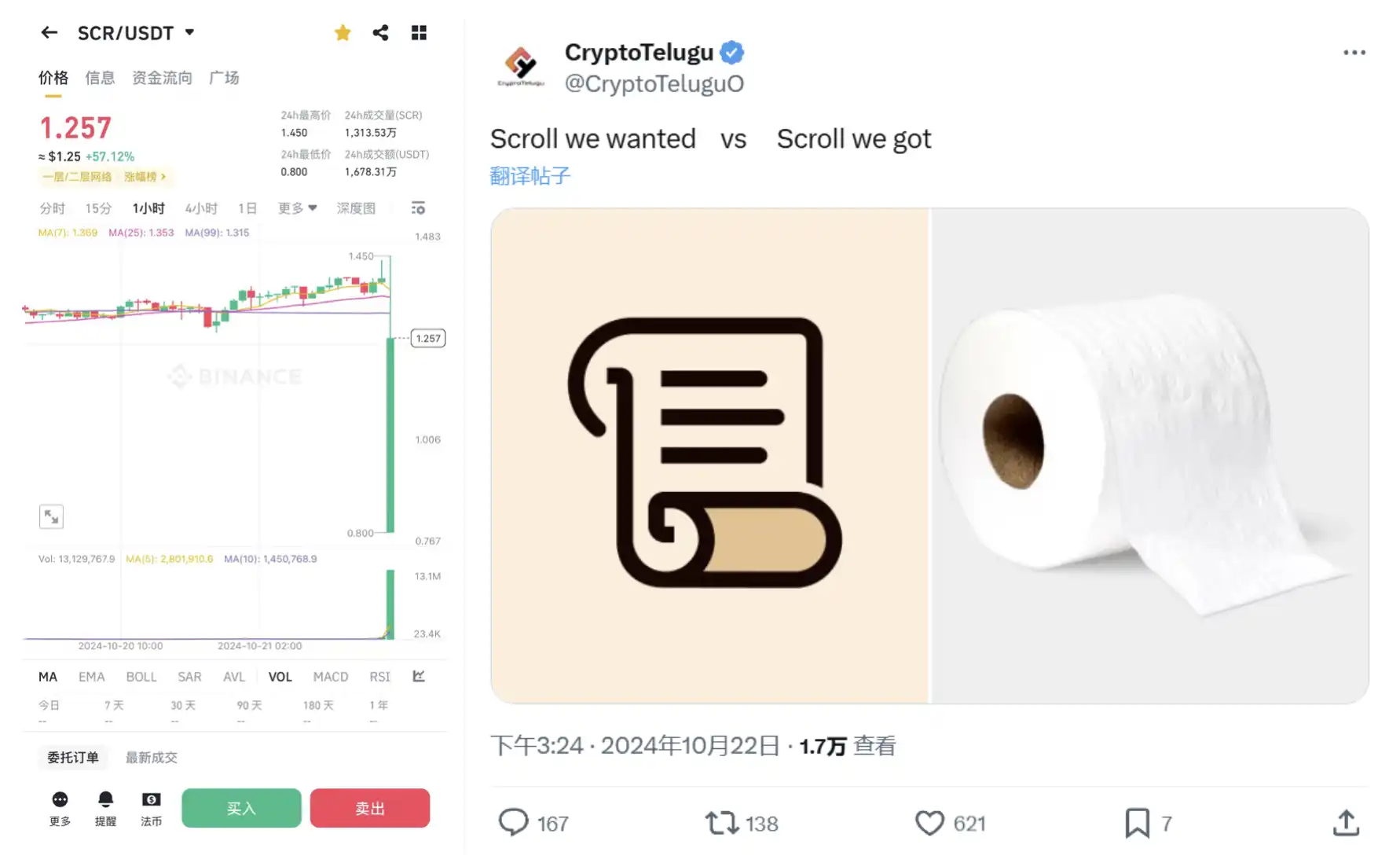
After closing the pre-trading session on Binance, a major S-named project officially opened for trading, with a candlestick chart that was momentarily indecipherable as to whether it was a rise or a fall, a rare sight in history.
Project Employs 4 Developers Online, Only to Discover They Are All the Same North Korean Hacker
On March 27, the Blast ecosystem project Munchables was hacked for $62.5 million. According to blockchain detective ZachXBT's investigation, it was because one of their developers was a North Korean hacker, and the four different developers employed by the Munchables team all had connections to the attacker, likely all being the same person. They referred each other to work in this field, regularly transferred payments to the same two deposit addresses on exchanges. The wallets of the "four individuals" showed transactions among themselves.
By annual earnings, the North Korean hacker should be earning more than many publicly traded companies.
Well-Known L-Named Cross-Chain Project Calls for "Witches" to Surrender Themselves, a Historical First
On May 4, a well-known L-named cross-chain project released an announcement stating that users identified as witches could voluntarily surrender, providing their witch addresses to receive the original 15% allocation. If they do not surrender voluntarily and are discovered later, their entire allocation will be forfeited.
That's not all; the project team stated that whistleblowers must provide at least 20 clearly identified addresses involved in witch operations, and rewards will be prioritized for the first user to successfully submit. Subsequently, they further updated the reporting mechanism, introducing a collateral system.
This is truly unprecedented.
Cryptocurrency Custodian Company Copper Apologizes for Serving Naked Sushi at Event
A source close to Copper said the models, one male and one female, were wearing swimwear and added that it was "very flashy...".
Looks like the project team really made a lot of money this year.

Slerf Founder Accidentally Burns Tokens and LP, Internet Learns the "Oh Fuck" Lesson
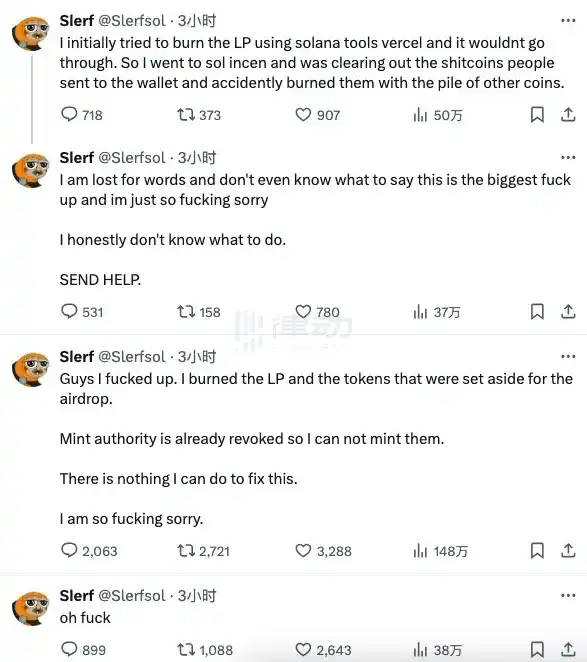
On March 18, Slerf project founder @Slerfsol posted on X platform, admitting to mistakenly destroying LP and airdrop reserve tokens, revoking minting rights, feeling helpless, and even shedding tears of true emotion in Space.
What was thought to be the end of the MEME project SLERF, which raised over 50,000 SOL, turned into a record-breaking moment. In just 30 minutes, SLERF's market cap exceeded a billion, surpassing BOME's previous 9-hour record, establishing SLERF as the new meme king. Subsequent encounters with meme token burns are now dubbed with the Slerf narrative for community engagement.
Setting Himself on Fire for Entertainment
In a previous event on Pump.Fun, a dev immersed himself in isopropyl alcohol and livestreamed fireworks being launched at himself to pump up the meme coin's value. The token price surged 2000% within hours, reaching a $2 million market cap. However, due to a lack of necessary fire safety measures, he was engulfed in flames instantly, suffering third-degree burns and hospitalized, rendering him unable to sell the tokens. Upon recovery, he found himself unable to use his hands properly, and even facial recognition on his phone failed to recognize him. Later, this dev exited the project, most likely without having sold the tokens in time.

Easter Egg: Selling High to Fly Forever
On March 8, a WIF developer sold 29,000 WIF worth $2.9 million (511 SOL) within 2 days of WIF's launch, which is now valued at $693 million.
The German government previously held 49,858 bitcoins and sold its holdings in July for $2.89 billion, at an average price of $57,900. After Bitcoin surpassed $100,000, the German government missed out on nearly $3 billion in profit.
On September 28, a trader spent 196 SUI (worth $368) to purchase 25.3 billion HIPPO tokens. In less than a day, the user sold all HIPPO tokens at a price of $7,500, with the total value exceeding $30 million a week later.
On October 10, a trader spent 2.07 SOL to purchase 21.26 million GOAT tokens, sold them at a price of 2.8 SOL, and earned only 0.7 SOL ($108). A week later, the value reached $8.9 million.
On November 13, a trader spent 8 SOL ($1,392) to buy 19.4 million Pnut tokens, then sold them at a price of 4.09 SOL ($711), resulting in a loss of $681. These Pnut tokens are now worth over $24.69 million.
On November 17, a trader once spent 19.8 SOL ($3,000) to buy 59 million FARTCOIN tokens but later sold them for 7.16 SOL ($1,100), resulting in a $1,900 loss. These FARTCOIN tokens are now worth over $18.42 million.
On November 21, a trader sold early CHILLGUY chips obtained for 1 SOL at a price of 1.6 SOL, from which they bought 33.95 million CHILLGUY tokens. These tokens are now worth over $10 million.
You may also like

CFTC Reportedly Plans New Prediction Market Rules Focused on Manipulation Risk and Public Interest Review
The CFTC is reportedly preparing new prediction market rules focused on manipulation risk, public interest review, and retail trader protections.

Meet the new WEEX trial fund—your gateway to greater profits

WEEX Labs Lands at Dutch Blockchain Week: A Disruptive Crypto × AI Conversation Sets Sail in Amsterdam

SK Hynix Reportedly Plans U.S. ADR Listing as Early as August, With SEC Approval Possible in Late June
SK Hynix may pursue a U.S. ADR listing as early as August, with SEC approval reportedly possible in late June amid strong AI chip supply chain demand.

SpaceX vs Tesla vs xAI: Which Elon Musk Trade Has the Biggest Upside in 2026?
OpenAI Reveals It Has Confidentially Submitted an S-1 to the SEC, Keeping the Door Open for a Future IPO
On June 9, according to an OpenAI announcement, the company recently confidentially submitted a draft S-1 registration statement to the U.S. Securities and Exchange Commission (SEC), beginning the preliminary compliance process for a potential initial public offering. OpenAI said it chose to disclose this proactively because it expected the news might leak; however, the company has not yet set a specific listing timeline, and related arrangements may still take some time.

Latest research from 13 top universities including Cornell University: The current state, challenges, and misconceptions of the fusion of Crypto and AI
Deconstructing Anthropic: The Best AI Company, Possibly Also a Type of Organizational Invention
Apollo and Blackstone Reportedly Back $35 Billion Anthropic Chip Financing as Deal Details Remain Unclear
On June 9, according to currently available news alerts, Apollo and Blackstone Group participated in a $35 billion financing for an Anthropic “chip project.” Based on the original wording of the report, the funding has already been raised, but public information remains limited. The financing structure, use of proceeds, project entity, and whether Apollo and Blackstone participated through equity, debt, or project financing have not yet been disclosed.

Humanity Protocol Security Incident Escalates: More Than $31 Million Stolen From Related Addresses as Attacker Continues Selling H for ETH
On June 9, according to monitoring by Onchain Lens, more than $31 million has been stolen from addresses linked to Humanity Protocol, and the attack is still ongoing, with the hacker continuously swapping H tokens for ETH. Project founder Terence Kwok later confirmed the security incident on X, saying the issue involved a private key leak.

Bloomberg: As Bitcoin Weakens, Stablecoins and RWA Continue to Drive Expansion in Crypto Businesses
In June, Bloomberg reported that despite Bitcoin falling below $60,000 last week, wiping out about $235 billion in market value within seven days, and dropping close to 50% from last year’s peak, some core businesses in the crypto industry are still expanding, mainly in stablecoins, real-world asset tokenization (RWA), payments, and infrastructure. The report also noted that overall altcoin activity has contracted significantly: altcoin market capitalization has fallen from a peak of about $431 billion in November 2021 to around $170 billion, and among the tens of millions of tokens issued in recent years, fewer than 1,700 still maintain meaningful trading activity.

Galaxy Deep Research Report: How Hyperliquid's HIP-4 Upgrade Changes the Landscape of Prediction Markets?
Binance Research: RWA Market Expected to Expand Nearly 6x from Early 2025, with Public Equities and Onchain Payments Heating Up Together
In June, Binance Research said in its monthly market report that the real-world asset (RWA) market is expected to grow by about 589% from the beginning of 2025. Bond- and money market fund-related RWA expanded by about $6.5 billion, up 83% year over year, while publicly traded equity RWAs grew by about 422%. The report also noted that monthly crypto debit card transaction volume exceeded $747 million in May, up 48.6% year to date.

Japan to Assess a Framework for Yen Stablecoins and Crypto ETFs as Asia’s Compliant Payments Narrative Heats Up
Recently, according to the original report, Japan is considering the launch of yen stablecoins and cryptocurrency ETFs. Public information remains limited at this stage, and there is still no complete policy text, regulatory draft, or clear implementation timeline, so this is better characterized as a “policy discussion” rather than formal implementation. The original wording also noted that advancing stablecoin regulation in Asia is driving XRP usage and supporting growth in the XRPL ecosystem. However, based on currently available public information, there is not enough evidence to directly establish a clear causal relationship between this round of discussion in Japan and XRP or XRPL.

ZachXBT: Humanity private key leak and abnormal surge in H token should be viewed separately
On June 9, according to related disclosures, on-chain investigator ZachXBT posted an update on Humanity’s roughly $31 million security incident, saying that after further analyzing fund flows, he currently tends to believe the project team was not involved in an “inside job” or a self-staged attack. According to him, the official explanation about the private key leak was broadly accurate, but before the token unlock, the price of H had been artificially pushed higher, and the hacker later took advantage of that market environment; therefore, the private key leak and the earlier abnormal price pumping should be regarded as two separate and independent events. This reframing has shifted the market’s understanding of the nature of the incident. Earlier discussion around Humanity had focused on whether the team directly participated in the attack or used the security incident to cover up internal operations. ZachXBT’s latest remarks shift the focus from “whether it was self-theft” to “whether there were pre-unlock market structure issues.” He also questioned whether the team may have.

Morning Report | OpenAI has submitted an S-1 registration statement draft to the U.S. SEC; Morpho completes $175 million financing

Morning Report | BitMine increased its holdings by 126,971 ETH last week; trader Eugene announced his exit from the crypto market

Wang Chuan: How can one not feel anxious after the neighbor Old Wang made thirty times profit by investing in storage stocks? (Seven) - A quarter-century cycle
CFTC Reportedly Plans New Prediction Market Rules Focused on Manipulation Risk and Public Interest Review
The CFTC is reportedly preparing new prediction market rules focused on manipulation risk, public interest review, and retail trader protections.
Meet the new WEEX trial fund—your gateway to greater profits
WEEX Labs Lands at Dutch Blockchain Week: A Disruptive Crypto × AI Conversation Sets Sail in Amsterdam
SK Hynix Reportedly Plans U.S. ADR Listing as Early as August, With SEC Approval Possible in Late June
SK Hynix may pursue a U.S. ADR listing as early as August, with SEC approval reportedly possible in late June amid strong AI chip supply chain demand.
SpaceX vs Tesla vs xAI: Which Elon Musk Trade Has the Biggest Upside in 2026?
OpenAI Reveals It Has Confidentially Submitted an S-1 to the SEC, Keeping the Door Open for a Future IPO
On June 9, according to an OpenAI announcement, the company recently confidentially submitted a draft S-1 registration statement to the U.S. Securities and Exchange Commission (SEC), beginning the preliminary compliance process for a potential initial public offering. OpenAI said it chose to disclose this proactively because it expected the news might leak; however, the company has not yet set a specific listing timeline, and related arrangements may still take some time.


