
- Buy Crypto
- Markets
- Futures
- Spot
- Copy Trade
 Earn
Earn- More
What Are Traditional Enterprises Building on Ethereum?

Original Article Title: What Big Companies Are Building on Ethereum
Original Article Author: Christine Kim, Vice President of Galaxy Research
Original Article Translation: Luffy, Foresight News
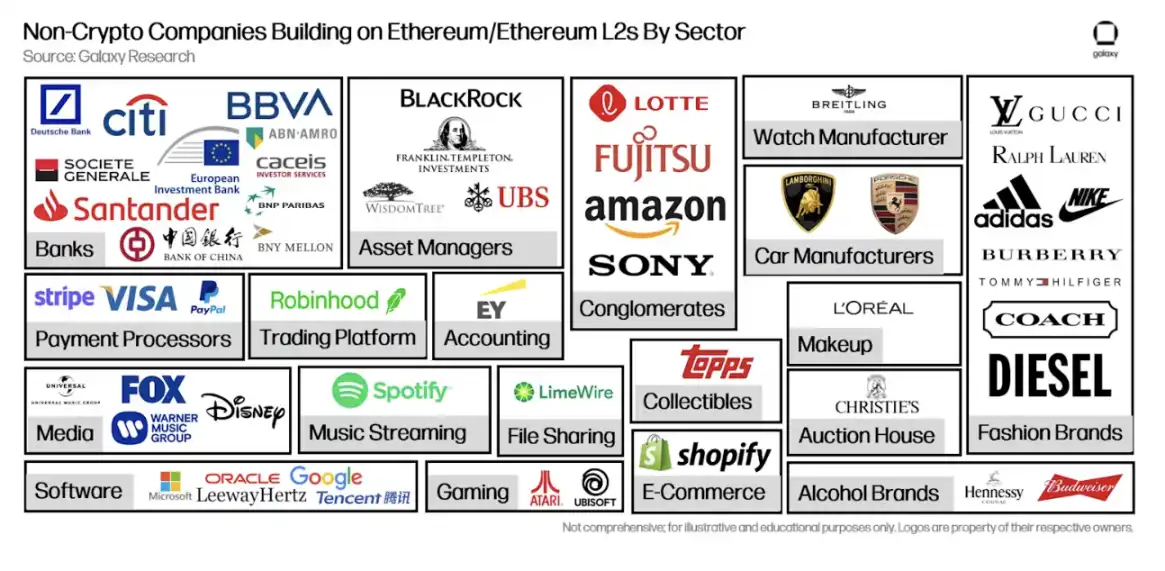
Over 50 non-native cryptocurrency companies have already built products and services on Ethereum or Ethereum Layer 2 (L2). From fashion giants like Louis Vuitton and Adidas to financial powerhouses like Deutsche Bank and PayPal, the innovative practices of these companies are reshaping the landscape of the crypto space. It is worth noting that the crypto business of these traditional large companies is not focused on general market infrastructure such as cryptocurrency exchanges, custody, auditing, and compliance but rather on specific crypto infrastructure and use cases, such as Non-Fungible Tokens (NFTs), Real-World Assets (RWAs), Web3 developer tools, and Layer 2 solutions. Among the 20 financial institutions building crypto-specific infrastructure and applications, banks occupy 10 seats, with most actively issuing real-world assets on Ethereum. This report aims to delve into Ethereum's pioneering and leading-edge applications in traditional enterprises and institutions.
Introduction
In this report, the cryptocurrency industry can be broadly divided into three main categories:
· General Infrastructure: Companies providing products and services related to cryptocurrency and blockchain that are not unique or exclusive to the crypto industry, such as general market infrastructure (e.g., exchanges, market makers, asset management) and general business support (e.g., banking, accounting, consulting, compliance).
· Crypto-Specific Infrastructure: Companies offering products and services specific to the crypto industry. For example, companies involved in mining, staking, and building on-chain oracles, whose infrastructure is tailored specifically for the cryptocurrency and blockchain sector.
· Crypto Use Cases and Applications: Companies building consumer-level applications that run entirely or partially on the blockchain. For example, decentralized exchanges that can autonomously execute cryptocurrency trades on the blockchain without relying on third-party intermediaries.
Today, traditional companies are no longer limited to extending existing applications and service suites to support cryptocurrency but are actively innovating new products and services that can only be achieved through blockchain. Additionally, at least 55 of these companies are building on public blockchains like Ethereum and Ethereum Layer 2 networks such as Polygon, Arbitrum, and Optimism.
Here is a Market Map of 55 Non-Native Cryptocurrency Companies that have built on Ethereum or Ethereum Layer 2 networks, or are building cryptocurrency-specific infrastructure and applications.
Among these 55 companies, at least 23 have minted NFTs on Ethereum or Ethereum Layer 2 networks.
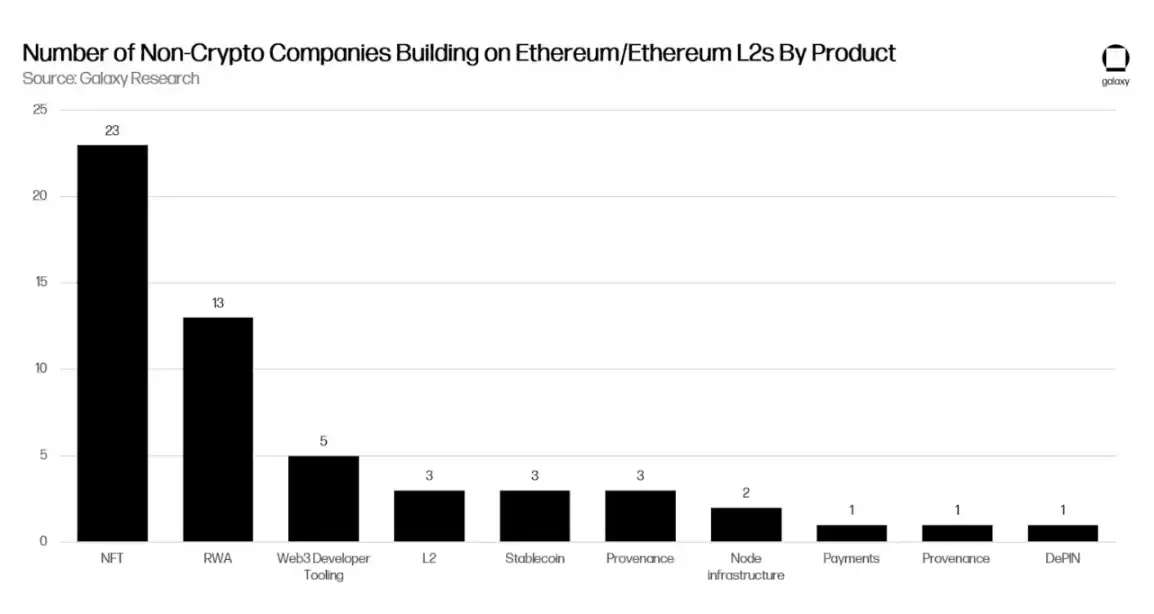
While most companies are directly building on Ethereum, at least 17 have either already explored or are exploring multiple general-purpose blockchains and L2 solutions.
Real-World Assets (RWA) on Ethereum
One common type of non-native company doing business in the Ethereum ecosystem is financial institutions such as banks, asset management firms, payment processors, exchanges, and accounting firms. Among the 20 financial institutions that have been identified as building cryptocurrency-specific infrastructure and applications, 13 have issued real-world assets on Ethereum and Ethereum L2. The types of on-chain issued real-world assets are diverse, ranging from the Franklin OnChain U.S. Government Money Fund to government bonds issued by institutions like the European Investment Bank.
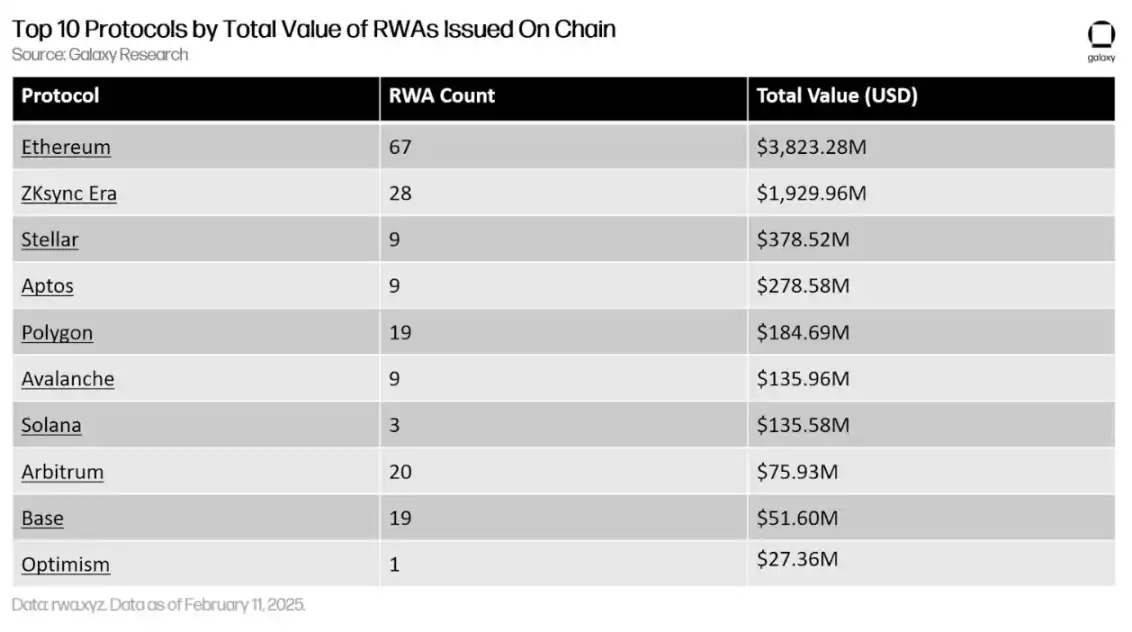
Ethereum is the preferred blockchain for issuing tokenized assets, with the total value of its real-world assets nearly ten times that of the second most popular real-world asset blockchain—Stellar. ZKsync, an Ethereum Layer 2 network, has a higher number and total value of on-chain issued real-world assets compared to Stellar. Among the top ten networks for issuing real-world assets, six are Ethereum or Ethereum L2.
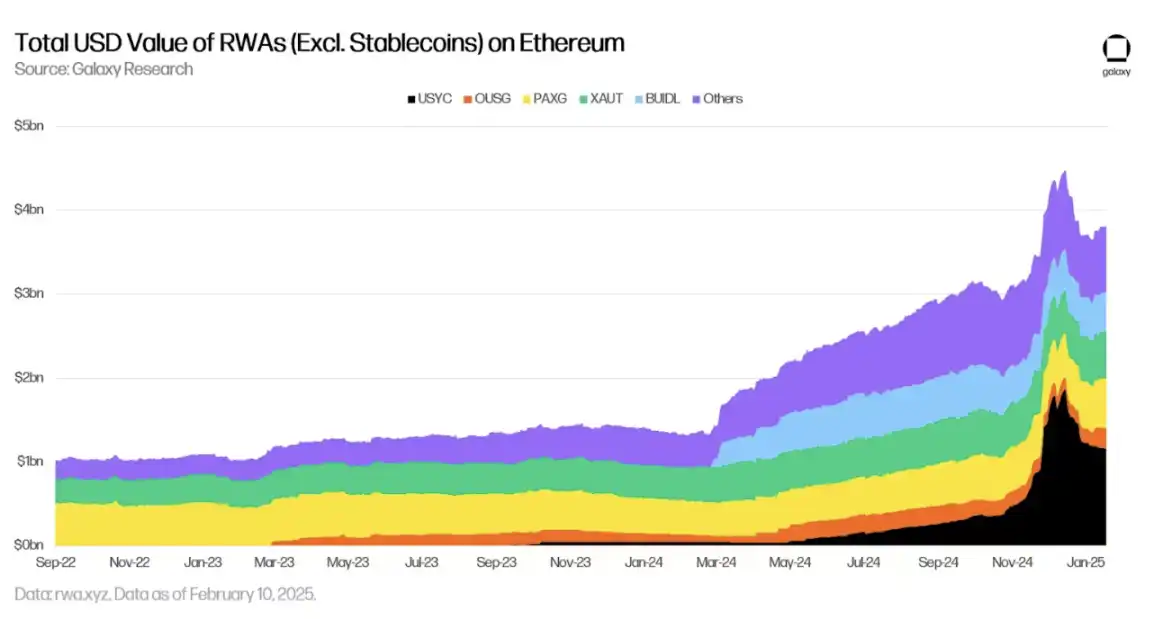
As of February 11, 2025, the third-largest tokenized fund across all blockchains is BlackRock's Institutional Digital Liquidity Fund (BUIDL). Launched in March 2024, the fund offers investors USD returns with instant, transparent settlement and interoperability between traditional financial markets and decentralized finance advantage. BlackRock's Head of Digital Assets, Robert Mitchnick, stated in March last year: "Through tokenization, we have packaged traditional financial investments in a crypto-native wrapper."
The world's largest asset manager, BlackRock, collaborated with the tokenization platform Securitize and the U.S. financial services company BNY Mellon to first launch BUIDL on Ethereum. Since March last year, BlackRock has expanded the fund to five additional networks beyond Ethereum, three of which are Ethereum Layer 2 networks.
The value of real-world assets issued on Ethereum has doubled in the past year. According to rwa.xyz data, over 160 real-world assets have been issued on Ethereum, distributed across 60,000 active wallet addresses. This does not include stablecoins.
While the number is small, some financial institutions involved in real-world assets and tokenization business are also developing their own stablecoins. Payment processor PayPal first launched its USD-pegged stablecoin PYUSD on Ethereum in August 2023. Since then, PayPal has expanded the issuance of PYUSD to Solana. Trading platform Robinhood, in collaboration with a range of crypto-native institutions including Galaxy Digital, Kraken, Nuvei, Anchorage, Bullish, and Paxos, also launched its own USD-pegged stablecoin USDG on Ethereum in November 2024.
The total circulation supply of stablecoins on Ethereum has increased by 70% in the past year. These stablecoins vary in collateral composition and design type, but the vast majority are USD-pegged instruments collateralized by high-quality liquid assets. As of February 11, 2025, Ethereum accounts for over 50% of the stablecoin market share.
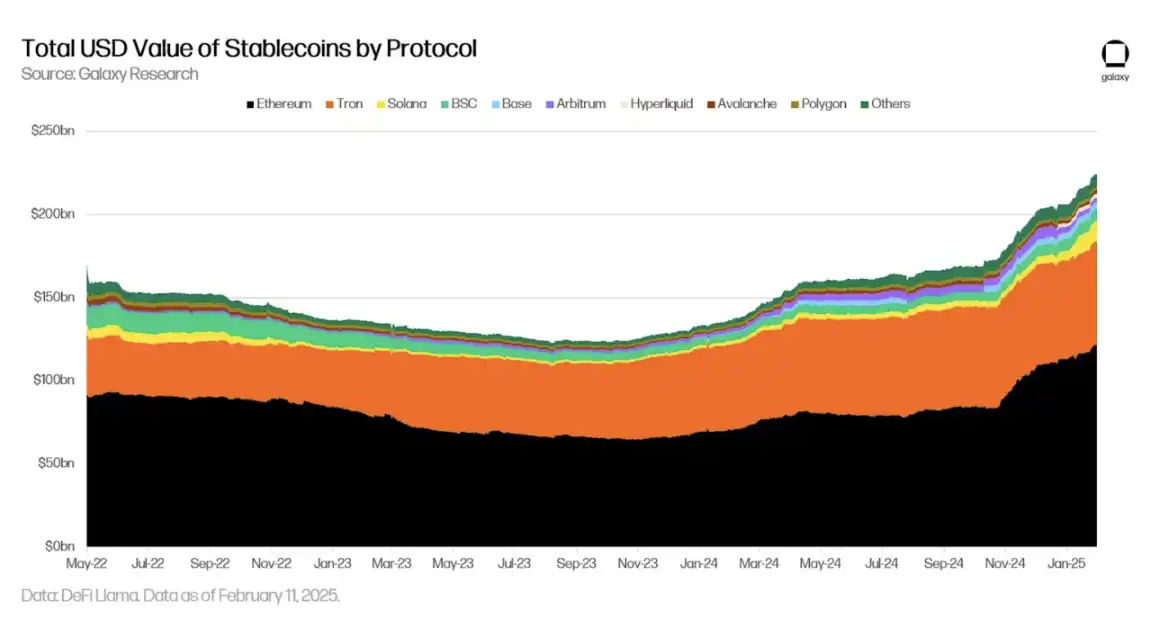
According to Galaxy Research, the total supply of stablecoins is expected to double in 2025, exceeding $400 billion. One catalyst for traditional financial institutions accelerating the launch of new stablecoins this year was the $1 billion acquisition of the stablecoin payment platform Bridge by payment company Stripe in 2024. Regarding this acquisition, Stripe CEO Patrick Collison stated: "Stablecoins are the room-temperature superconductors of financial services. Thanks to stablecoins, global enterprises will achieve significant improvements in speed, coverage, and cost over the next few years."
In the United States, another catalyst for the application of real-world assets and stablecoins is the regulatory environment. SEC Commissioner Hester Peirce released a statement on Tuesday, February 4, 2025, outlining specific priorities and themes that the SEC may address in the digital asset industry, with the ninth item emphasizing the modernization of traditional finance through tokenization. The statement reads: "The specialized working group also plans to examine the intersection of cryptocurrency with clearing agency and transfer agent rules. We will continue to collaborate with market participants interested in tokenizing securities or otherwise using blockchain technology to modernize traditional financial markets."
Real-world assets and stablecoins are native applications of crypto, rapidly finding points of product-market fit within traditional financial institutions. As the most decentralized, widely adopted by crypto-native users, and longest-running network in terms of uptime, Ethereum serves as the entry point for many institutions to incubate and launch finance-focused crypto services and products.
Scalable Blockchain Infrastructure
While Ethereum serves as the entry point for many financial institutions and non-crypto-native companies adopting cryptocurrency and blockchain technology, it is not a blockchain with a scalable protocol for new application scenarios. Compared to blockchains like Solana, Ethereum has poorer performance, slower block times, and higher transaction fees. Ethereum protocol developers are unwilling to sacrifice the network's resilience and security for speed and are instead focused on scaling Ethereum through Layer 2 solutions. A scalability solution is a type of blockchain infrastructure that can inherit Ethereum's security and scale to millions of new users.
Non-crypto-native companies are not only advancing crypto application scenarios like tokenization on Ethereum but also investing in the infrastructure needed to support these application scenarios to reach a wider audience than just crypto-native users. Germany's largest bank, Deutsche Bank, is collaborating with Matter Labs, the builder of the ZKSync scaling solution, to develop a new scaling solution on Ethereum. The scaling solution, codenamed DAMA 2, is part of a broader initiative led by the Monetary Authority of Singapore (MAS) and 24 other global financial institutions aimed at exploring the application scenarios of public blockchains in global finance.
Deutsche Bank's primary motivation for developing an L2 network is to create a scalable, auditable, transparent, and interoperable blockchain infrastructure with regulated platforms and financial services. Alex Gluchowski, co-creator of ZKSync, commented on Deutsche Bank's motivation for developing an L2 network, stating: "Institutions building on-chain choose ZKSync because it allows them to build on Web3 without compromise. ZKSync gives institutions a customizable architecture to build bespoke solutions, achieving privacy, scalability, and interoperability with other private and public blockchains."
Financial institutions like Deutsche Bank are developing scalable, customizable, and regionally compliant blockchain infrastructure on Ethereum. However, the appeal of scalable and customizable blockchain infrastructure is not limited to financial application scenarios.
Japanese company Sony recently launched its own scaling solution using the OP tech stack on Ethereum. Their motivation for creating and operating their own general-purpose scaling solution is to support a broader ecosystem of gaming, finance, and entertainment applications. Regarding Sony's L2 network, Soneium, Jun Watanabe, Chairman of Sony's Blockchain Solutions Lab, stated: "I believe that developing comprehensive Web3 solutions based on blockchain is essential for the Sony Group. Sony conducts extensive business activities based on its corporate philosophy of 'filling the world with emotion through the power of creativity and technology.'
Since the launch of Soneium, the protocol has faced strong opposition due to Sony's oversight of on-chain activities, especially token transfer restrictions and address blacklisting. While this event has sparked questions about the level of control that enterprises building on permissionless infrastructure like Ethereum should have, it has also highlighted the determination of one of the world's largest corporate groups to seek answers to these questions. Sony's investment in new digital experiences and applications on Ethereum through a scaling solution underscores the potential value of the Ethereum blockchain space and Layer 2.
Games on the Ethereum L2 Network
NFTs have been a primary use case for traditional companies, with participants including luxury fashion brands like Louis Vuitton and Gucci, as well as luxury car manufacturers like Porsche and Lamborghini. Most of the NFTs issued by these companies were during the peak of the NFT craze from 2021 to 2023. Considering the dwindling interest in NFTs over the past few years, many companies are no longer issuing NFTs on Ethereum and the Ethereum L2 network in 2025.
The few companies actively issuing NFTs on Ethereum in 2025 are mostly in the realm of game development and almost exclusively on the Ethereum L2 network rather than the Ethereum mainnet.
In July 2024, video game giant Atari deployed its two classic arcade games, "Asteroids" and "Breakout," on the Ethereum Layer 2 network Base operated by Coinbase. Until late August 2024, gamers could earn rewards on Base, mint exclusive Atari NFTs, and redeem physical goods. A few months after Atari's foray into on-chain gaming, in October 2024, Lamborghini announced a partnership with the Web3 game company Animoca Brands to launch a digital collectibles platform called FastForWorld.
FastForWorld allows gamers to buy, sell, and drive Lamborghini cars in a series of games developed by Animoca Brands, including "Torque Drift 2," "REVV Racing," "Auto Universe Center," and FastForWorld's proprietary experiences.
FastForWorld's in-game assets are minted on Base. The platform's first version launched on November 7, 2024, and is currently under active development, with more expansions to the FastForWorld platform expected to be announced in 2025.
On January 7, 2025, one of South Korea's top five conglomerates, Lotte Group, announced a deeper collaboration with the Arbitrum Foundation and Offchain Labs to build Lotte's metaverse gaming platform, "Caliverse," on the Ethereum L2 network Arbitrum. Caliverse has already launched, allowing users to shop, attend virtual concerts, and play games on the platform. Kima Kim, CEO of Caliverse, commented on the collaboration with Arbitrum, stating, "We are excited to partner with the most trusted blockchain, Arbitrum, and take the first step into the blockchain world. Through Lotte Caliverse, we will leverage Lotte's successful history in retail to provide outstanding products and services to over 40 million people." During the 2025 Consumer Electronics Show in Las Vegas, the Caliverse team announced plans to introduce virtual reality and 3D movie features on its platform in the first half of 2025.

Non-crypto-native companies like Atari, Lamborghini, and Lotte's Caliverse continue their ongoing investment and development in NFTs, notably within the context of blockchain-based gaming applications. Blockchain-based games may require frequent on-chain transactions, which can lead to high fees and network congestion. Therefore, these companies are building games on the Ethereum L2 network to leverage the scalability benefits of Ethereum's L2-centric architecture.
Steven Goldfeder, Co-Founder and CEO of Offchain Labs, stated, "Due to Arbitrum's industry-leading 250-millisecond block time, capable of supporting seamless virtual worlds and gaming applications, it is the ideal home for Caliverse."
Conclusion
NFTs and real-world assets are a key application of Ethereum in non-crypto-native companies and institutions. Among the companies issuing NFTs in the Ethereum ecosystem, the most active in 2025 are those issuing NFTs within the context of blockchain-based gaming applications built on the Ethereum L2 network. This highlights how the scalability of L2 networks has helped support crypto-native use cases, such as games in large retail brands and enterprises that require frequent on-chain interactions. Ethereum's commitment to scaling its infrastructure through layer 2 solutions also provides an opportunity for early technology adopters in traditional finance and other industries by creating customizable and compliant infrastructure for these use cases, driving non-speculative cryptocurrency applications. Lastly, Ethereum remains the preferred blockchain for traditional financial institutions issuing real-world assets and stablecoins. Key partnerships established in 2024 are expected to further advance stablecoin adoption in 2025.
You may also like
$COIN Joins S&P 500, but Coinbase Isn't Celebrating
On May 13, S&P Dow Jones Indices announced that Coinbase would officially replace Discover Financial Services in the S&P 500 on May 19. While other companies like Block and MicroStrategy, closely tied to Bitcoin, were already part of the S&P 500, Coinbase became the first cryptocurrency exchange whose primary business is in the index. This also signifies that cryptocurrency is gradually moving from the fringes to the mainstream in the U.S.
On the day of the announcement, Coinbase's stock price surged by 23%, surpassing the $250 mark. However, just 3 days later, Coinbase was hit by two consecutive events: a hack where employees were bribed to steal customer data and a demand for a $20 million ransom, and an investigation by the U.S. Securities and Exchange Commission (SEC) into the authenticity of its claim of having over 100 million "verified users" in its securities filings and marketing materials. These two events acted as mini-bombs, and at the time of writing, Coinbase's stock had already dropped by over 7.3%.
Coincidentally, Discover Financial Services, being replaced by Coinbase, can also be considered the "Coinbase" of the previous payment era. Discover is a U.S.-based digital banking and payment services company headquartered in Illinois, founded in 1960. Its payment network, Discover Network, is the fourth largest payment network apart from Visa, Mastercard, and American Express.
In April, after the approval of the acquisition of Discover by the sixth-largest U.S. bank, Capital One, this well-established digital banking company of over 60 years smoothly handed over its S&P 500 "seat" to this emerging cryptocurrency "bank." This unexpected coincidence also portrayed the handover between the new and old eras in Coinbase's entry into the S&P 500, resembling a relay race scene. However, this relay baton also brought Coinbase's accumulated "external troubles and internal strife" to a tipping point.
Over the past decade, cryptocurrency exchanges have been the most stable "profit machines." They play a role in providing liquidity to the entire industry and rely on trading fees to sustain their operations. However, with the comprehensive rollout of ETF products in the U.S. market, this profit model is facing unprecedented challenges. As the leader in the "American stack," with over 80% of its business coming from the U.S., Coinbase is most affected by this.
Starting from the approval of Bitcoin and Ethereum spot ETFs, traditional financial capital has significantly onboarded users and funds that originally belonged to exchanges in a more cost-effective, compliant, and transparent manner. The transaction fee revenue of cryptocurrency exchanges has started to decline, and this trend may further intensify in the coming months.
According to Coinbase's 2024 Q4 financial report, the platform's total trading revenue was $417 million, a 45% year-on-year decrease. The contribution of BTC and ETH's trading revenue dropped from 65% in the same period last year to less than 50%.
This decline is not a result of a decrease in market enthusiasm. In fact, since the approval of the Bitcoin ETF in January 2024, the inflow of BTC into the U.S. market has continued to reach new highs, with asset management giants like BlackRock and Fidelity rapidly expanding their management scale. Data shows that BlackRock's iShares Bitcoin ETF (IBIT) alone has surpassed $17 billion in assets under management. As of mid-May 2025, the cumulative net inflow of 11 major institutional Bitcoin spot ETFs on the market has exceeded $41.5 billion, with a total net asset value of $1214.69 billion, accounting for approximately 5.91% of the total Bitcoin market capitalization.
Institutional investors and some retail investors are shifting towards ETF products, partly due to compliance and tax considerations. On one hand, ETFs have much lower trading costs compared to cryptocurrency exchanges. While Coinbase's spot trading fee rate varies annually in a tiered manner but averages around 1.49%, for example, the management fee for IBIT ETF is only 0.25%, and the majority of ETF institution fees fluctuate around 0.15% to 0.25%.
In other words, the more rational users are, the more likely they are to move from exchanges to ETF products, especially for investors aiming for long-term holdings.
According to multiple sources, several institutions, including VanEck and Grayscale, have submitted applications to the SEC for a Solana (SOL) ETF, with some institutions also planning to submit an XRP ETF proposal. Once approved, this may trigger a new round of fund migration. According to a report submitted by Coinbase to the SEC, as of April, the platform's trading revenue from XRP and Solana accounted for 18% and 10%, nearly one-third of the platform's fee revenue.
However, the Bitcoin and Ethereum ETFs passed in 2024 also reduced the fees for these two tokens on Coinbase from 30% and 15% to 26% and 10%, respectively. If the SOL and XRP ETFs are approved, it will further undermine the core fee revenue of exchanges like Coinbase.
The expansion of ETF products is gradually weakening the financial intermediary status of cryptocurrency exchanges. From their original roles as matchmakers and clearers to now gradually becoming mere "on-ramps and off-ramps" for funds, exchanges are seeing their marginal value squeezed by ETFs.
On May 12, 2025, SEC Chairman Paul S. Atkins gave a keynote speech at the Tokenization and Cryptocurrency Working Group roundtable. The theme of his speech revolved around "It is a new day at the SEC," where he indicated that the SEC would not approach enforcement and regulation the same way as before but would instead pave the way for cryptocurrency assets in the U.S. market.
With signs of cryptocurrency compliance such as the SEC's "NEW DAY" declaration, an increasing number of traditional brokerages are attempting to enter the cryptocurrency industry. One of the most representative cases is the well-known U.S. brokerage Robinhood, which began expanding its crypto business in 2018. By the time of its IPO in 2021, Robinhood's crypto business revenue accounted for over 50% of the company, with a significant boost from the Dogecoin "moonshot" promoted by Musk.
In Q1 2025 earnings report, Robinhood showcased strong growth, especially in revenue from cryptocurrency and options trading. Fueled by Trump's Memecoin, cryptocurrency-related revenue reached $250 million, nearly doubling year-over-year. Consequently, Robinhood Gold subscription users reached 3.5 million, a 90% increase from the previous year, with the rapid growth of Robinhood Gold providing the company with a stable source of income.
Meanwhile, RobinHood is actively pursuing acquisitions in the cryptocurrency space. In 2024, it announced a $2 billion acquisition of the long-standing European cryptocurrency exchange Bitstamp. Additionally, Canada's largest cryptocurrency CEX, WonderFi, which recently went public on the Toronto Stock Exchange, also announced its integration with RobinHood Crypto. After obtaining virtual asset licenses in the UK, Canada, Singapore, and other markets, RobinHood has taken a proactive approach in the compliant cryptocurrency trading market.
Furthermore, an increasing number of brokerage firms are exploring the same path. Futu Securities, Tiger Brokers, and others are also dipping their toes into cryptocurrency trading, with some having applied for or obtained the VA license from the Hong Kong SFC. Although their user bases are currently small, traditional brokerages have a natural advantage in user trust, regulatory licenses, and low fee structures. This could pose a threat to native cryptocurrency platforms in the future.
In April 2025, security researchers discovered that some Coinbase user data was leaked on the dark web. While the platform initially responded by attributing it to a "technical misinformation," it still raised concerns among users regarding its security and privacy protection. Just two days before Dow Jones Indexes announced Coinbase's addition to the S&P 500 Index, on May 11, 2025, Coinbase received an email from an unknown threat actor claiming to have obtained customer account information and internal documents, demanding a $20 million ransom to keep the data private. Subsequent investigations confirmed the data breach.
Cybercriminals obtained the data by bribing overseas customer service agents and support staff, mainly in "non-U.S. regions such as India." These agents abused their access to Coinbase's internal customer support system and stole customer data. As early as February this year, blockchain detective ZachXBT revealed on X platform that between December 2024 and January 2025, Coinbase users lost over $65 million to social engineering scams, with the actual amount potentially higher.
Among the victims was a well-known figure, 67-year-old Ed Suman, an established artist in the art world for nearly two decades, having been involved in the creation of artworks such as Jeff Koons' "Balloon Dog" sculpture. Earlier this year, he fell victim to an impersonation scam involving fake Coinbase customer support, resulting in a loss of over $2 million in cryptocurrency. ZachXBT critiqued Coinbase for its inadequate handling of such scams, noting that other major exchanges have not faced similar issues and recommending Coinbase to enhance its security measures.
Amidst a series of ongoing social engineering incidents, although there has not been any impact on user assets at the technical level so far, it has raised concerns among many retail and institutional investors. Especially institutions holding massive assets on Coinbase. Just considering the U.S. BTC ETF institutions, as of mid-May 2025, they collectively hold nearly 840,000 BTC, and 75% of these are custodied by Coinbase. If we price BTC at $100,000, this amount reaches a staggering $63 billion, which is equivalent to the nominal GDP of two Iceland in the year 2024.
In addition, Coinbase Custody also serves over 300 institutional clients, including hedge funds, family offices, pension funds, and endowments. As of the Q1 2025 financial report, Coinbase's total assets under management (including institutional and retail clients) reached $404 billion. The specific amount of institutional custodied assets was not explicitly disclosed in the latest report, but it should still be over 50% based on the Q4 2024 report.
Once this security barrier is breached, not only could the rate of user attrition far exceed expectations, but more importantly, institutional trust in it would undermine the foundation of its business. Therefore, after a hacking event, Coinbase's stock price plummeted significantly.
Facing a decline in spot trading fee revenue, Coinbase is also accelerating its transformation, attempting to find growth opportunities in derivatives and emerging assets. Coinbase acquired a stake in the options platform Deribit at the end of 2024 and announced the official launch of perpetual contract products in 2025. This acquisition fills in Coinbase's gap in options trading and its relatively small global market share.
Deribit has a strong presence in non-U.S. markets, especially in Asia and Europe. The acquisition has enabled Coinbase to gain a dominant position in bitcoin and ethereum options trading on Deribit, accounting for approximately 80% of the global options trading volume, with daily trading volume remaining above $2 billion.
Meanwhile, 80-90% of Deribit's customer base consists of institutional investors, with their professionalism and liquidity in the Bitcoin and Ethereum options market highly favored by institutions. Coinbase's compliance advantage, coupled with its already robust institutional ecosystem, makes it even more suitable. By using institutions as an entry point, it can face the squeeze from giants like Binance and OKX in the derivatives market.
Facing a similar dilemma is Kraken, which is attempting to replicate Binance Futures' model in non-U.S. markets. Since the derivatives market relies more on professional users, fee rates are relatively higher and stickiness is stronger, making it a significant source of revenue for exchanges. In the first half of 2025, Kraken completed the acquisition of TradeStation Crypto and a futures exchange, aiming to build a complete derivatives trading ecosystem to hedge the risk of declining spot transaction fee income.
With the surge of Memecoin in 2024, Binance, OKX, and various CEX platforms began massively listing small-market-cap, highly volatile tokens to activate active trading users. Due to the wealth effect and trading activity of Memecoins, Coinbase was also forced to join the battle, successively listing popular tokens from the Solana ecosystem such as BOOK OF MEME and Dogwifhat. Although these coins are controversial, they are frequently traded, with fee rates several times higher than mainstream coins, serving as a "blood-boosting" method for spot trading.
However, due to its status as a publicly traded company, this practice is a riskier endeavor for Coinbase. Even in the current crypto-friendly environment, the SEC is still investigating whether tokens like SOL, ADA, and SAND constitute securities.
In addition to the forced transformation strategies carried out by the aforementioned CEXs, they are also starting to lay out RWAs and the most talked-about stablecoin payment fields, such as the PYUSD launched through a collaboration between Coinbase and Paypal, Coinbase's support for the Euro stablecoin EURC by Circle that complies with EU MiCA regulatory requirements, or the USD1 launched through a collaboration between Binance and WIFL. In the increasingly crowded trading field, many CEXs have shifted their focus from just the trading market to the application field.
The golden age of transaction fees has quietly ended, and the second half of the crypto exchange platform game has silently begun.
After CEX and Wallet, OKX enters the payment game
Stablecoin Showdown: Six Rising Stars Enter the Fray, Will the Market Structure Shift?
Vitalik's Talk: Exploring the Ethereum 2025 Vision, Fusion Innovation of POS, L2, Cryptography, and AI
This Week in Review | Trump to Host Dinner for TRUMP Holders; Musk and US Treasury Secretary Engage in Heated Argument at the White House
Cryptocurrency Market Sentiment Warms Up, MCP Emerges as New AI Frontier
A Trader's Growth Experience
Synthetix has issued another fix, can sUSD re-anchor?
Zora Mint Fund: Transformation Story from NFT Newbie to Social Media Maniac
The Stablecoin's Secret Goldmine: How to Profit from US Treasuries and Interest Rates?
Each to Their Own, Every Public Blockchain Has Its Purpose
Is Solana About to Recover? Analyzing On-Chain MEME Whale Movement
ZKSync Hacked for $5 Million: Token Price Plunges, Former L2 Darling Now in Shambles
Is USDT's cross-chain version, USDT0, reliable?
Decentralized Discord? Will Towns' new a16z funding break the curse of on-chain social?
Rate Cut Countdown: $9 Trillion National Debt "Maturity Wall" Could Be the Cryptocurrency Market's Most Powerful Catalyst
Key Market Information Discrepancy on April 11th - A Must-Read! | Alpha Morning Post
Tariff Reprieve Unleashes SOL On-Chain 'Emotion Rush' Space, FART and VINE Surge Over 40% Intraday
$COIN Joins S&P 500, but Coinbase Isn't Celebrating
On May 13, S&P Dow Jones Indices announced that Coinbase would officially replace Discover Financial Services in the S&P 500 on May 19. While other companies like Block and MicroStrategy, closely tied to Bitcoin, were already part of the S&P 500, Coinbase became the first cryptocurrency exchange whose primary business is in the index. This also signifies that cryptocurrency is gradually moving from the fringes to the mainstream in the U.S.
On the day of the announcement, Coinbase's stock price surged by 23%, surpassing the $250 mark. However, just 3 days later, Coinbase was hit by two consecutive events: a hack where employees were bribed to steal customer data and a demand for a $20 million ransom, and an investigation by the U.S. Securities and Exchange Commission (SEC) into the authenticity of its claim of having over 100 million "verified users" in its securities filings and marketing materials. These two events acted as mini-bombs, and at the time of writing, Coinbase's stock had already dropped by over 7.3%.
Coincidentally, Discover Financial Services, being replaced by Coinbase, can also be considered the "Coinbase" of the previous payment era. Discover is a U.S.-based digital banking and payment services company headquartered in Illinois, founded in 1960. Its payment network, Discover Network, is the fourth largest payment network apart from Visa, Mastercard, and American Express.
In April, after the approval of the acquisition of Discover by the sixth-largest U.S. bank, Capital One, this well-established digital banking company of over 60 years smoothly handed over its S&P 500 "seat" to this emerging cryptocurrency "bank." This unexpected coincidence also portrayed the handover between the new and old eras in Coinbase's entry into the S&P 500, resembling a relay race scene. However, this relay baton also brought Coinbase's accumulated "external troubles and internal strife" to a tipping point.
Over the past decade, cryptocurrency exchanges have been the most stable "profit machines." They play a role in providing liquidity to the entire industry and rely on trading fees to sustain their operations. However, with the comprehensive rollout of ETF products in the U.S. market, this profit model is facing unprecedented challenges. As the leader in the "American stack," with over 80% of its business coming from the U.S., Coinbase is most affected by this.
Starting from the approval of Bitcoin and Ethereum spot ETFs, traditional financial capital has significantly onboarded users and funds that originally belonged to exchanges in a more cost-effective, compliant, and transparent manner. The transaction fee revenue of cryptocurrency exchanges has started to decline, and this trend may further intensify in the coming months.
According to Coinbase's 2024 Q4 financial report, the platform's total trading revenue was $417 million, a 45% year-on-year decrease. The contribution of BTC and ETH's trading revenue dropped from 65% in the same period last year to less than 50%.
This decline is not a result of a decrease in market enthusiasm. In fact, since the approval of the Bitcoin ETF in January 2024, the inflow of BTC into the U.S. market has continued to reach new highs, with asset management giants like BlackRock and Fidelity rapidly expanding their management scale. Data shows that BlackRock's iShares Bitcoin ETF (IBIT) alone has surpassed $17 billion in assets under management. As of mid-May 2025, the cumulative net inflow of 11 major institutional Bitcoin spot ETFs on the market has exceeded $41.5 billion, with a total net asset value of $1214.69 billion, accounting for approximately 5.91% of the total Bitcoin market capitalization.
Institutional investors and some retail investors are shifting towards ETF products, partly due to compliance and tax considerations. On one hand, ETFs have much lower trading costs compared to cryptocurrency exchanges. While Coinbase's spot trading fee rate varies annually in a tiered manner but averages around 1.49%, for example, the management fee for IBIT ETF is only 0.25%, and the majority of ETF institution fees fluctuate around 0.15% to 0.25%.
In other words, the more rational users are, the more likely they are to move from exchanges to ETF products, especially for investors aiming for long-term holdings.
According to multiple sources, several institutions, including VanEck and Grayscale, have submitted applications to the SEC for a Solana (SOL) ETF, with some institutions also planning to submit an XRP ETF proposal. Once approved, this may trigger a new round of fund migration. According to a report submitted by Coinbase to the SEC, as of April, the platform's trading revenue from XRP and Solana accounted for 18% and 10%, nearly one-third of the platform's fee revenue.
However, the Bitcoin and Ethereum ETFs passed in 2024 also reduced the fees for these two tokens on Coinbase from 30% and 15% to 26% and 10%, respectively. If the SOL and XRP ETFs are approved, it will further undermine the core fee revenue of exchanges like Coinbase.
The expansion of ETF products is gradually weakening the financial intermediary status of cryptocurrency exchanges. From their original roles as matchmakers and clearers to now gradually becoming mere "on-ramps and off-ramps" for funds, exchanges are seeing their marginal value squeezed by ETFs.
On May 12, 2025, SEC Chairman Paul S. Atkins gave a keynote speech at the Tokenization and Cryptocurrency Working Group roundtable. The theme of his speech revolved around "It is a new day at the SEC," where he indicated that the SEC would not approach enforcement and regulation the same way as before but would instead pave the way for cryptocurrency assets in the U.S. market.
With signs of cryptocurrency compliance such as the SEC's "NEW DAY" declaration, an increasing number of traditional brokerages are attempting to enter the cryptocurrency industry. One of the most representative cases is the well-known U.S. brokerage Robinhood, which began expanding its crypto business in 2018. By the time of its IPO in 2021, Robinhood's crypto business revenue accounted for over 50% of the company, with a significant boost from the Dogecoin "moonshot" promoted by Musk.
In Q1 2025 earnings report, Robinhood showcased strong growth, especially in revenue from cryptocurrency and options trading. Fueled by Trump's Memecoin, cryptocurrency-related revenue reached $250 million, nearly doubling year-over-year. Consequently, Robinhood Gold subscription users reached 3.5 million, a 90% increase from the previous year, with the rapid growth of Robinhood Gold providing the company with a stable source of income.
Meanwhile, RobinHood is actively pursuing acquisitions in the cryptocurrency space. In 2024, it announced a $2 billion acquisition of the long-standing European cryptocurrency exchange Bitstamp. Additionally, Canada's largest cryptocurrency CEX, WonderFi, which recently went public on the Toronto Stock Exchange, also announced its integration with RobinHood Crypto. After obtaining virtual asset licenses in the UK, Canada, Singapore, and other markets, RobinHood has taken a proactive approach in the compliant cryptocurrency trading market.
Furthermore, an increasing number of brokerage firms are exploring the same path. Futu Securities, Tiger Brokers, and others are also dipping their toes into cryptocurrency trading, with some having applied for or obtained the VA license from the Hong Kong SFC. Although their user bases are currently small, traditional brokerages have a natural advantage in user trust, regulatory licenses, and low fee structures. This could pose a threat to native cryptocurrency platforms in the future.
In April 2025, security researchers discovered that some Coinbase user data was leaked on the dark web. While the platform initially responded by attributing it to a "technical misinformation," it still raised concerns among users regarding its security and privacy protection. Just two days before Dow Jones Indexes announced Coinbase's addition to the S&P 500 Index, on May 11, 2025, Coinbase received an email from an unknown threat actor claiming to have obtained customer account information and internal documents, demanding a $20 million ransom to keep the data private. Subsequent investigations confirmed the data breach.
Cybercriminals obtained the data by bribing overseas customer service agents and support staff, mainly in "non-U.S. regions such as India." These agents abused their access to Coinbase's internal customer support system and stole customer data. As early as February this year, blockchain detective ZachXBT revealed on X platform that between December 2024 and January 2025, Coinbase users lost over $65 million to social engineering scams, with the actual amount potentially higher.
Among the victims was a well-known figure, 67-year-old Ed Suman, an established artist in the art world for nearly two decades, having been involved in the creation of artworks such as Jeff Koons' "Balloon Dog" sculpture. Earlier this year, he fell victim to an impersonation scam involving fake Coinbase customer support, resulting in a loss of over $2 million in cryptocurrency. ZachXBT critiqued Coinbase for its inadequate handling of such scams, noting that other major exchanges have not faced similar issues and recommending Coinbase to enhance its security measures.
Amidst a series of ongoing social engineering incidents, although there has not been any impact on user assets at the technical level so far, it has raised concerns among many retail and institutional investors. Especially institutions holding massive assets on Coinbase. Just considering the U.S. BTC ETF institutions, as of mid-May 2025, they collectively hold nearly 840,000 BTC, and 75% of these are custodied by Coinbase. If we price BTC at $100,000, this amount reaches a staggering $63 billion, which is equivalent to the nominal GDP of two Iceland in the year 2024.
In addition, Coinbase Custody also serves over 300 institutional clients, including hedge funds, family offices, pension funds, and endowments. As of the Q1 2025 financial report, Coinbase's total assets under management (including institutional and retail clients) reached $404 billion. The specific amount of institutional custodied assets was not explicitly disclosed in the latest report, but it should still be over 50% based on the Q4 2024 report.
Once this security barrier is breached, not only could the rate of user attrition far exceed expectations, but more importantly, institutional trust in it would undermine the foundation of its business. Therefore, after a hacking event, Coinbase's stock price plummeted significantly.
Facing a decline in spot trading fee revenue, Coinbase is also accelerating its transformation, attempting to find growth opportunities in derivatives and emerging assets. Coinbase acquired a stake in the options platform Deribit at the end of 2024 and announced the official launch of perpetual contract products in 2025. This acquisition fills in Coinbase's gap in options trading and its relatively small global market share.
Deribit has a strong presence in non-U.S. markets, especially in Asia and Europe. The acquisition has enabled Coinbase to gain a dominant position in bitcoin and ethereum options trading on Deribit, accounting for approximately 80% of the global options trading volume, with daily trading volume remaining above $2 billion.
Meanwhile, 80-90% of Deribit's customer base consists of institutional investors, with their professionalism and liquidity in the Bitcoin and Ethereum options market highly favored by institutions. Coinbase's compliance advantage, coupled with its already robust institutional ecosystem, makes it even more suitable. By using institutions as an entry point, it can face the squeeze from giants like Binance and OKX in the derivatives market.
Facing a similar dilemma is Kraken, which is attempting to replicate Binance Futures' model in non-U.S. markets. Since the derivatives market relies more on professional users, fee rates are relatively higher and stickiness is stronger, making it a significant source of revenue for exchanges. In the first half of 2025, Kraken completed the acquisition of TradeStation Crypto and a futures exchange, aiming to build a complete derivatives trading ecosystem to hedge the risk of declining spot transaction fee income.
With the surge of Memecoin in 2024, Binance, OKX, and various CEX platforms began massively listing small-market-cap, highly volatile tokens to activate active trading users. Due to the wealth effect and trading activity of Memecoins, Coinbase was also forced to join the battle, successively listing popular tokens from the Solana ecosystem such as BOOK OF MEME and Dogwifhat. Although these coins are controversial, they are frequently traded, with fee rates several times higher than mainstream coins, serving as a "blood-boosting" method for spot trading.
However, due to its status as a publicly traded company, this practice is a riskier endeavor for Coinbase. Even in the current crypto-friendly environment, the SEC is still investigating whether tokens like SOL, ADA, and SAND constitute securities.
In addition to the forced transformation strategies carried out by the aforementioned CEXs, they are also starting to lay out RWAs and the most talked-about stablecoin payment fields, such as the PYUSD launched through a collaboration between Coinbase and Paypal, Coinbase's support for the Euro stablecoin EURC by Circle that complies with EU MiCA regulatory requirements, or the USD1 launched through a collaboration between Binance and WIFL. In the increasingly crowded trading field, many CEXs have shifted their focus from just the trading market to the application field.
The golden age of transaction fees has quietly ended, and the second half of the crypto exchange platform game has silently begun.


 App
App