
- Buy Crypto
- Markets
- Futures
- Spot
- Copy Trade
 Earn
Earn- More
Understand the Market Like a Puzzle: Decoding the Inner Logic of Liquidity, Spread, and Market Movement

Original Article by: TradeStream | Improve Your Trading
Original Article Translated by: DeepFlow Tech
Trading: If we choose to act in a place where most people are willing to trade based on common sense... then this may mean that we do not have more valuable information than others.
One Metaphor of Market Behavior: Jigsaw Puzzle
I like to use a jigsaw puzzle to describe market behavior. You can imagine the overall market as a person trying to complete a puzzle, with the trading volume being the puzzle pieces. The market will strive to put all the pieces together. By analyzing the distribution of trading volume, we can more clearly see where "pieces" are missing. When the market finds areas with more pieces (i.e., higher trading volume and time accumulation), it will try to allocate these pieces to areas with fewer pieces (i.e., lower trading volume and time).
How the Market Chooses Direction
Sometimes, when both sides of the market lack "pieces," how can we determine which side it will fill first?
This reminds me of a theory about human behavior in the book "Atomic Habits." In such situations, we need to focus on two key points:
Attraction: People usually hope that their actions will bring rewards, and the market is the same because it reflects human behavioral patterns. As we discussed earlier, we tend to avoid overly crowded trading scenarios, and a more attractive strategy is often trading against the majority of mispositioned participants, especially when we have clear structural reasons.
Reducing Resistance: According to the "law of least effort," the more effort something requires, the less likely it is to happen. If the resistance is too high, the difficulty of achieving our goal will also increase.
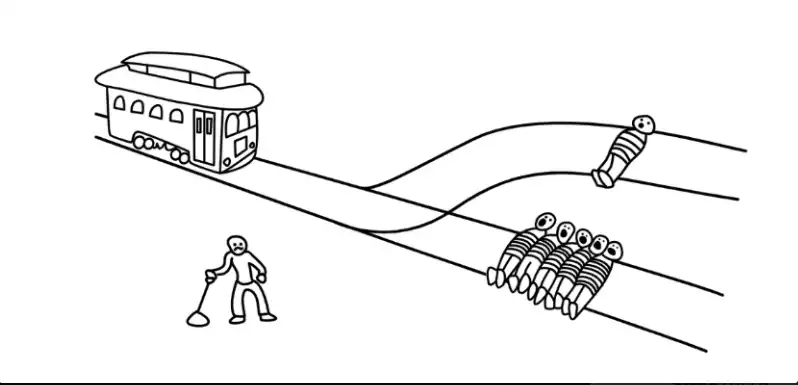
Another Metaphor of Market Behavior: Trolley Problem
Imagine the market as a train, and this train is like an "executioner" eager to "hunt." When we take action in the fair value area, both sides of the market are crowded with participants, making it difficult to predict which side the market will "hunt" more people. However, once the market chooses a side, the other side becomes the only choice, making our decision-making simpler.
What is Liquidity?
Liquidity refers to whether there are enough counterparties in the market to trade with. When we trade, we are either consuming liquidity or providing liquidity. If the price is stable in a certain area (i.e., a balance area) or unable to fluctuate smoothly, it is because buyers have not consumed enough liquidity; conversely, if the price can fluctuate smoothly, it means that buyers have successfully consumed enough liquidity.
Limit Order vs. Market Order
A limit order is a tool for "adding liquidity," while a market order is a tool for executing a trade and consuming this liquidity. Passive liquidity (limit orders) is often more impactful because limit orders typically determine market structure, while aggressive market orders will be absorbed at key points.
Why is a limit order more impactful? Because when you execute a market order, you need to cross the bid-ask spread, which means you will immediately be in an unrealized loss position after placing the order.
What is the Spread?
The spread is the difference between the asset's buy price (advertisement bid) and sell price (advertisement ask). Market makers provide liquidity through the spread, meaning the price to immediately buy an asset is usually slightly higher than the market price, while the price to immediately sell is slightly lower than the market price.
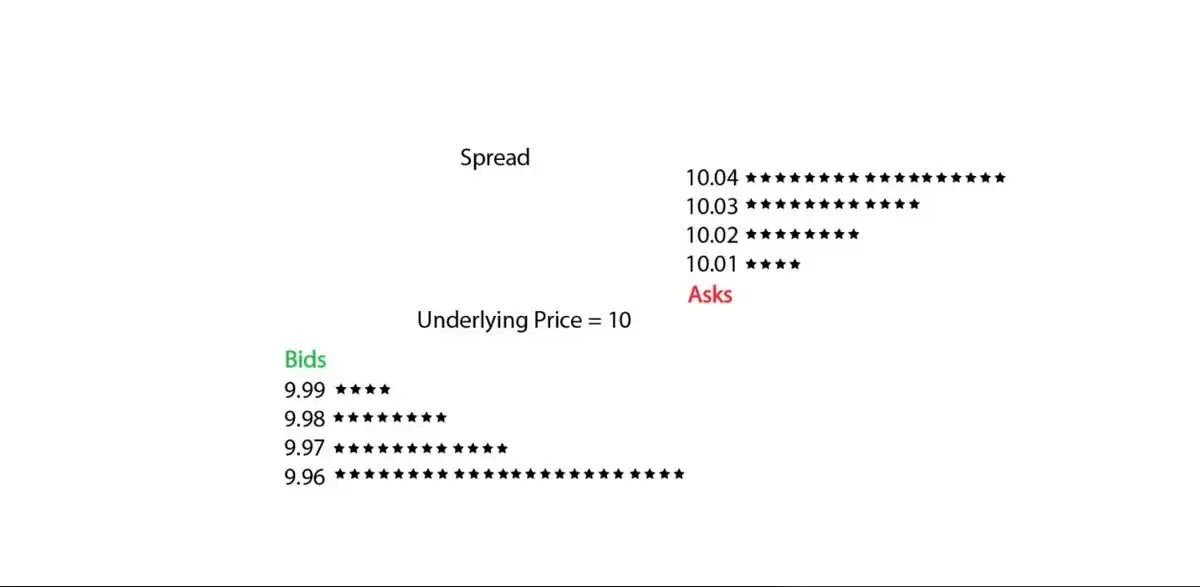
Let's assume an asset's current price is $10.00, and an asterisk (*) represents one contract. If we want to buy immediately, there is no $10.00 quote in the market because if there were, the market maker would not profit. Therefore, they would set the advertised liquidity slightly higher, for example, placing four contracts at $10.01 to capture this small difference.
If we decide to buy three contracts, we would transact at the $10.01 price. But what if we want to buy more, say 15 contracts? We would need to cross the spread until we find enough orders to fulfill the trade. As a result, the price would eventually be pushed to $10.03 because only at this price level are there enough contracts to meet our demand.
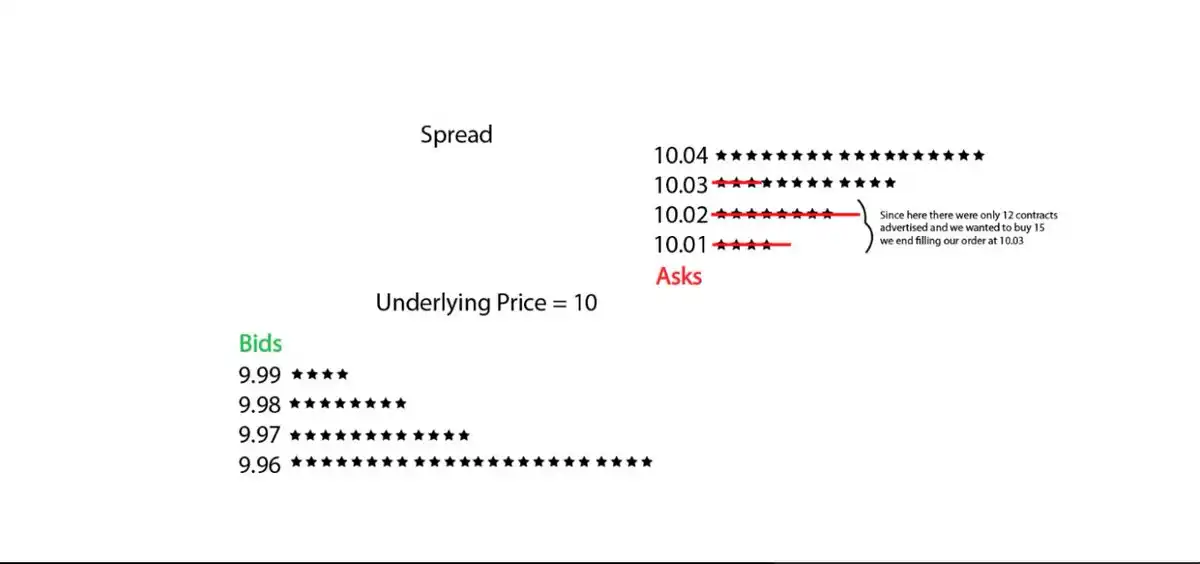
Through this example, we can understand why limit orders are usually more impactful. Small-scale traders have a negligible impact on the price as they will not encounter significant slippage. However, if someone wants to buy 500 contracts and there is not enough liquidity nearby, they will have to cross a significant spread, causing substantial price fluctuations.
If traders choose to place orders where liquidity is abundant, they can avoid significant slippage. So, where is liquidity usually concentrated? The answer is above swing highs and below swing lows. This is because most technical analysis-based traders exhibit similar behavior in setting stop-loss orders, and these locations are often where stop-losses cluster, making price reversals likely at these points.
So, their stop-loss is your entry point? Indeed.
Summary
· Impatient buyers or sellers are driving the price through market orders (taker), consuming liquidity.
· More patient buyers or sellers are preventing price fluctuations through limit orders (maker).
We can use a metaphor to describe this: market orders are like a hammer, while limit orders act as the floor or ceiling of a building. Breaking through the floor or ceiling requires sufficient hammer force to do so.
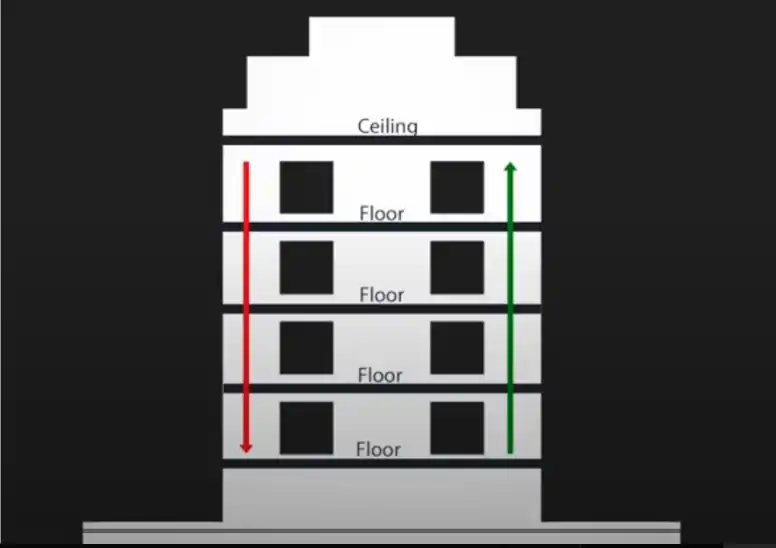
What happens when the floor is broken? The price quickly moves to the next floor.
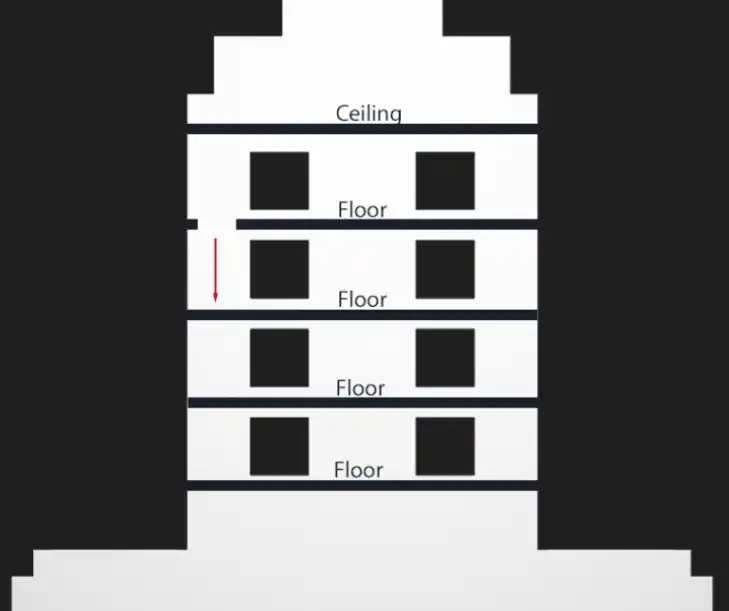
Once the price reaches the next floor, upward movement becomes easier because the ceiling has been broken, creating a "gap" that allows the price to more easily fluctuate in areas of scarce liquidity.
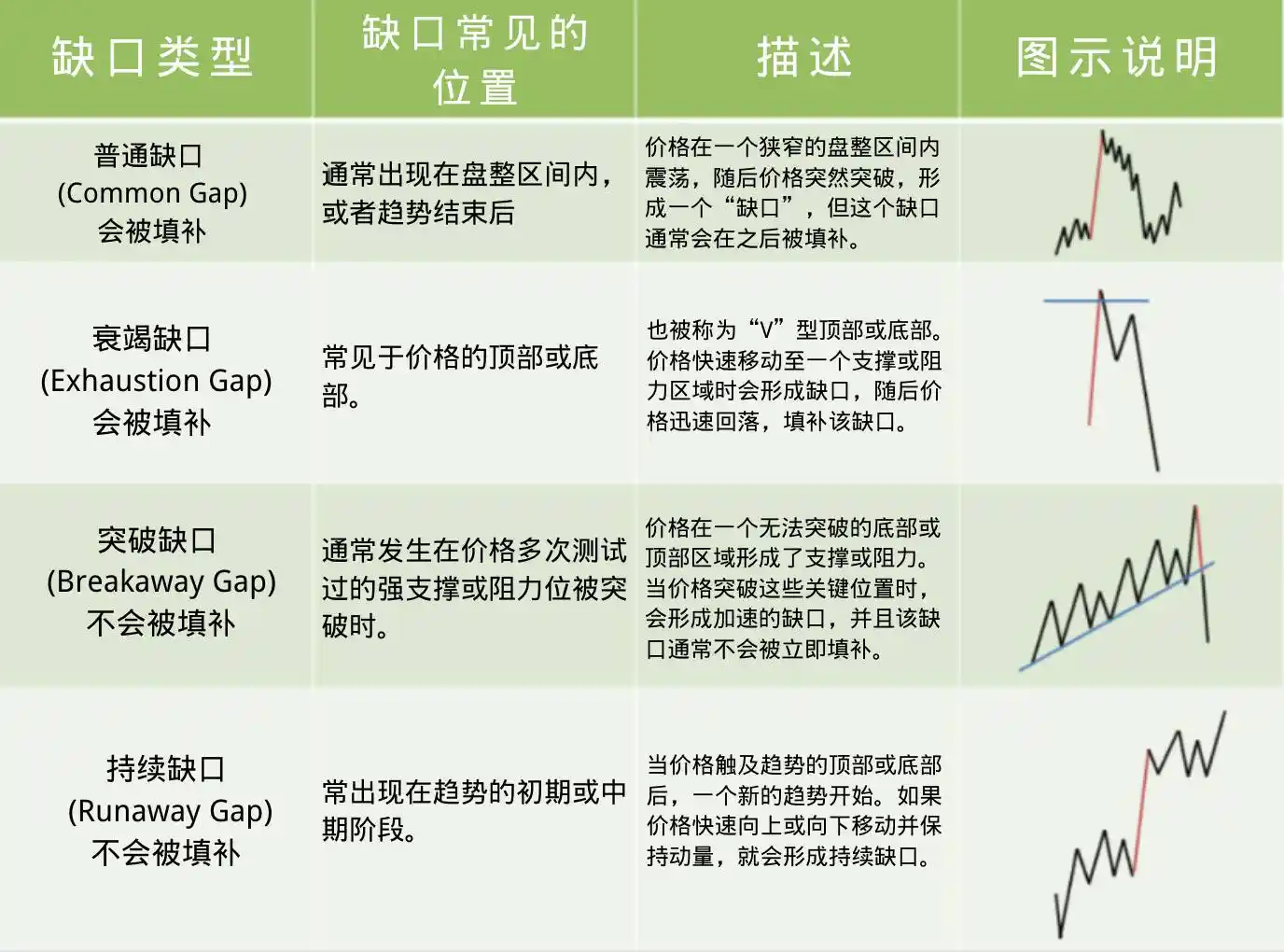
Liquidity cascading is a very effective way to make money because at this point, we are trading with a price-insensitive group that is forced to transact (e.g., liquidated traders). But we need to be clear about what we are trading.
If you are trading liquidity premium, this effect is usually very short-lived, lasting a maximum of 10-15 seconds. In a cascading environment, this situation changes. In this case, you need to assess whether liquidity has fully recovered from the initial volatility.
Although the chain reaction of momentum shifts is not as reliable as liquidity premium, its sustainability is stronger (many people think they are trading liquidity premium when, in fact, they are trading this momentum effect).
The first method (liquidity premium) is more suitable for PNL attribution (i.e., analyzing the reason for making money) and is also the more ideal way to operate. The second method (momentum effect) captures the core part of large fluctuations but comes with greater volatility and looser risk control.
Overall, liquidity cascades lead to a supply-demand imbalance as a large number of price-insensitive traders enter, causing the order book to not withstand so many aggressive traders. But once the market stabilizes, the price will more easily return to those areas that failed to accumulate enough volume due to rapid fluctuations.
After all, the market is a two-way auction mechanism that usually tests low-volume areas for two reasons:
· There is less path resistance;
· The market seeks efficiency and will test these areas to see if anyone is willing to trade at those price levels.
As a result, the market will experience a "mechanical bounce back," as the order book needs time to rebalance. During this time, only a small amount of trading volume is needed to drive price fluctuations. Once the market settles, price movements will rely more on momentum, accompanied by increased volatility, but also allowing for greater profit potential.
Remember, high volatility often begets high volatility, while low volatility often begets low volatility, a phenomenon known as volatility clustering. Therefore, seize the opportunity and adjust your risk management strategy based on each change in market conditions.
You may also like

Alibaba Backed Latin America Stablecoin Company, Why VelaFi?

AI Crypto Trading in 2026: How AI Agents Use Stablecoins for Capital Management and Settlement
Learn how AI agents use stablecoins for crypto trading in 2026 — managing capital, settling transactions, and operating across exchanges and DeFi protocols.

US Senate Agriculture Committee Schedules January 27 for Crypto Market Structure Hearing
Key Takeaways The Senate Agriculture Committee will release its crypto market structure bill on January 21, followed by…

Key Market Information Discrepancy on January 14th – A Must-See! | Alpha Early Report
Key Takeaways Bitcoin reached a new milestone, hitting $96,000, while Ethereum surpassed $3,300. Privacy coins such as ORDI…

Tether Freezes $182 Million in Assets in a Day: Is USDT Still a Neutral Coin?
Key Takeaways Tether recently froze $182 million in USDT across five wallets on the Tron blockchain, raising questions…

A Developer’s Three-Year Gamble on Base and the Turn Towards Solana
Key Takeaways: Base’s promise to support developers fell short, leading many to seek more supportive ecosystems. Developer frustration…

ETHGas Foundation Coin Issuance: Examining the Emotional Transaction Mechanism and Global Insights
Key Takeaways Zama’s token auction on CoinList is polarizing, showcasing potential for future applications amidst short-term market skepticism.…

a16z Secures $15 Billion: Redefining Venture Capital Through Visionary Storytelling
Key Takeaways a16z Raises Capital: The firm has raised an astronomical $15 billion, marking a significant point in…

Founder of DeepSeek’s Magic Square Quantitative Strategy Achieved a 56.55% Return in 2025
Key Takeaways Huansquare Quant, led by Liang Wenfeng, achieved a 56.55% return in 2025. The fund’s assets under…
Analyst: MSTR is the “Mullet” of this Bitcoin Bull Cycle, Acting as a Bitcoin Pressure Relief
MSTR absorbed significant volatility in this Bitcoin cycle, easing potential pressure on Bitcoin itself. Michael Saylor’s strategic issuance…

XMR Surges Over 50% in One Week: Who’s Buying?
Key Takeaways Monero (XMR) defies regulatory pressures, marking a 262% increase since January 2025, reaching an all-time high…

BitGo’s Revenue Surges with Upcoming IPO as Institutional Interest Grows
Key Takeaways BitGo, a major player in cryptocurrency custody, aims to raise $201 million through a U.S. IPO…
The New Era in Bitcoin Core Development: The Rise of Core Maintainer TheCharlatan
Key Takeaways Integration of a New Maintainer: For the first time in three years, a new Bitcoin Core…

Bitwise CIO Predicts Parabolic Bitcoin Surge with Sustained ETF Demand
Key Takeaways Prolonged demand for Bitcoin ETFs may lead to a parabolic rise in Bitcoin’s price, drawing parallels…

Binance Alpha to Launch Empire of Sight (Sight) on January 14
Key Takeaways Binance Alpha will kick off the trading of Empire of Sight (Sight) at 16:00 (UTC+8) on…
Today’s Trump Tariff Decision and Economic Data Releases
Key Takeaways The U.S. Supreme Court is set to rule on a significant Trump tariff case that could…

Binance Wallet Partners with Aster, Launches Seamless On-chain Perpetual Contract Trading
Key Takeaways: Binance Wallet has integrated with Aster to offer a streamlined and stable perpetual contract trading feature…
Final Federal Reserve Chair Candidate Rick Rieder, How He Views Cryptocurrency
Key Takeaways Rick Rieder stands out among the Federal Reserve Chair candidates due to his strong pro-crypto stance,…
Alibaba Backed Latin America Stablecoin Company, Why VelaFi?
AI Crypto Trading in 2026: How AI Agents Use Stablecoins for Capital Management and Settlement
Learn how AI agents use stablecoins for crypto trading in 2026 — managing capital, settling transactions, and operating across exchanges and DeFi protocols.
US Senate Agriculture Committee Schedules January 27 for Crypto Market Structure Hearing
Key Takeaways The Senate Agriculture Committee will release its crypto market structure bill on January 21, followed by…
Key Market Information Discrepancy on January 14th – A Must-See! | Alpha Early Report
Key Takeaways Bitcoin reached a new milestone, hitting $96,000, while Ethereum surpassed $3,300. Privacy coins such as ORDI…
Tether Freezes $182 Million in Assets in a Day: Is USDT Still a Neutral Coin?
Key Takeaways Tether recently froze $182 million in USDT across five wallets on the Tron blockchain, raising questions…
A Developer’s Three-Year Gamble on Base and the Turn Towards Solana
Key Takeaways: Base’s promise to support developers fell short, leading many to seek more supportive ecosystems. Developer frustration…


 App
App