
- Buy Crypto
- Markets
- Futures
- Spot
- Copy Trade
 Earn
Earn- More
The Vice President of the United States is also using Signal for "group chat" during wartime, The Encryption Saga of the Privacy Champion Signal

Original Article Title: "Even the U.S. Vice President Uses Signal 'Group Chat' for War, The Encryption Story of the Privacy King Signal"
Original Article Author: Deep Tide TechFlow
The world is a stage, and new evidence (material for jokes) has emerged.
We are all used to "group chatting" on various social apps to discuss work, life, and gossip. But have you ever thought that the U.S. high-ranking officials who hold the world's strongest military power are also engaged in a different form of "WeChat group work"?
Recently, Jeffrey Goldberg, the editor-in-chief of The Atlantic, revealed a hilarious story: he was mistakenly added to a Signal group chat named "Houthi PC" by U.S. national security senior officials, witnessing U.S. Vice President Pence and others "mocking" Europe in the group and, two hours before the U.S. military action, personally witnessing the high-ranking officials discussing the details of a military strike against the Houthi armed group in Yemen.
Initially, this veteran media person was deeply skeptical. He couldn't believe that U.S. national security senior officials would discuss such a confidential military operation on a commercial instant messaging app, and he couldn't believe that the Assistant to the President for National Security Affairs would so "recklessly" add a media editor into such discussions.
However, when he saw Secretary of Defense Hedgeseth disclosing in detail the upcoming operational details in the group chat, including the target of the strike, weapon deployment, and the order of attack, and these actions did indeed take place later, he had to accept this absurd reality.
As this event was exposed, Vice President Pence, Secretary of Defense Hedgeseth, Secretary of State Rubio, CIA Director Ratcliffe, and other U.S. senior officials became the targets of group ridicule, and the emoji used by the senior officials in the group chat also became a popular meme on the internet.
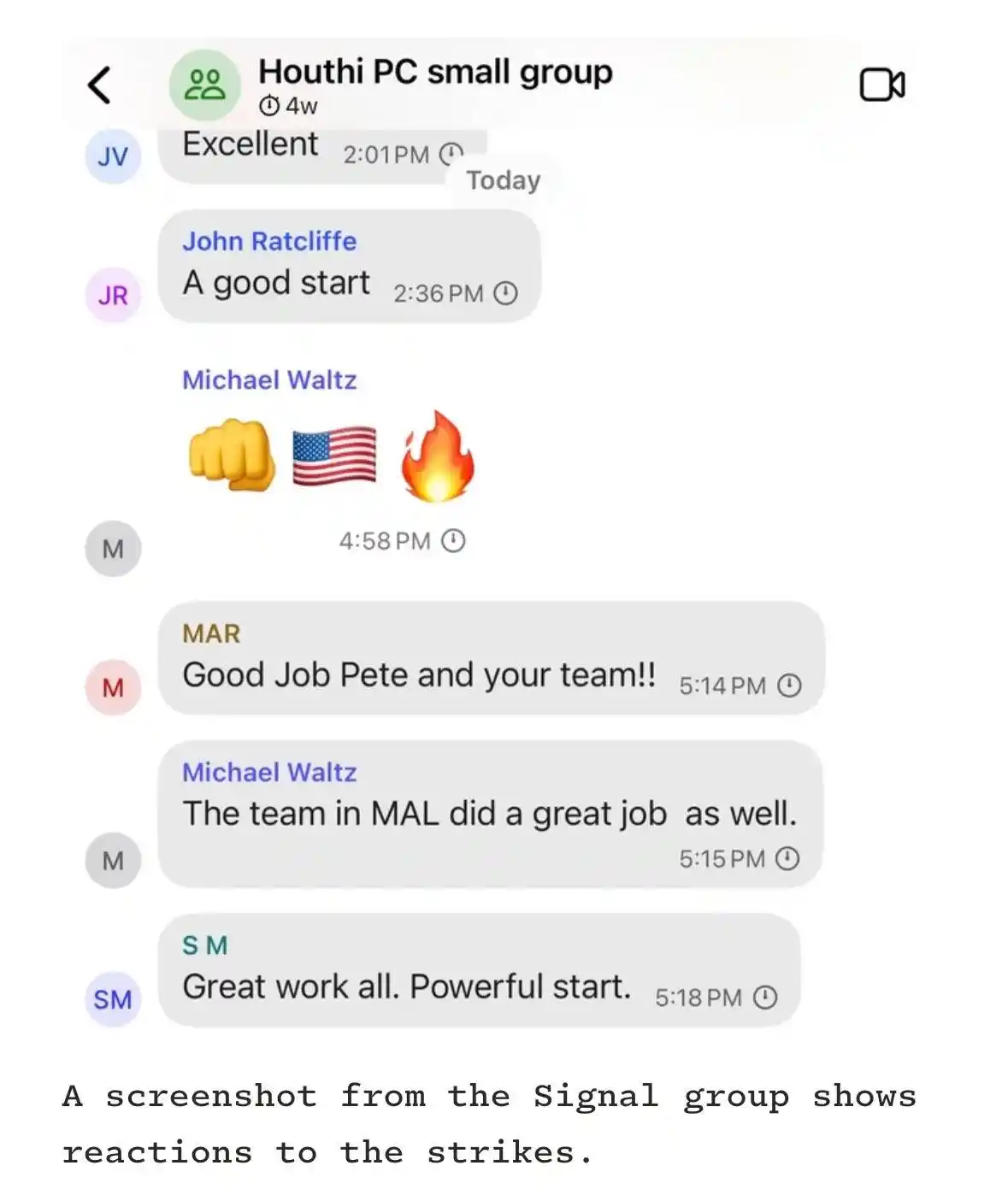
This incident perfectly illustrates the so-called "stage theory." What appears to outsiders as a well-organized, authoritative, and solemn power structure may be more chaotic and impromptu on the inside than we imagine. The most powerful government in the world is also conducting group work online, and may even make such low-level mistakes as "adding the wrong person."
Looking at the messaging app they used, Signal, is both unexpected and reasonable.
Signal is no stranger to the spotlight.
Long before becoming an inadvertent "witness platform" for U.S. military operations, this instant messaging app had gained widespread recognition from the tech industry and privacy advocates for its outstanding privacy protection capabilities. Figures such as Tesla CEO Elon Musk and "Prismgate" whistleblower Edward Snowden have openly praised Signal.
At the beginning of 2021, when WhatsApp announced an update to its privacy policy, Musk simply tweeted "Use Signal," prompting a significant surge in Signal downloads that temporarily crashed its verification system.

Edward Snowden, seen as a champion of privacy, had already stated back in 2015: "I use Signal every day." He believed Signal to be one of the most secure communication tools on the market.
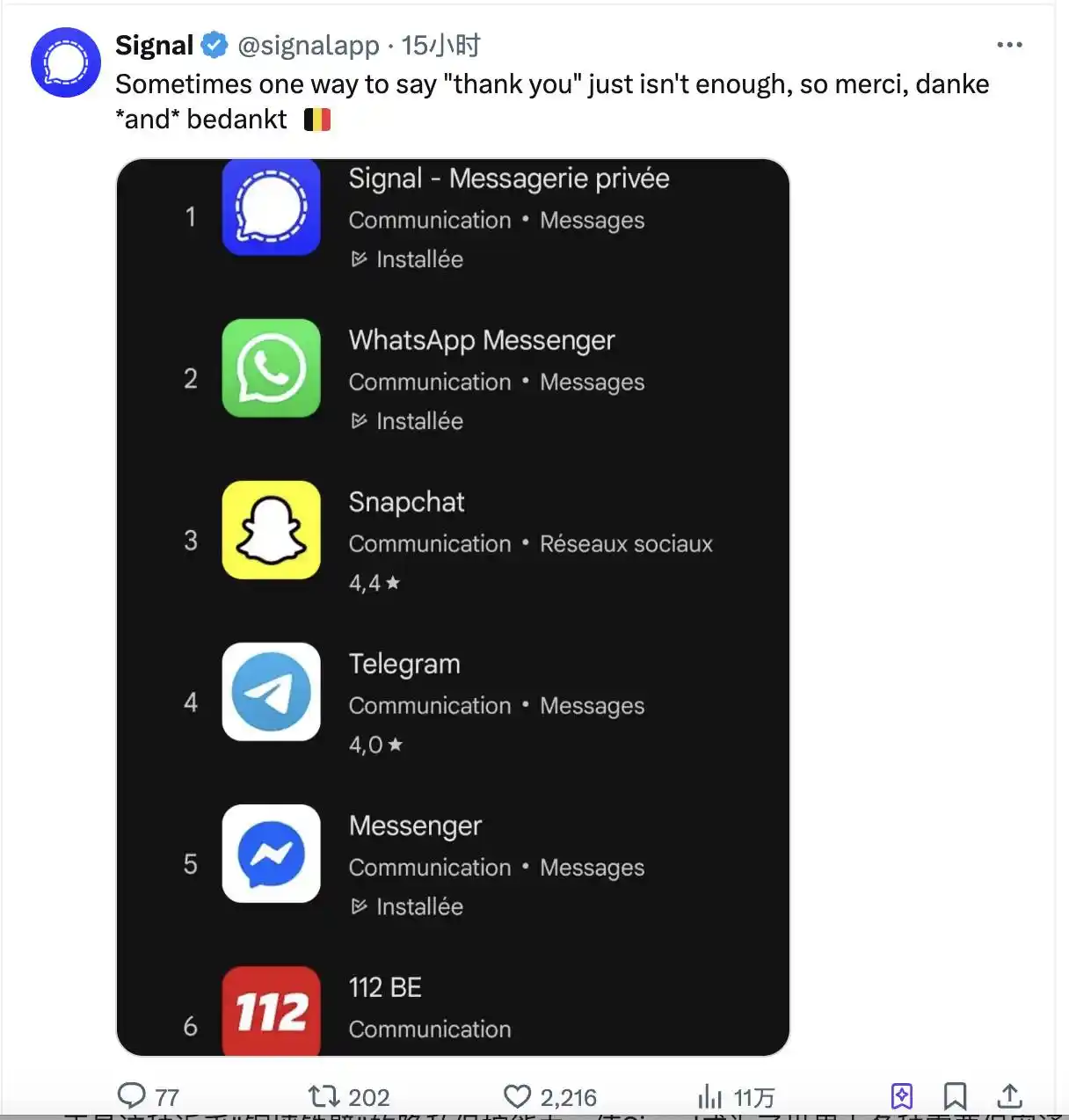
This event also brought Signal a lot of exposure, with Signal's Android app download surpassing that of WhatsApp and briefly ranking first. The official Signal account posted saying: Sometimes simply saying "thank you" in one language isn't enough, so merci, danke, and bedankt (note: thank you in other languages).
Signal's core strength lies in its advanced end-to-end encryption technology, where all communication content (including text, voice, video, and emojis) can only be deciphered by the sender and the receiver. Even if communication is intercepted, eavesdroppers can only see meaningless strings.
This encryption mechanism is so strong that even Signal itself cannot read users' communication content, does not collect metadata, does not store call records, and does not perform cloud backups, fundamentally eliminating the possibility of data leaks.
It is this nearly "impregnable" privacy protection capability that has made Signal the preferred tool for various individuals requiring secure communication worldwide.
From journalists, human rights activists, and political dissidents to many sensitive-position individuals, Signal is relied upon to safeguard their communication security. In Latin America, there are activists helping women seek abortion rights, defectors evading spies, lawyers from national bar associations, leaders of the "Black Lives Matter" movement, and even former ISIS members—all finding a new user base on Signal, including high-ranking officials from the Trump administration.
When the U.S. government and its adversaries are all "working remotely" on the same communication platform, there is a cyberpunk-esque absurdity: those wielding immense power are using a tool created by an anarchist to exercise their authority.
This anarchist's name is Moxie Marlinspike.
The Most Interesting Person in the World
Signal's founder Moxie Marlinspike is a legendary and mysterious figure in the tech world.
This cryptography genius, whose real name is Matthew Rosenfeld, not only created the world's most secure communication software but also led an incredibly adventurous life, earning the title of "one of the most interesting people on Earth" by Snowden.
Marlinspike grew up in central Georgia, showing dissatisfaction with conventional education and a talent for technology from a young age. He despised the mundane tasks that stifled curiosity in school but found the joy of programming on a rudimentary computer in the school library that had no hard drive and couldn't even save code.
Before the age of ten, he discovered the hacker classic magazine 2600 in a local bookstore, starting his hacker journey. When his mother bought him a cheap desktop computer, the young Marlinspike could already set up "ambushes" on his friends' computers, making messages suddenly appear on the screen to startle them.
In 1999, filled with a yearning for the cyberpunk world, Marlinspike moved to Silicon Valley after high school graduation, only to find that it was a far cry from the future world depicted in William Gibson's novels, with only "office parks and highways."
He soon found a programming job at WebLogic but grew tired of the "40 hours a week in front of a keyboard" life that came with entering the tech industry. Over the next few years, Marlinspike lived a nearly punk lifestyle in the San Francisco Bay Area—from squatting in abandoned buildings to moving into an old post office warehouse, participating in political protests, and reading works by anarchist theorists like Emma Goldman.
These experiences during this period profoundly shaped his critical thinking towards authority.
Unwilling to lead a mundane life, Marlinspike's life was full of incredible adventures.
He once rode a bicycle through San Francisco carrying a 40-foot sailboat mast; self-taught to fly a hot air balloon but crashed in the desert, leading to a month of crutch-assisted recovery; and even had friends witness his miraculous performance of playing rock-paper-scissors for high stakes without ever losing.
In 2003, he decided to learn sailing, spent all his savings on buying a run-down 27-foot Catalina sailboat, and then set off alone from the San Francisco harbor to Mexico, achieving self-taught mastery through repeated trials along the way.
The following year, he even filmed the DIY sailboat documentary Hold Fast, documenting his adventure with three friends sailing a leaky "plague ship" from Florida to the Bahamas, eventually abandoning ship in the Dominican Republic.
Perhaps it is this pursuit of freedom and questioning of authority that led Marlinspike to create Signal.
In 2010, he launched TextSecure (Signal's precursor), beginning his revolutionary work in the field of encrypted communication. In 2015, when Snowden first met Marlinspike in Moscow, he described the cryptographer as "hilarious, awesome, incredibly fun, wild."
Marlinspike has always maintained a high regard for personal privacy, rarely discussing his own personal life, including his age, hometown, or even his real name. This dedication to privacy is also reflected in Signal, the communication tool he created—a tool that does not collect user data, does not store communication records, and is fully end-to-end encrypted.
Unlike many tech founders, Marlinspike is not driven by commercial success. The Signal Foundation operates as a non-profit organization, primarily funded by donations, including an initial $50 million donation from WhatsApp co-founder Brian Acton.
Signal Meets Cryptocurrency, FTX Loses Hundreds of Millions
As a staunch anarchist and privacy advocate, Marlinspike also intersects with cryptocurrency.
The decentralization, censorship resistance, and privacy protection features of cryptocurrencies like Bitcoin align philosophically with Marlinspike's original intent in creating Signal—to provide people with a communication tool that is free from government or corporate surveillance. Both stem from the cypherpunk movement, seeking to protect individual freedom and privacy through cryptographic technology.
In April 2021, the Signal mobile app announced the integration of the privacy-focused payment project MobileCoin, enabling payments with MobileCoin. Following this announcement, the MOB token saw a sustained surge with a 6x increase in 14 days and an 8x increase in 30 days.
The reason behind the surge was later exposed when an FTX customer engaged in heavy leveraged trading on MobileCoin (MOB), causing the coin price to skyrocket from $6 to nearly $70 at its peak and leveraging their large positions for collateralized lending.
However, the MOB price quickly retraced to pre-surge levels, leading Alameda, a market maker also owned by FTX founder SBF, to intervene to protect FTX's liquidity, resulting in Alameda bearing losses of hundreds of millions of dollars.
The integration of MobileCoin into Signal has also sparked significant controversy. Reports have indicated that Marlinspike previously served as a technical advisor to MobileCoin and may hold a significant amount of the coin. This has led some users to question whether Signal is deviating from its nonprofit origins and turning towards a commercialization path.
In response to this, Marlinspike stated that Signal chose MobileCoin because it offers the best privacy protection and user experience, rather than out of personal interest.
Despite his strong ties to cryptocurrency, Marlinspike is also a critic of cryptocurrency.
In early 2022, he published a widely circulated article on his personal blog titled "My first impressions of web3," questioning the decentralization promises of Web3 and blockchain technology.
He pointed out that while blockchain protocols themselves are decentralized, the way users access these protocols is often highly centralized, such as relying on wallets like MetaMask and infrastructure services like Infura.
Marlinspike also conducted an experiment: he listed an NFT that would change its appearance based on where you viewed it from. When browsing on OpenSea or Rarible, it appeared as artwork; but after purchasing and viewing it from a wallet, it showed an emoji of poop!
Subsequently, this NFT was inexplicably taken down by OpenSea, leaving him speechless. What's more, after the NFT was delisted, the NFT he had in his wallet (which he purchased himself) also disappeared!
Marlinspike believes that a truly decentralized system should be one where people "can participate directly in a system without requiring any third-party permission or mediation."
Ethereum founder Vitalik Buterin quickly responded to this article on Reddit, broadly agreeing with Marlinspike's points and considering it a fair critique of the current situation. However, he also mentioned that there are many developers and researchers looking to use cryptography to improve the entire ecosystem and realize the decentralization ideal.
The current trend towards centralization is mainly because it is a simpler and quicker approach, while the slower development towards decentralization is due to a lack of technical resources and funding, along with encountering various technical challenges along the way. However, most of the major challenges have now been overcome, so Vitalik remains optimistic about the future development.
Although Marlinspike does hold some criticisms of cryptocurrency, the story of Signal intertwined with the world of cryptocurrency continues, both sharing a mission to protect user privacy and resist centralised control.
In this era of constant struggle between encryption and decryption, privacy and surveillance, Signal has become a unique presence—it is both a symbol of resistance and a tool of power; both a fortress of privacy and a stage for unexpected leaks.
Signal, this ship, carries passengers of all kinds, from government officials to anarchists, from cryptocurrency enthusiasts to regular users, sailing towards a more chaotic future.
You may also like

Predicting the market does not predict the truth; it simply rewards those who guess right

Delphi Digital's Top 10 Predictions for 2026: Perp DEX Eats Wall Street, AI Agents Usher in Era of Autonomous Trading

X Pulls the Plug — the Era of “Talking Your Way to Traffic” Comes to an End.
Other people’s traffic will always belong to them—not to you.

First Zero, First Revival: A Real Story from the WEEX Global AI Trading Hackathon Preliminary Round
WEEX Labs, the innovation arm of the global crypto exchange WEEX, launched the preliminary round of its flagship AI trading hackathon, AI Wars: WEEX Alpha Awakens, on January 12, 2026. Backed by world-class sponsors including AWS, the prize pool has reached $1.88 million, with a Bentley Bentayga S awaiting the champion in Dubai. Already, 788 elite teams worldwide are battling for a spot in the finals. This is more than a hackathon — it is a real-market stress test for AI trading. Registration remains open until January 18. If you want your AI to face real volatility, this is your moment.

AI Wars: WEEX Alpha Awakens – Insights, Top Strategies, and Real-Market Execution Takeaways
WEEX Labs has officially launched the preliminary round of its global AI trading hackathon, AI Wars: WEEX Alpha Awakens, bringing together hundreds of elite teams to compete in real-market conditions. With a record-breaking $1.88 million prize pool and backing from top-tier sponsors like AWS, the event has quickly become a global proving ground for AI-powered trading strategies. As competition intensifies and standout teams emerge on the leaderboard, the hackathon not only showcases cutting-edge AI execution and risk management, but also offers valuable insights and inspiration for traders looking to build or refine their own AI-driven systems.

WEEX P2P now supports Polish zloty (PLN)—new users and merchant rewards
To make crypto deposits easier, WEEX has officially launched its P2P trading platform and continues to expand fiat support. We're excited to announce that the Polish Zloty (PLN) is now available on WEEX P2P!

Layoffs of 30%, But Spending $250 Million to Buy a Company - What Is Polygon Thinking?

Sentient Reveals Tokenomics, How Will the Market Price It?

AI in the Crypto Market: How Artificial Intelligence is Changing Trading Strategies
This article explores how AI contributes to these movements and share practical strategies to help you navigate an AI-powered crypto market.
Yen Weakness Nears Inflation Red Line: Bank of Japan May Be Forced to Hike Early

Cross-chain Collaboration: Tom Lee Invests $200 Million, Joins Forces with Global Top Streamer Mr. Beast

Interactive Brokers Integrates USDC, US Bank Questions Stablecoin, What's the Overseas Buzz?

Trump Waves Hand, Stirs Venezuela's Game Hurricane
The Genius Stopping Law: Why Did Coinbase Backpedal at the Eleventh Hour?

Fact Check: How Much Money Did the University of Chicago Lose in its Crypto Investment?

Rumor has it that Coinbase is set to acquire Farcaster, still an Acquihire.

VanEck Q1 Market Outlook: Long-Term Bullish on Cryptocurrency, Strong Gold Demand
In the span of a week, what does Twitter's continuous updating on the Coin Circle Plate reform and Musk's intentions mean?
Predicting the market does not predict the truth; it simply rewards those who guess right
Delphi Digital's Top 10 Predictions for 2026: Perp DEX Eats Wall Street, AI Agents Usher in Era of Autonomous Trading
X Pulls the Plug — the Era of “Talking Your Way to Traffic” Comes to an End.
Other people’s traffic will always belong to them—not to you.
First Zero, First Revival: A Real Story from the WEEX Global AI Trading Hackathon Preliminary Round
WEEX Labs, the innovation arm of the global crypto exchange WEEX, launched the preliminary round of its flagship AI trading hackathon, AI Wars: WEEX Alpha Awakens, on January 12, 2026. Backed by world-class sponsors including AWS, the prize pool has reached $1.88 million, with a Bentley Bentayga S awaiting the champion in Dubai. Already, 788 elite teams worldwide are battling for a spot in the finals. This is more than a hackathon — it is a real-market stress test for AI trading. Registration remains open until January 18. If you want your AI to face real volatility, this is your moment.
AI Wars: WEEX Alpha Awakens – Insights, Top Strategies, and Real-Market Execution Takeaways
WEEX Labs has officially launched the preliminary round of its global AI trading hackathon, AI Wars: WEEX Alpha Awakens, bringing together hundreds of elite teams to compete in real-market conditions. With a record-breaking $1.88 million prize pool and backing from top-tier sponsors like AWS, the event has quickly become a global proving ground for AI-powered trading strategies. As competition intensifies and standout teams emerge on the leaderboard, the hackathon not only showcases cutting-edge AI execution and risk management, but also offers valuable insights and inspiration for traders looking to build or refine their own AI-driven systems.
WEEX P2P now supports Polish zloty (PLN)—new users and merchant rewards
To make crypto deposits easier, WEEX has officially launched its P2P trading platform and continues to expand fiat support. We're excited to announce that the Polish Zloty (PLN) is now available on WEEX P2P!


 App
App