
- Buy Crypto
- Markets
- Futures
- Spot
- Copy Trade
 Earn
Earn- More
Tether, which has "enriched" itself through stablecoins, is now heavily investing in AI

Original Title: "AI Industry, Here Comes Cash-Rich Tether"
Original Author: Kuri, Deep Tide TechFlow
Tether earned $13 billion in 2024.
This number may not mean much to you. Let's put it another way: OpenAI had $3.7 billion in revenue in 2024 but lost $5 billion. Anthropic had $1 billion in revenue but also lost $5 billion.
The combined losses of these two reputable AI companies are still less than what Tether earned in a year.
Tether has 150 employees, while OpenAI has over 3000 employees. The difference in per capita output is approximately:
60 times.
How does Tether make money? You buy 1 USDT for $1, they take that $1 and buy US Treasury bonds. The bond interest goes to them, not you.
The essence of this is that Tether does not pay interest. Banks have to pay interest on deposits, but Tether doesn't. When you exchange your money for USDT, holding it, you earn zero interest. They take your money to buy US Treasury bonds, and in 2024 alone, they earned $7 billion in interest.
With 150 people overseeing over $130 billion in Treasury bonds, they don't have to do anything, as the interest comes in by itself.
Anybody would want to take it easy with such a business.
But when you have a lot of money, you have to spend it somehow. Tether chose a direction:
AI.
And it's not just about randomly investing in a couple of projects.
Let's talk about computational power first.
AI computation requires GPUs, the more, the better, and the more expensive, the better. Tether provided a loan of over $600 million to a German company, Northern Data.
What does this company do?
It's Europe's largest GPU cloud service provider. With over ten thousand Nvidia H100 GPUs, the same type used by OpenAI to train GPT, each costing two to three thousand dollars.
This cluster of GPUs ranks 26th in the world's TOP500 supercomputers. The $600 million that Tether poured in is essentially buying an AI training base in Europe.
Talking Data.
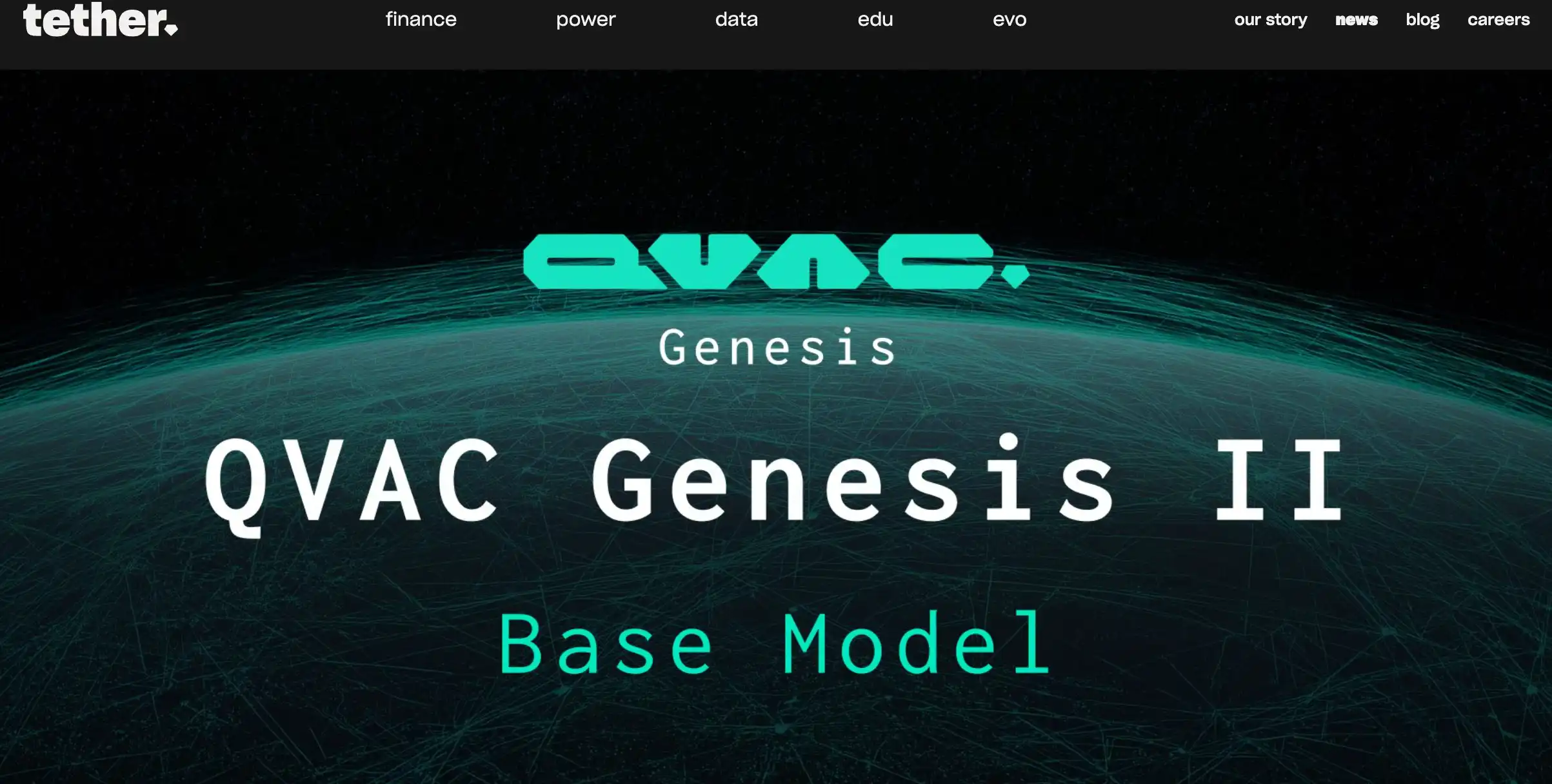
Training AI requires feeding data. Last week, Tether released a dataset called QVAC Genesis, covering 19 subjects including mathematics, physics, chemistry, and computer science. They claim it to be the world's largest open-source AI training data.
Note that the training data from OpenAI and Anthropic is not public, but Tether released theirs directly for free for anyone to use.
Now onto the more futuristic part.
In April 2024, Tether spent $200 million to acquire a company called Blackrock Neurotech. Despite the name similarities, it has no relation to BlackRock the asset manager.
This company works on brain-computer interfaces. They implant chips into people's brains, allowing paralyzed individuals to type with their mind, control wheelchairs, or operate robotic arms. It sounds like science fiction, but they started back in 2008, eight years before Musk's Neuralink.
How impressive is this company?
A total of 35 people globally have brain-computer interface chips, with 31 of them using Blackrock's technology. In 2016, a fully paralyzed patient controlled a robotic arm with their device and fist-bumped Obama. The chip in their sensory cortex allowed them to "feel" the President's hand.
Last year, this brain-computer interface company enabled an ALS patient to "speak" again, with the chip in their brain translating thoughts into speech at a rate of 62 words per minute.
Tether spent $200 million to become a major shareholder in this company.
Altogether, Tether has invested close to $1 billion in AI-related fields. It is said that they are also in talks to acquire a German robotics company for $1.2 billion. If successful, their total investment will approach $2 billion.
What does this mean?
Anthropic raised $35 billion in funding throughout 2024. The investment by Tether, from one company, is close to half of what a top-tier AI company raises.
OpenAI spent $6.7 billion on R&D in the first half of 2025. With the profits, Tether, with spare change, could play the role of a big daddy in the AI realm.
Why would a stablecoin issuer venture into AI?
We see two possibilities.
The first is anxiety. The Fed is cutting rates, bond yields are falling. Earning $7 billion in interest while lying down in 2024, things might not be as good from 2025 onwards. The money printer also needs a new narrative.
The second is ambition. The whole world is talking about AI—investors, the media, politicians. If you say you're a stablecoin company, no one pays much attention. But if you say you're working on AI, brain-machine interfaces, humanoid robots, then you are:
A technology leader.
But what's most amusing is this.
Tether is venturing into AI, chanting slogans like "decentralization," "on-device computation," and "returning intelligence to individuals."
But Tether, itself, is the most centralized company in the crypto world.
He decides when to issue coins, he decides the reserve amount. In its ten years of existence, it has never been audited. Only he knows where users' money is.
Now, this company wants to teach the world what "decentralized AI" means.
It's really quite like a casino owner offering classes on quitting gambling.
But it's not impossible.
After all, OpenAI is still losing money, projected to stop burning cash in 2029. Anthropic is in a similar situation, projected to break even in 2028. Sam Altman is fundraising everywhere, Dario Amodei is fundraising everywhere. These two companies together have lost $10 billion and are still storytelling to investors.
Tether doesn't need to do that. The money is already in his pocket.
What's the biggest challenge facing the entire AI industry? The business model.
How do you make money? Don't know. When will you make money? Don't know. Can you make money? Don't know.
Tether doesn't have this worry. His business model is simply:
Not doing AI.
The money earned from stablecoins is used to invest in AI. Making the right investment is foresight, making the wrong one is a tuition fee. In any case, it doesn't affect the core business.
Those doing AI are losing money, those not doing AI are making money. Those doing AI are fundraising, those not doing AI are investing.
The best AI business model in 2026 may be not doing AI at all.
Get your money printer right first.
You may also like

Error Prevented Content Extraction: Causes and Solutions
Key Takeaways Excessive requests can result in blocked access to data sources. Ensuring adherence to API usage policies…

80% of oil income settled in stablecoins, Venezuela makes USDT its second currency

After Stepping Down as Mayor of New York City, He Pivoted to Selling Cryptocurrency

AI Crypto Trading in 2026: How AI Assistants Are Reshaping Trading Platforms and Strategies
Learn how AI assistants support crypto trading decisions, improve risk awareness, and are becoming part of modern trading platforms and exchanges.

Life Candlestick Drama Escalates: Fund Established, 'Cyber Altruism Box' Feature Launched; Founder Denies Meme Coin Issuance

Dubai Bans Privacy Coins and Updates Stablecoin Regulations
Key Takeaways The Dubai Financial Services Authority (DFSA) has completely prohibited privacy tokens within the Dubai International Financial…

New Drag-to-Set TP/SL Candlestick Chart Feature on Web
Make risk management more intuitive and efficient! The WEEX web platform is introducing the "Drag-to-set TP/SL" feature.

Crypto Rich Threaten to Depart California Amid New Tax Proposal
Key Takeaways Proposed California tax imposes a 5% assets tax on residents with over $1 billion, sparking debate…

zkSync Price Forecast – ZK Value Anticipated to Decline to $0.026629 by January 15, 2026
Key Takeaways zkSync’s current price is $0.034635, with an anticipated drop to $0.026629 by mid-January 2026. The crypto…
South Korea to Lift Longstanding Ban on Corporate Crypto Investments
Key Takeaways South Korea is lifting a nine-year ban on corporate cryptocurrency investments, allowing firms to invest up…

Coinbase May Withdraw Support for CLARITY Act Amid Stablecoin Rewards Ban Debate
Key Takeaways Potential Withdrawal: Coinbase is considering withdrawing support for the CLARITY Act if it restricts stablecoin rewards.…

Crypto Crucial: Will Tax Threats Push California’s Wealthiest to Flee?
Crypto billionaires in California are contemplating relocation due to a proposed wealth tax targeting assets over $1 billion.…
Crypto Project Failures Hit Record in 2025 Amid Memecoin Turbulence
Key Takeaways Memecoin launchpads have saturated the crypto market in 2025, leading to an unprecedented number of token…

UK Backbenchers Committee Demands Total Ban on Crypto Political Contributions
Key Takeaways: A group of senior Labour MPs are advocating for a total ban on cryptocurrency donations to…
Powell States Federal Reserve Targeted by DOJ, Trump Dismisses Interest Rate Ties
Key Takeaways Federal Reserve Chair Jerome Powell revealed that the Justice Department issued subpoenas to the central bank…

Senate Agriculture Chair Considers Postponement of Crypto Bill Vote Amid Growing Bipartisan Discussions
Key Takeaways: Senate Agriculture Chair John Boozman considers delaying the upcoming vote on the cryptocurrency legislation as bipartisan…

AI Trading in 2026: Bitcoin, Ethereum, and the Shift Toward Changing Crypto Trading
In early 2026, AI has returned to the center of the crypto market — not as a short-lived narrative, but as part of trading infrastructure. AI-powered tokens continue to attract attention, while AI-assisted trading tools are increasingly embedded into exchanges, strategy platforms, and risk systems. For traders, the key question is no longer whether AI will be used, but how it changes execution, risk control, and decision-making in practice. Understanding this shift requires separating market narratives from the actual mechanics of AI-driven trading.

Old Order's Backlash: Market Predicted to Be 'Paused' in Tennessee
Error Prevented Content Extraction: Causes and Solutions
Key Takeaways Excessive requests can result in blocked access to data sources. Ensuring adherence to API usage policies…
80% of oil income settled in stablecoins, Venezuela makes USDT its second currency
After Stepping Down as Mayor of New York City, He Pivoted to Selling Cryptocurrency
AI Crypto Trading in 2026: How AI Assistants Are Reshaping Trading Platforms and Strategies
Learn how AI assistants support crypto trading decisions, improve risk awareness, and are becoming part of modern trading platforms and exchanges.
Life Candlestick Drama Escalates: Fund Established, 'Cyber Altruism Box' Feature Launched; Founder Denies Meme Coin Issuance
Dubai Bans Privacy Coins and Updates Stablecoin Regulations
Key Takeaways The Dubai Financial Services Authority (DFSA) has completely prohibited privacy tokens within the Dubai International Financial…


 App
App