
- Buy Crypto
- Markets
- Futures
- Spot
- Copy Trade
 Earn
Earn- More
Preliminary Round Participant Insights — AOT Matrix: Left-Brain Analysis, Right-Brain Decisions in AI Trading


Opening
In the WEEX AI Trading Hackathon, AOT Matrix chose a more cautious path in system design — one that’s actually harder to pull off in a live trading environment.
From the very start, they made clear choices about what role AI should and shouldn’t play in the trading system.
We interviewed AOT Matrix about their decision-making logic, the multiple iterations of their system architecture, and what it’s like to implement it under WEEX’s real trading environment and engineering constraints.
Q1. In AI trading, most people’s first instinct is “let AI place orders.” Why did you dismiss this idea from the start?
AOT Matrix:
Because crypto markets are inherently unstable.
Price distributions shift, volatility structures break, and historical patterns often fail when it matters most. Letting AI execute buy or sell orders directly would turn any model mismatch into immediate real losses.
Based on that, in the very first week we ruled out two common approaches: using AI as an automated trading bot, or letting it generate trading signals directly.
Instead, we chose to have AI answer a more restrained but far more critical question: is this the right environment to trade right now?
Q2. During the preparation phase, what system architecture did you initially experiment with?
AOT Matrix:
At first, we tried a hybrid setup: AI signals direction, and the rule-based system executes.
But during backtests and simulations, issues became clear: the stability of AI signals varied greatly across different market phases.
As soon as market structure shifted, the reliability of those signals dropped significantly.
We later realized the problem wasn’t the model accuracy — it was the very division of responsibilities.
Q3. How did you redefine the roles of AI and trading decision-making?
AOT Matrix:
After several iterations, we finalized a “left brain / right brain” system structure.
AI resides in the “left brain,” responsible solely for analysis and not for making trading decisions.
Its job is to assess market conditions — trending, ranging, high-risk scenarios, or whether trading should be paused — while providing a confidence score for the environment. It doesn’t predict exact prices or place orders.
Actual trading decisions are handled by the “right brain,” a rule-based system managing trade permissions, position sizing, and leverage controls.
Every trade must be auditable and replayable — a hard requirement we set for ourselves at the WEEX AI Hackathon.
Q4. During preparation, how challenging was it to translate trading experience into AI-readable input?
AOT Matrix:
Extremely challenging. Traders’ experience is often intuitive, but AI requires structured information.
So instead of just adding more data, we broke the logic down. We split trading logic into three types: market structure, volatility state, and risk conditions. AI learns and outputs only these intermediate states.
This way, AI no longer predicts future prices; it focuses on answering whether the current environment is healthy and suitable for trading.
Given the short preparation time, we believed this was a safer and more practical approach.
Q5. When integrating the WEEX API and moving from simulation to live trading, what unexpected challenges came up?
AOT Matrix:
Most challenges were engineering-related. We initially completed basic authentication and order submission via the WEEX API, but in live trading, we quickly realized that “being able to place orders” doesn’t guarantee long-term system stability.
Network jitter, request timeouts, and multi-strategy execution issues surfaced gradually during both simulations and live tests.
To fix this, we made systematic engineering upgrades, including:
- Full-chain trace IDs for order-level tracking
- Idempotent order controls to prevent duplicate executions
- Asynchronous queues and order status reconciliation to enhance system recovery under anomalies
This phase was a critical step in turning a demo into a system capable of long-term operation.
Q6. You put a lot of effort into recording trading decisions and executions. What was the reasoning behind this?
AOT Matrix:
In live trading, any trade that can’t be explained will eventually become a source of risk.
Therefore, we require that every order can answer three questions: Why was it opened at that moment? What did the system judge the market environment to be? Would the same decision hold if conditions repeated?
The system fully records AI assessments of market conditions, the rationale behind decision execution, and the final trade outcome.
The goal isn’t to complicate things, but to ensure all trades are traceable, replayable, and reviewable — what we call “full-chain auditability.”
Q7. While preparing for the WEEX AI Trading Hackathon, what has been your biggest insight about AI trading?
AOT Matrix:
Three main insights.
First, AI in trading is not meant to replace humans, but to constrain them.
It’s better at curbing emotional decisions and spotting untradeable environments than chasing “bigger returns.”
Second, system stability often matters more than model precision.
A system that looks perfect in backtests but fails live simply turns its technical edge into risk exposure.
Third, interpretability is critical for long-term survival.
Only if every P&L can be understood and reviewed can the system be fixed after drawdowns, rather than being scrapped and rebuilt.
Closing
For AOT Matrix, the WEEX AI Trading Hackathon isn’t just a model competition — it’s a comprehensive test of system design, engineering, and risk awareness.
Their architecture is the product of continuous validation, adjustments, and convergence under WEEX’s live trading conditions and engineering constraints.
And this is exactly the process AI trading must go through to move from concept to a sustainable, long-term tool.
You may also like

After Stepping Down as Mayor of New York City, He Pivoted to Selling Cryptocurrency

AI Crypto Trading in 2026: How AI Assistants Are Reshaping Trading Platforms and Strategies
Learn how AI assistants support crypto trading decisions, improve risk awareness, and are becoming part of modern trading platforms and exchanges.

Life Candlestick Drama Escalates: Fund Established, 'Cyber Altruism Box' Feature Launched; Founder Denies Meme Coin Issuance

Dubai Bans Privacy Coins and Updates Stablecoin Regulations
Key Takeaways The Dubai Financial Services Authority (DFSA) has completely prohibited privacy tokens within the Dubai International Financial…

UK Backbenchers Committee Demands Total Ban on Crypto Political Contributions
Key Takeaways: A group of senior Labour MPs are advocating for a total ban on cryptocurrency donations to…
Powell States Federal Reserve Targeted by DOJ, Trump Dismisses Interest Rate Ties
Key Takeaways Federal Reserve Chair Jerome Powell revealed that the Justice Department issued subpoenas to the central bank…

Senate Agriculture Chair Considers Postponement of Crypto Bill Vote Amid Growing Bipartisan Discussions
Key Takeaways: Senate Agriculture Chair John Boozman considers delaying the upcoming vote on the cryptocurrency legislation as bipartisan…

AI Trading in 2026: Bitcoin, Ethereum, and the Shift Toward Changing Crypto Trading
In early 2026, AI has returned to the center of the crypto market — not as a short-lived narrative, but as part of trading infrastructure. AI-powered tokens continue to attract attention, while AI-assisted trading tools are increasingly embedded into exchanges, strategy platforms, and risk systems. For traders, the key question is no longer whether AI will be used, but how it changes execution, risk control, and decision-making in practice. Understanding this shift requires separating market narratives from the actual mechanics of AI-driven trading.

Old Order's Backlash: Market Predicted to Be 'Paused' in Tennessee

Trump Gets Serious: Powell Faces Criminal Investigation, Rate Battle Intensifies

WEEX × LALIGA Partner to Bring Professional Discipline From Football to Crypto Trading
As an official regional partner of LALIGA, WEEX highlights seven outstanding players who embody the league’s competitive spirit and global appeal. Each brings a unique style to the pitch, yet all share values that closely align with WEEX’s commitment to stability, precision, and professional execution. This partnership is built on shared standards — where consistency and control define performance under pressure.

Crypto and AI: the hidden digital gray market of Xianyu
Crypto and AI: You Can Buy Anything on Xianyu.

What’s Driving Crypto Markets in Early 2026: Market Swings, AI Trading, and ETF Flows?
Imagine checking Bitcoin and Ethereum prices in a day — one minute up 5%, the next down 4%. Sharp moves, quick reversals, and sensitivity to macro signals marked the first week of 2026. After an early-year rally, both assets pulled back as markets recalibrated expectations around U.S. monetary policy and institutional flows. For traders — including those relying on AI or automated systems — this period offered a vivid reminder: abundant signals do not guarantee clarity. Staying disciplined in execution is often the real challenge.
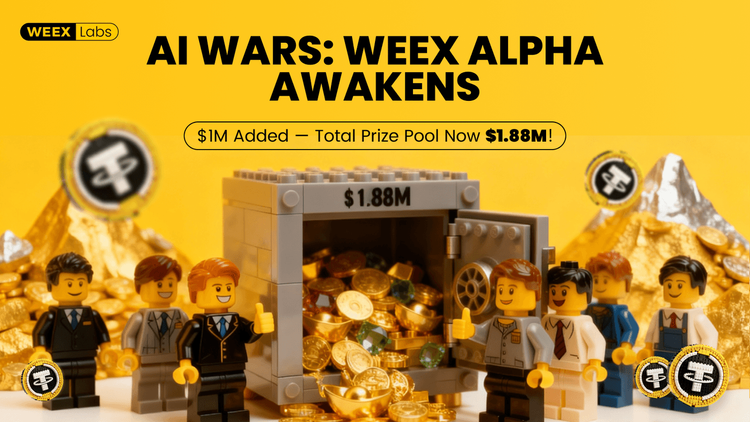
WEEX Global AI Trading Hackathon Kicks Off: $1.88M Prize Pool Powers the Next Generation of AI Trading Champions
WEEX Labs, the innovation arm of WEEX, a leading global crypto exchange serving over 6.2 million users across 150+ countries, is set to kick off the preliminary round of its flagship global AI trading hackathon, AI Wars: WEEX Alpha Awakens, on January 12, 2026. Backed by the strong support of world-class sponsors including Amazon Web Services (AWS), the total prize pool has surged from $880,000 to an unprecedented $1,880,000, positioning AI Wars among the largest AI trading hackathons in the crypto industry. At the top of the leaderboard awaits an extraordinary champion prize — a Bentley Bentayga S, already on standby in Dubai, ready to be claimed by the ultimate AI trading victor.

2025 Market Prediction Retrospective: Total Transaction Volume Exceeds $50 Billion, Duopoly Market Share Exceeds 97.5%
Pentagon Pizza Index Soars 1250%: Who Will Be the Next Venezuela?

From Theory to Live Markets: AOT Matrix’s Dual-Brain System in WEEX AI Trading Hackathon
In crypto markets — one of the most unforgiving non-stationary systems — strategy failure is rarely caused by models being too simple. It happens because most strategies are never truly exposed to live-market pressure. This is exactly the problem WEEX AI Trading Hackathon is designed to surface — shifting the focus from theoretical innovation to real deployability, real execution, and real performance. Among the participating teams, AOT Matrix stood out with advanced AI-driven quantitative capabilities. Through its V4.4 dual-brain architecture, the system achieved end-to-end optimization — from core logic to execution — reflecting the platform’s dual emphasis on innovation and real-world performance.
Predicting Contrarian Buy Pressure in the Market: Who is Taking the Other Side of Your Trade?
After Stepping Down as Mayor of New York City, He Pivoted to Selling Cryptocurrency
AI Crypto Trading in 2026: How AI Assistants Are Reshaping Trading Platforms and Strategies
Learn how AI assistants support crypto trading decisions, improve risk awareness, and are becoming part of modern trading platforms and exchanges.
Life Candlestick Drama Escalates: Fund Established, 'Cyber Altruism Box' Feature Launched; Founder Denies Meme Coin Issuance
Dubai Bans Privacy Coins and Updates Stablecoin Regulations
Key Takeaways The Dubai Financial Services Authority (DFSA) has completely prohibited privacy tokens within the Dubai International Financial…
UK Backbenchers Committee Demands Total Ban on Crypto Political Contributions
Key Takeaways: A group of senior Labour MPs are advocating for a total ban on cryptocurrency donations to…
Powell States Federal Reserve Targeted by DOJ, Trump Dismisses Interest Rate Ties
Key Takeaways Federal Reserve Chair Jerome Powell revealed that the Justice Department issued subpoenas to the central bank…


 App
App