
- Buy Crypto
- Markets
- Futures
- Spot
- Copy Trade
 Earn
Earn- More
**Military Lockdown Shakes Up South Korean Crypto Market: $33 Billion Sell-Off Wave and Native Project Exoduses**

Original Article Title: Martial law in South Korea and the crypto market outlook
Original Source: Tiger Research Reports
Original Translation: Deep Tide TechFlow
Key Points Summary:
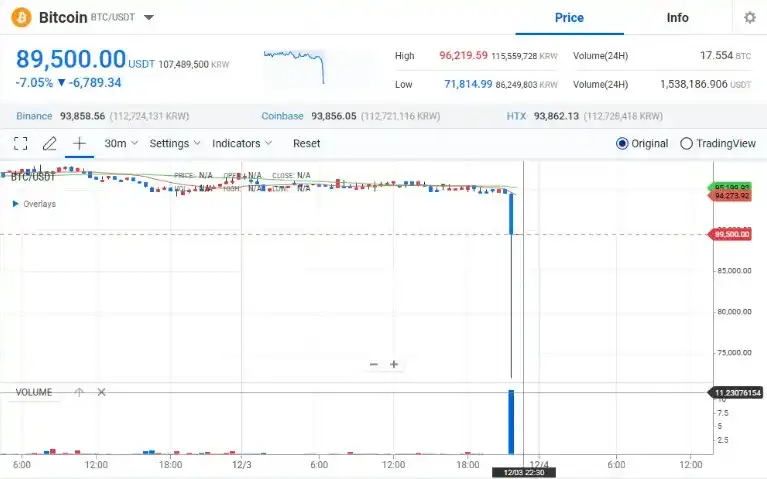
· Market Volatility: The announcement of martial law triggered a massive sell-off on South Korean cryptocurrency exchanges, with a total sell-off amounting to around 33.3 billion USD. The price of Bitcoin dropped to 62,300 USD, with the local market recording the highest trading volume globally at one point.
· Investor Exodus: Due to price fluctuations and system failures in local exchanges, South Korean investors are expected to pivot to overseas exchanges and DeFi platforms.
· Industry Contraction: Political instability is prompting South Korean blockchain projects to move overseas. Key legislation, such as the Virtual Asset User Protection Law, may be delayed as a result.
1. Introduction

Source: Yonhap News
Last night, President Yoon Suk-yet suddenly announced and lifted martial law, causing a shock to South Korea's cryptocurrency market. Bitcoin's price on South Korea's largest exchange Upbit dropped to 62.3K USD. Upbit and Bithumb, the two major South Korean exchanges, saw 24-hour trading volumes of 26.9 billion USD and 6.4 billion USD, respectively, reaching their highest levels this year. This reflects the large-scale sell-off by South Korean investors following the declaration of martial law. During this period, South Korean exchanges briefly became the highest-volume market globally, highlighting the extreme volatility of its market.
2. Decline in Trust in the Won Assets and Rise in Cryptocurrency Demand

The martial law event severely eroded trust in won-denominated assets. With foreign capital exiting, the stock and bond markets may become even more volatile. As a result, investors are gradually shifting their focus to decentralized assets such as cryptocurrency.
Against the backdrop of rising geopolitical risks, investors are turning to cryptocurrency to protect their assets. Major cryptocurrencies like Bitcoin are garnering attention for being beyond government control. In past crises such as the Hong Kong protests and the Russia-Ukraine conflict, cryptocurrency has been seen as a safe-haven asset.
3. The Double-Edged Sword of Stringent Regulation and the Acceleration of Exchange Exodus
South Korean cryptocurrency exchanges maintain high security through strict travel rules and KYC regulations. The enactment of designated financial transaction information reporting and usage laws has strengthened anti-money laundering (AML) measures and enhanced investor protection. These efforts have positioned South Korea as a leader in regulatory compliance.
Source: Upbit
However, the market crash revealed the double-edged sword effect of stringent regulation. The strict rules have sustained a Kimchi Premium, widened the price gap with global markets, and made it difficult for investors to make rational decisions.
The significant price fluctuations and system instability of local exchanges have eroded investor trust. With overnight trading volumes reaching $33.3 billion, servers of Upbit and Bithumb experienced crashes. Unlike overseas exchanges, this instability has made local exchanges appear unreliable.
These issues are expected to accelerate South Korean investors' shift to overseas exchanges and DeFi platforms. Binance and Coinbase provide a stable trading environment and diverse financial products, making them the preferred choice for South Korean investors.
4. Acceleration of South Korean Blockchain Project Exodus
Due to political instability, the investment environment for South Korean blockchain projects has been affected. Many large projects have already moved overseas, and this trend is expected to continue. Nexon's blockchain division Nexpace has relocated to Abu Dhabi, Klaytn and LINE Finschia's Kaia Foundation have moved to Singapore, and Wemade's Wemix has shifted to Dubai. These companies have chosen blockchain-friendly countries to avoid South Korea's regulatory uncertainty and political risk. More projects are expected to move to Singapore and the UAE, where regulations remain clear and stable.
The overseas migration of blockchain startups has raised concerns about talent drain. This trend could weaken South Korea's competitiveness in the blockchain field. Against the backdrop of rapid development in Web3 and blockchain technology, talent outflow may have a long-term negative impact on South Korea's technological advantage. This brain drain has intensified the industry's sense of crisis.
Furthermore, the impeachment issue may delay the progress of key legislation. Laws such as the Virtual Asset User Protection Act currently being discussed in the National Assembly may face delays. These delays could further hinder the institutionalization process of South Korea's cryptocurrency market.
5. Conclusion
The martial law incident exposed structural weaknesses in the South Korean cryptocurrency market. Overnight, $333 billion in value vanished from sight, with major exchanges’ servers crippled. The market experienced extreme price volatility, with significant price discrepancies compared to global exchanges. These events underscored political risks in the market and the fragility of the current trading system under pressure.
In the short term, market instability is expected to persist. However, with appropriate institutional improvements and system enhancements, this crisis could also serve as a turning point. These efforts will help strengthen the stability of the South Korean cryptocurrency ecosystem and drive its globalization. The future trajectory is worth close monitoring.
You may also like

Alibaba Backed Latin America Stablecoin Company, Why VelaFi?

AI Crypto Trading in 2026: How AI Agents Use Stablecoins for Capital Management and Settlement
Learn how AI agents use stablecoins for crypto trading in 2026 — managing capital, settling transactions, and operating across exchanges and DeFi protocols.

US Senate Agriculture Committee Schedules January 27 for Crypto Market Structure Hearing
Key Takeaways The Senate Agriculture Committee will release its crypto market structure bill on January 21, followed by…

Key Market Information Discrepancy on January 14th – A Must-See! | Alpha Early Report
Key Takeaways Bitcoin reached a new milestone, hitting $96,000, while Ethereum surpassed $3,300. Privacy coins such as ORDI…

Tether Freezes $182 Million in Assets in a Day: Is USDT Still a Neutral Coin?
Key Takeaways Tether recently froze $182 million in USDT across five wallets on the Tron blockchain, raising questions…

A Developer’s Three-Year Gamble on Base and the Turn Towards Solana
Key Takeaways: Base’s promise to support developers fell short, leading many to seek more supportive ecosystems. Developer frustration…

ETHGas Foundation Coin Issuance: Examining the Emotional Transaction Mechanism and Global Insights
Key Takeaways Zama’s token auction on CoinList is polarizing, showcasing potential for future applications amidst short-term market skepticism.…

a16z Secures $15 Billion: Redefining Venture Capital Through Visionary Storytelling
Key Takeaways a16z Raises Capital: The firm has raised an astronomical $15 billion, marking a significant point in…

Founder of DeepSeek’s Magic Square Quantitative Strategy Achieved a 56.55% Return in 2025
Key Takeaways Huansquare Quant, led by Liang Wenfeng, achieved a 56.55% return in 2025. The fund’s assets under…
Analyst: MSTR is the “Mullet” of this Bitcoin Bull Cycle, Acting as a Bitcoin Pressure Relief
MSTR absorbed significant volatility in this Bitcoin cycle, easing potential pressure on Bitcoin itself. Michael Saylor’s strategic issuance…

XMR Surges Over 50% in One Week: Who’s Buying?
Key Takeaways Monero (XMR) defies regulatory pressures, marking a 262% increase since January 2025, reaching an all-time high…

BitGo’s Revenue Surges with Upcoming IPO as Institutional Interest Grows
Key Takeaways BitGo, a major player in cryptocurrency custody, aims to raise $201 million through a U.S. IPO…
The New Era in Bitcoin Core Development: The Rise of Core Maintainer TheCharlatan
Key Takeaways Integration of a New Maintainer: For the first time in three years, a new Bitcoin Core…

Bitwise CIO Predicts Parabolic Bitcoin Surge with Sustained ETF Demand
Key Takeaways Prolonged demand for Bitcoin ETFs may lead to a parabolic rise in Bitcoin’s price, drawing parallels…

Binance Alpha to Launch Empire of Sight (Sight) on January 14
Key Takeaways Binance Alpha will kick off the trading of Empire of Sight (Sight) at 16:00 (UTC+8) on…
Today’s Trump Tariff Decision and Economic Data Releases
Key Takeaways The U.S. Supreme Court is set to rule on a significant Trump tariff case that could…

Binance Wallet Partners with Aster, Launches Seamless On-chain Perpetual Contract Trading
Key Takeaways: Binance Wallet has integrated with Aster to offer a streamlined and stable perpetual contract trading feature…
Final Federal Reserve Chair Candidate Rick Rieder, How He Views Cryptocurrency
Key Takeaways Rick Rieder stands out among the Federal Reserve Chair candidates due to his strong pro-crypto stance,…
Alibaba Backed Latin America Stablecoin Company, Why VelaFi?
AI Crypto Trading in 2026: How AI Agents Use Stablecoins for Capital Management and Settlement
Learn how AI agents use stablecoins for crypto trading in 2026 — managing capital, settling transactions, and operating across exchanges and DeFi protocols.
US Senate Agriculture Committee Schedules January 27 for Crypto Market Structure Hearing
Key Takeaways The Senate Agriculture Committee will release its crypto market structure bill on January 21, followed by…
Key Market Information Discrepancy on January 14th – A Must-See! | Alpha Early Report
Key Takeaways Bitcoin reached a new milestone, hitting $96,000, while Ethereum surpassed $3,300. Privacy coins such as ORDI…
Tether Freezes $182 Million in Assets in a Day: Is USDT Still a Neutral Coin?
Key Takeaways Tether recently froze $182 million in USDT across five wallets on the Tron blockchain, raising questions…
A Developer’s Three-Year Gamble on Base and the Turn Towards Solana
Key Takeaways: Base’s promise to support developers fell short, leading many to seek more supportive ecosystems. Developer frustration…


 App
App