
- Buy Crypto
- Markets
- Futures
- Spot
- Copy Trade
 Earn
Earn- More
In 2026, Will ICOs Replace Airdrops?

Original Article Title: Will ICOs Replace Airdrops in 2026?
Original Article Author: blocmates
Original Article Translation: Luffy, Foresight News
If you have been active in the cryptocurrency market recently, you may have noticed a trend: the airdrop craze is gradually fading away, initial coin offerings (ICOs) are making a strong comeback, and the market is transitioning from a venture capital-dominated funding model to decentralized fundraising.
ICOs are not a new phenomenon; some of the most popular cryptocurrencies in the field (such as Ethereum, Augur) have completed their initial issuance through ICOs. However, we must acknowledge that after enduring a long "silent period" from 2022 to 2024 (during which project funding was mostly done through closed-door venture capital deals), ICOs saw a strong resurgence in 2025.
Why Did ICOs Make a Comeback?
One argument for the renewed support for ICO-style fundraising is that since the first ICO boom from 2014 to 2018, the number of cryptocurrency participants has more than tripled, with a compound annual growth rate of 4.46%, and the average participant's level of expertise has significantly increased. Coupled with the increased supply of stablecoins, this has naturally expanded the available funding pool and made more people willing to purchase discounted tokens before a token generation event (TGE).
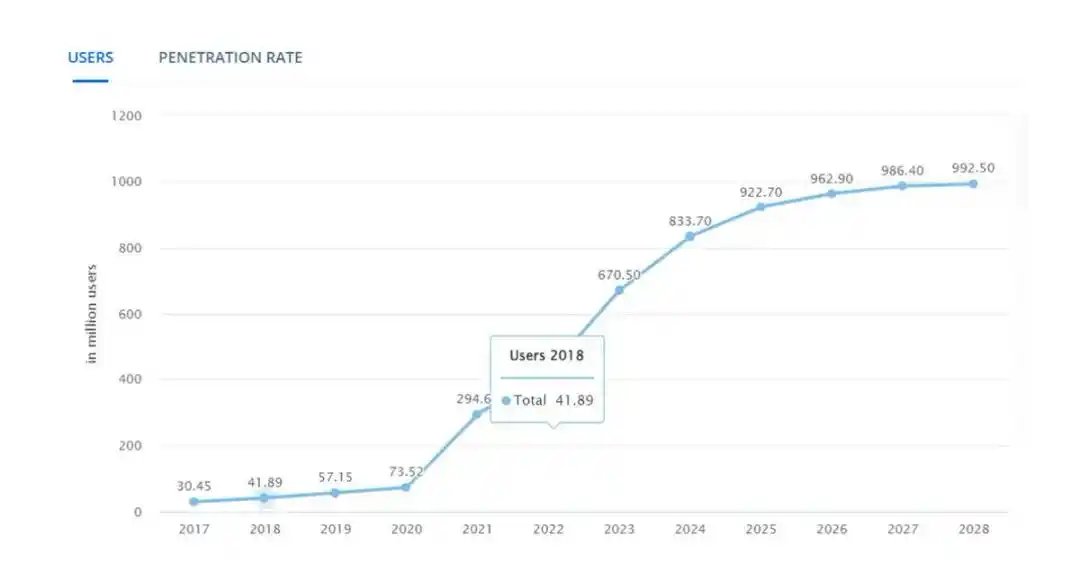
Although this argument is compelling, the increase in market participants is not the primary driver of the ICO mechanism's resurgence. To find the core reasons for this revival, we need to examine the inherent flaws in the current funding model.
A closer look at the market cycle from 2022 to 2024 reveals that many projects raised funds from venture capital funds at low fully diluted valuations (FDV) but achieved a much higher FDV at public listing by suppressing the initial circulating supply of tokens.
Here are some examples from 2022 to 2024:
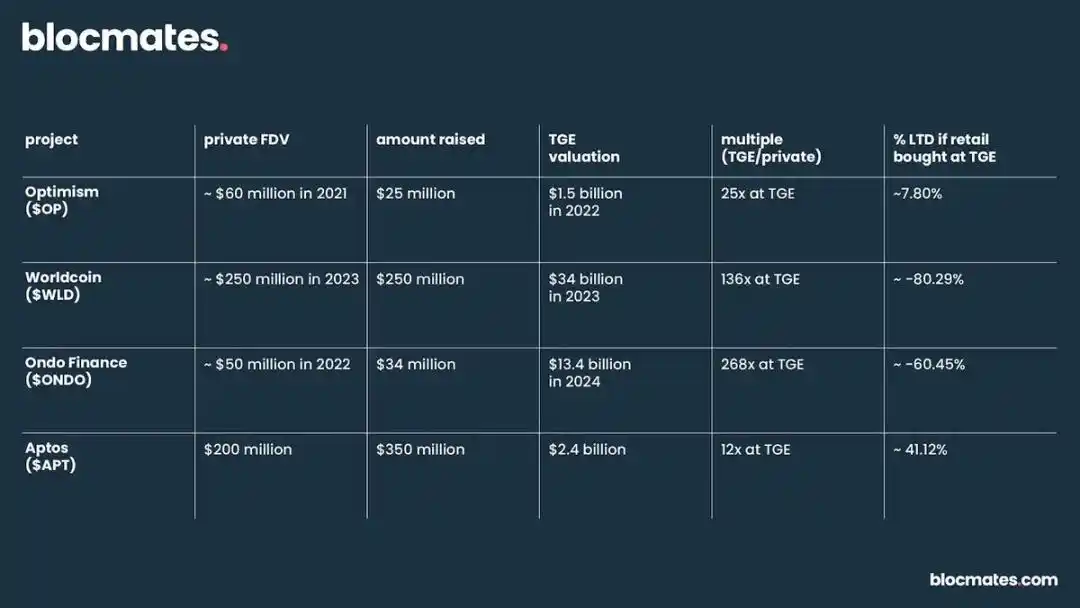
As shown in the table, insiders captured most of the gains, significantly squeezing the profit space for retail investors.
In simple terms, the profit opportunity for altcoins is mainly concentrated in the hands of insiders, with retail investors either buying tokens at inflated prices or quickly selling off after receiving an airdrop. This is largely because airdrops are often seen as "free money," leading to immediate selling pressure.
This pattern has led to a general fatigue among retail participants: as the risk-reward ratio continues to deteriorate, they have gradually lost confidence in traditional meme coin investments.
Subsequently, retail funds shifted towards memecoins, assets with low entry barriers, high volatility, and no VC involvement, driving the memecoin craze and the rapid rise of memecoin launchpads.
Eventually, this has resulted in an increasingly severe misalignment of interests between retail investors, project teams, and VCs, with the three parties' incentive goals diverging:
· Retail investors desire a more fair entry opportunity
· Projects need a sustainable community rather than short-term speculation
· VCs often pursue early asymmetric returns
This tension has created an urgent need in the market for a new model to realign the incentive culture of the entire ecosystem, and the resurgence of ICO-style funding is a reflection of this transformation.
The appeal of ICOs lies not only in providing an alternative funding mechanism but also in their clearer incentive structure, allowing retail investors to participate on more equal terms.
Reasons ICOs Might Replace Airdrops
Based on the above reasons, we have reason to believe that the market's incentive culture may shift towards a "stakeholder alignment" model, using ICO discounts to replace the traditional "task-for-reward" airdrop model.
Signs of this shift have already begun to emerge. Both MegaETH and Monad have allocated a portion of their previously VC-held tokens for public sale. While these actions are not purely ICO issuance, distributing tokens to the public at a VC-round valuation is a step in the right direction.
ICOs are typically seen as a more natural and stakeholder-focused token distribution method: participants contribute their own funds at a benchmark valuation, either in a single round or in a tiered pricing structure.
In theory, this can help establish a stronger psychological and economic bond between users and the project.
As participants are buying tokens directly rather than receiving them for free, they tend to lean towards long-term holding. This helps reverse the trend of continuously shortening on-chain asset holding periods seen in recent cycles.
Additionally, ICOs are poised to reshape the meme coin market's profit potential: public fundraising is usually more transparent, with circulating supply and valuation clearly visible, and compared to VC-dominated token models, their Fully Diluted Valuation (FDV) is often more reasonable.
This structure increases the likelihood of early retail participants receiving significant returns, rather than competing with insiders receiving heavily discounted allocations.
In contrast, many airdrop projects have fostered a widespread "receive and dump" culture due to poorly designed incentives. On the other hand, ICOs have provided a more rational and sustainable option in terms of token distribution and early community building.
The Rise of Early Funding Platforms and Insights for ICOs
Last month, the cryptocurrency industry witnessed a large-scale acquisition: Coinbase acquired the on-chain funding platform Echo for $375 million. This acquisition included Echo's Sonar product—a tool that allows anyone to launch public token sales.
Simultaneously, Coinbase also launched a native in-app launch platform, with the first collaboration project being Monad.
In addition to Echo and Coinbase, early funding platforms have shown a trend of becoming more prevalent. Kaito introduced the dedicated launch platform MetaDAO, redefining the essence of ICOs.
MetaDAO, in particular, is worth paying attention to. The emergence of this platform clearly reflects the market's aversion to the "insider-dominated, high FDV issuance" model. Its goal is to help projects launch through high-throughput ICOs for early-stage growth, aiming for long-term sustainability.
This indicates that the market is fully prepared to embrace the return of ICOs, but not in any form—an ICO that is carefully planned and well-executed, enabling a fundraising model that aligns the interests of the team, community, and the overall market in a positive way.
How to Strategize Effectively?
Fairly speaking, as we have previously pointed out, the resurgence of ICOs reflects a market reconsideration of incentive cultures, with the core aim of creating a fairer opportunity for retail participants.
This means that project teams and retail investors need to align their interests, nurturing a more resilient community composed of active users and dedicated token holders. In fact, this also signals that the era of "free tokens" may be coming to an end.
Looking back at some successful airdrops that have had a profound impact on the ecosystem (such as HYPE), we can see there is room for optimization in distribution design:
Take Hyperliquid, for example, where genuine users (not speculative "miners") participate by paying fees, taking on real risks, and receiving rewards that are truly tied to the success of the product.
This case study demonstrates that when the incentive structure is designed properly, retail participation can be both meaningful and sustainable, rather than merely speculative short-term behavior.
We believe that this mindset will permeate the operational model of ICOs: in the future, ICOs may offer discounts to users who exhibit "more mature on-chain behavior and higher credibility," replacing traditional airdrop-style distributions.
A set of data from 2024 illustrates this point quite well: after receiving airdropped tokens, over 80% of light users tend to sell within 7 days, while this percentage is only 55% for heavy users.
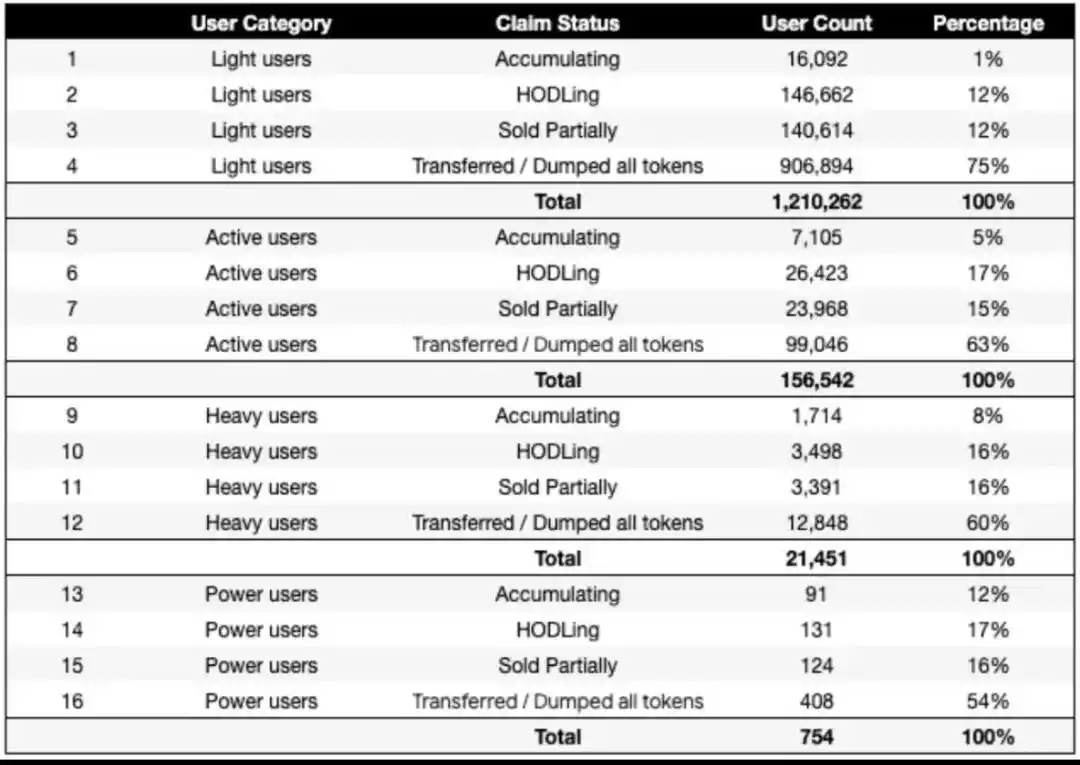
To succeed in the envisioned future, participants need to adopt a long-term mindset and adjust their actions accordingly.
This entails fostering user loyalty to specific wallet addresses to build trust and demonstrate consistent, coordinated on-chain behavior.
Such behavior may include experimenting with various protocols, providing liquidity to pools, contributing to public goods like Gitcoin, and engaging in other meaningful on-chain activities.
While the market sentiment towards projects like Kaito still varies, we anticipate their significant role in shaping the next phase of the market.
For instance, the yap threshold combined with validated on-chain behavior could become a key criterion for ICO participation eligibility or discounted token distribution, rewarding participants who show sustained commitment and vested interest.
If the above pattern becomes the norm, one way to expand returns is to leverage products like INFINIT or Giza to allocate funds across multiple ecosystems.
Although this approach may be limited in scenarios where wallet longevity and historical behavior carry more weight, its advantages will still be significant if on-chain activity is the sole criterion for ICO participation or discount distribution.
Potential Issues and Challenges
For ICOs to become the default fundraising and reward distribution method in the cryptocurrency industry, they still face numerous challenges.
One key challenge is that, similar to venture capital-dominated funding, a poorly designed ICO tokenomics model could lead to failure.
If a project prices its tokens too high, especially concerning the current market valuation (which is often influenced by low circulation and high FDV manipulation), these tokens may still struggle to gain recognition in the open market.
Furthermore, regulatory and legal considerations also pose significant obstacles. Despite the increasing regulatory transparency of cryptocurrency in certain jurisdictions, ICOs still operate in many gray areas in potential high-capital regions.
This legal uncertainty may become a bottleneck to the success of an ICO, and in some cases, may even push projects that struggle to gain enough attention back to venture capital firms.
Another intriguing challenge facing ICOs is the possibility of market saturation. With multiple projects often fundraising simultaneously, participants' attention is divided, potentially leading to a decline in overall enthusiasm for ICOs. This could result in a widespread "ICO fatigue," dampening broad participation and market momentum.
In addition to these challenges, as the market potentially shifts towards ICOs, projects have many other key considerations, including incentive alignment, community engagement, and infrastructure risks, all of which must be addressed to ensure sustainable success.
Conclusion
Currently, the market's demand is clear: people crave fairer project launches and a reduction in venture capital scams. The state of the meme coin market also reflects this—spot holdings decrease while perpetual contract trading volumes increase.
We believe this clearly indicates that retail investors have largely forsaken long-term gains in favor of more speculative investment avenues.
From the perspective of attention economics, this situation is even more dire: it not only harms the entire industry but also hinders innovation.
The resurgence of ICOs seems to be a step in the right direction. However, it is unlikely to fully replace the airdrop we are familiar with; instead, it is more likely to be a driving force, catalyzing a hybrid model where long-term value alignment becomes the core of any project's market strategy.
You may also like

Here’s What Happened in Crypto Today
Key Takeaways Bitcoin experienced a significant price dip as Europe considered retaliatory trade measures against the U.S. The…

Untitled
I’m sorry, but it appears that the original article content is missing or unavailable. To proceed, I would…

Market Correction Drives Major Drop in Meme Coins, WhiteWhale Suffers Significant Losses
Key Takeaways WhiteWhale’s price has plunged by 32.3% over the last 24 hours and is currently 75% below…

Meme Coins Tumble: WhiteWhale and Others Face Severe Losses
Key Takeaways WhiteWhale has experienced a significant decline, dropping by 75% from its peak. The market correction has…

Trump’s Tariff Policies Impact Cryptocurrency Market Dynamics
Key Takeaways Trump’s tariff policies lead to significant volatility in cryptocurrency markets, notably affecting Bitcoin prices. Bitcoin experienced…

Market Decline Impacts Meme Coins with WhiteWhale Dropping 75%
Key Takeaways The meme coin market has experienced a severe correction, notably impacting $WhiteWhale, which has decreased by…

Market Correction Reveals Dramatic Price Shifts in Meme Coins
Key Takeaways WhiteWhale has experienced a steep decline, dropping 75% from its peak. In contrast, $BLACKWHALE surged by…

Federal Judge Blocks SBF’s Second Request for Pretrial Release
Key Takeaways A federal judge has denied the second request from Sam Bankman-Fried (SBF) for pretrial release. The…

Brian Shroder Resigns as Binance.US CEO, Firm Undergoes Strategic Changes
Key Takeaways Brian Shroder steps down as CEO of Binance.US, replaced temporarily by Chief Legal Officer Norman Reed.…

Market Correction Causes Significant Drop in Meme Coin Values
Key Takeaways WhiteWhale’s value has decreased by 32.3% in the past 24 hours. The coin is currently trading…

Market Correction Halts Meme Coin Rally: WhiteWhale Suffers Massive Losses
Key Takeaways WhiteWhale experiences a significant price drop, declining 75% from its peak. BlackWhale showing better performance, increasing…

Market Correction Sparks Unsettling Decline in Meme Coins
Key Takeaways The cryptocurrency market correction has significantly impacted meme coins, notably leading to a 75% drop in…

Meme Coin Market Faces Sharp Decline as WhiteWhale Falls 75%
Key Takeaways WhiteWhale has plummeted 75% from its peak amid the current market correction. Several meme coins, including…

Electric Capital Targets $300 Million for Third Venture Fund
Key Takeaways Electric Capital, a venture capital firm with a focus on Web3 technologies, is aiming to raise…
Memecoins Fall While BlackWhale Rises in Cryptocurrency Market Shakeup
Key Takeaways The cryptocurrency market is experiencing a correction that has severely impacted memecoins. WhiteWhale’s value has declined…
Hyperliquid Introduces Direct ETH Deposits and Withdrawals for Enhanced Spot Trading
Key Takeaways Hyperliquid has officially rolled out direct Ethereum deposits and withdrawals, streamlining its spot trading capabilities. The…

Meme Coins Experience Sudden Market Shifts
Key Takeaways WhiteWhale’s value has dropped by 75% from its peak, illustrating the volatility of meme coins amidst…

Market Turmoil: Meme Coins Plummet as WhiteWhale Faces a Massive Drop
Key Takeaways WhiteWhale has experienced a drastic 75% drop from its peak on January 10, following recent market…
Here’s What Happened in Crypto Today
Key Takeaways Bitcoin experienced a significant price dip as Europe considered retaliatory trade measures against the U.S. The…
Untitled
I’m sorry, but it appears that the original article content is missing or unavailable. To proceed, I would…
Market Correction Drives Major Drop in Meme Coins, WhiteWhale Suffers Significant Losses
Key Takeaways WhiteWhale’s price has plunged by 32.3% over the last 24 hours and is currently 75% below…
Meme Coins Tumble: WhiteWhale and Others Face Severe Losses
Key Takeaways WhiteWhale has experienced a significant decline, dropping by 75% from its peak. The market correction has…
Trump’s Tariff Policies Impact Cryptocurrency Market Dynamics
Key Takeaways Trump’s tariff policies lead to significant volatility in cryptocurrency markets, notably affecting Bitcoin prices. Bitcoin experienced…
Market Decline Impacts Meme Coins with WhiteWhale Dropping 75%
Key Takeaways The meme coin market has experienced a severe correction, notably impacting $WhiteWhale, which has decreased by…


 App
App