
- Buy Crypto
- Markets
- Futures
- Spot
- Copy Trade
 Earn
Earn- More
Google’s Strategic Ascent in the AI Landscape: A Detailed Exploration

Key Takeaways:
- Google’s decision to create an exclusive AI framework represents a critical shift in technological and financial strategy.
- The company harnesses its proprietary hardware, particularly TPU chips, to craft efficient AI systems that promise both market competitiveness and reduced costs.
- Buffett’s unprecedented investment in Google marks a turning point, reflecting confidence in the company’s long-term strategic capabilities.
- This move raises questions about the sustainability and future dominance of AI competitors like OpenAI and Nvidia.
WEEX Crypto News, 2025-12-01 10:31:14
Introduction: A Strategic Investment in Google’s Future
In an unexpected move by Warren Buffett’s investment firm, the decision to purchase Google shares has captivated the financial and tech industries alike. This unprecedented step comes as Google embarks on a significant transformation, leveraging its proprietary resources to compete aggressively in the AI domain. Buffett’s choice diverges from his previous investment philosophy, which traditionally emphasized clarity over complexity in business models. This pivotal investment underscores a seismic shift in Google’s role within the AI and tech landscape.
Google’s Evolution and AI Ambitions
When examining Google’s recent strategic pivot, it is essential to understand the company’s historical context and current innovations. Google’s dabble into AI is not a spur-of-the-moment decision but a well-orchestrated manoeuvre rooted in years of research and development. Historically, Google’s AI advancements, particularly the Transformer model introduced by its researchers in 2017, have laid the groundwork for the burgeoning field of artificial intelligence today. Even as competitors, most notably OpenAI, have capitalized on these innovations, Google’s influence remains undeniable.
At the heart of Google’s current AI strategy are its Gemini models, symbolizing a direct challenge to the incumbents like OpenAI. The release of Gemini 3 marks a significant milestone, showcasing superior performance in comprehensive benchmarks against established competitors, although it conceded in terms of programming capabilities. This model, entirely nurtured on Google’s in-house developed TPU (Tensor Processing Unit) chips, underscores the technical and market autonomy Google is striving for.
The Catalyst: Buffett’s Bet and Market Reactions
Buffett’s strategic investment in Google, defying his own investment axioms, is driven by key factors within the company. Google’s AI ambitions, combined with its burgeoning deployment of TPU chips as economically viable alternatives to Nvidia’s high-cost GPUs, presents a compelling financial narrative. These chips not only empower Google’s own AI frameworks but are also positioned to cater to external enterprises seeking cost-effective solutions—heralding a twilight of dependence on rivals like Nvidia.
However, the market’s response has been a blend of enthusiasm and caution. While Google’s stock price has seen upward movement, bolstered by positive reviews of Gemini 3 and strategic TPU developments, there is hesitance as analysts weigh the implications of these advances for incumbent competitors such as Nvidia. The latter’s stock has experienced volatility, with investor sentiment rattled by Google’s assertive strides into what has been Nvidia’s domain.
Comparative Advantages: Google’s Self-contained AI Model
Google’s approach to its AI operations represents a full-stack, integrated model—a clear departure from the more fragmented collaborative networks seen in the tech sphere. This method grants Google end-to-end control over its AI ecosystems, from hardware deployment via TPU chips to embodying AI models within its substantial platforms like Google Search and YouTube. This self-sufficient paradigm not only leads to lower dependency on external partners for technological needs but also promises to streamline costs and optimize performance.
Contrastingly, competitors like OpenAI rely on a mesh of collaborations spanning hardware suppliers like Nvidia, data providers, and cloud services such as those provided by Microsoft. This network, resembling a horizontal integration model, can offer flexibility and specialization but often at increased financial and operational complexities.
Financial Dynamics and Strategic Implications
On the financial front, Google’s robust revenue, exceeding $100 billion with a pronounced growth trajectory, offers a financial ballast that many of its competitors envy. This fiscal health equips Google with unparalleled room to expand its AI initiatives without the Pressing need for external investments that many startups might face. Google’s investment in expanding its data center capabilities to $40 billion exemplifies its commitment to lead not just in software innovation but also in the infrastructure that underpins AI development.
Moreover, the financial pressures on entities like OpenAI are prominent. Despite its phenomenal market valuation, OpenAI’s path to achieving generalized AI capabilities requires unprecedented capital outlay, estimated beyond $1000 billion over forthcoming years. This starkly contrasts Google’s strategy, resting largely on internally generative financial capabilities and strategic infrastructure expansions.
Future Outlook: Industry Implications and the Road Ahead
As Google continues to expand its AI footprint, the broader implications for the industry are considerable. Google’s approach suggests a future where tech giants aim to consolidate and internalize entire technological ecosystems, reducing reliance on ancillary suppliers. This not only shifts the competitive landscape, potentially marginalizing specialized hardware providers but also sets a precedent for holistic technology development strategies in other sectors.
Google’s systems are also poised to continue expanding across various facets of daily life and industry, with potential applications in healthcare, logistics, media, and beyond. The success of Google’s Gemini and related TPU advancements could usher in an era where large tech companies not only dominate but also configure the rules of engagement in sectors traditionally reliant on decentralized technological partnerships.
Another layer to this scenario involves market orientation and consumer engagement. As tech entities vie for dominance, the balance between offering cutting-edge technology and maintaining user-centric, privacy-conscious policies becomes crucial. Google’s vast troves of user data provide it with a competitive edge in creating personalized AI experiences but concurrently pose challenges in terms of data protection and ethical use.
Conclusion: A New Era in AI and Investment
Google’s strategic moves, underscored by Buffett’s investment, signal a new chapter not just for the company but for the broader AI sector. As Google aligns its technical prowess with financial acumen, it sets a course that could redefine AI development and deployment paradigms. Competitors must now reassess their strategies, potentially opting either for deeper collaboration or greater vertical integration, in response to such transformative industry shifts.
Buffett’s confidence in Google may well serve as a bellwether for AI’s future economic landscape, where integrated and financially robust corporations lead the charge. This evolving dynamic, characterized by technological innovation paired with strategic investments, is poised to reshape the contours of modern industry, making it a vibrant domain ripe with opportunities and challenges.
FAQ
What prompted Warren Buffett to invest in Google?
Buffett’s investment in Google was driven by the company’s strategic advancements in AI, particularly its proprietary Gemini models and TPU chips, which offer a self-sustaining, cost-effective alternative to the existing industry leaders.
How do Google’s TPU chips challenge Nvidia’s market position?
Google’s TPU chips provide a cost-effective alternative to Nvidia’s GPUs, promising similar performance at a reduced price. This positions Google to potentially capture a significant portion of the market, challenging Nvidia’s dominance.
What makes Google’s AI strategy stand out?
Google’s AI strategy is characterized by vertical integration, where the company maintains control over its entire tech stack from hardware to software and application deployment, unlike the more decentralized approaches of its competitors.
How does Google’s financial health support its AI ambitions?
With quarterly revenues over $100 billion, Google possesses significant financial resources that allow it to invest heavily in infrastructure like data centers and further AI research without relying on external funding.
What are the potential industry-wide impacts of Google’s AI strategies?
Google’s approach could shift the industry towards more vertically integrated models, reduce dependency on third-party suppliers, and redefine competition in areas like AI development, deployment, and application.
You may also like

Market Prediction Scam "Oracle": 8300x Rug Pull Scheme, the $230K Harvest

Traveling? ‘Evil Twin’ WiFi networks can steal crypto passwords
Key Takeaways “Evil Twin” WiFi attacks occur when hackers mimic legitimate WiFi networks to steal sensitive user data.…

Crypto’s Decentralization Promise Falters at Interoperability
Interoperability in crypto exposes a decentralization gap, highlighting the reliance on centralized intermediaries. Users’ understanding of technical infrastructure…
Binance Australia Restores Fiat Transfers, Overcoming Two-Year Banking Barrier
Key Takeaways After being cut off from the Australian banking system in 2023, Binance Australia has successfully reinstated…

US Crypto Market Structure Bill in Limbo as Industry Reconsiders Support
Key Takeaways The US crypto market structure bill faces delays due to ongoing disputes among lawmakers and industry…

Senate Judiciary Leaders Push for Revisions in Crypto Bill
Key Takeaways Senate Judiciary chair Charles Grassley and top Democrat Richard Durbin express concerns about the crypto market…

How AI Crypto Trading Will Transform Human Roles
Key Takeaways AI is revolutionizing crypto trading by automating data-heavy tasks, yet humans still retain key decision-making responsibilities.…

Crypto Mining Rig Maker Canaan Warned of Potential Nasdaq Delisting
Key Takeaways Canaan Inc., a well-known crypto mining hardware producer, faces a possible Nasdaq delisting due to its…

The CLARITY Act’s Delay Could Benefit the Crypto Sector
Key Takeaways The stalling of the CLARITY Act is seen as beneficial for the crypto industry, as overregulation…

80% of Hacked Crypto Projects Never Fully Recover, Expert Advises
Key Takeaways Nearly four out of five crypto projects fail to regain stability after a major hack, according…

China-led CBDC Project mBridge Surpasses $55 Billion in Cross-Border Payments
Key Takeaways The mBridge project has handled over $55 billion in cross-border payments, signaling a shift from traditional…
Scaramucci Remarks on Stablecoin Yield Ban’s Impact on US Dollar
Key Takeaways: The CLARITY Act’s prohibition on yield-bearing stablecoins decreases the competitive edge of the US dollar against…

How to Stand Up to Twitter Manipulation Algorithms and Get Your Account Back?
All-In Podcast Deep Dive: What Money-Making Opportunities Did the Four Silicon Valley Billionaires See in 2026?

Key Market Information Discrepancy on January 19th - A Must-Read! | Alpha Morning Report

First Zero, First Revival: A Real Story from the WEEX Global AI Trading Hackathon Preliminary Round
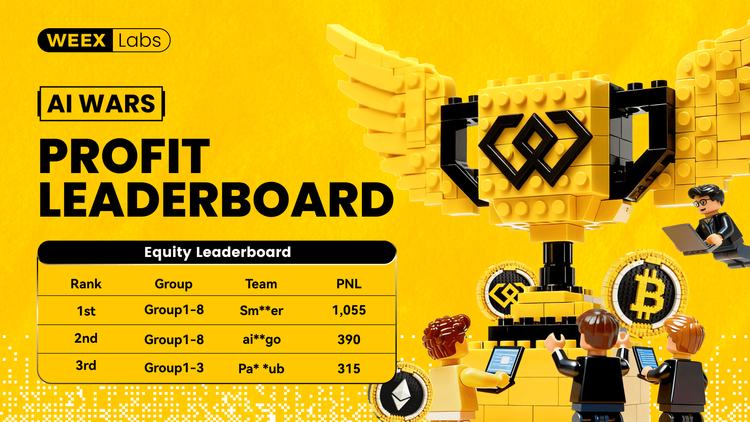
WEEX Labs, the innovation arm of the global crypto exchange WEEX, launched the preliminary round of its flagship AI trading hackathon, AI Wars: WEEX Alpha Awakens, on January 12, 2026. Backed by world-class sponsors including AWS, the prize pool has reached $1.88 million, with a Bentley Bentayga S awaiting the champion in Dubai. Already, 788 elite teams worldwide are battling for a spot in the finals. This is more than a hackathon — it is a real-market stress test for AI trading. Registration remains open until January 18. If you want your AI to face real volatility, this is your moment.
AI Wars: WEEX Alpha Awakens – Insights, Top Strategies, and Real-Market Execution Takeaways
WEEX Labs has officially launched the preliminary round of its global AI trading hackathon, AI Wars: WEEX Alpha Awakens, bringing together hundreds of elite teams to compete in real-market conditions. With a record-breaking $1.88 million prize pool and backing from top-tier sponsors like AWS, the event has quickly become a global proving ground for AI-powered trading strategies. As competition intensifies and standout teams emerge on the leaderboard, the hackathon not only showcases cutting-edge AI execution and risk management, but also offers valuable insights and inspiration for traders looking to build or refine their own AI-driven systems.

WEEX P2P now supports Polish zloty (PLN)—new users and merchant rewards
To make crypto deposits easier, WEEX has officially launched its P2P trading platform and continues to expand fiat support. We're excited to announce that the Polish Zloty (PLN) is now available on WEEX P2P!
Market Prediction Scam "Oracle": 8300x Rug Pull Scheme, the $230K Harvest
Traveling? ‘Evil Twin’ WiFi networks can steal crypto passwords
Key Takeaways “Evil Twin” WiFi attacks occur when hackers mimic legitimate WiFi networks to steal sensitive user data.…
Crypto’s Decentralization Promise Falters at Interoperability
Interoperability in crypto exposes a decentralization gap, highlighting the reliance on centralized intermediaries. Users’ understanding of technical infrastructure…
Binance Australia Restores Fiat Transfers, Overcoming Two-Year Banking Barrier
Key Takeaways After being cut off from the Australian banking system in 2023, Binance Australia has successfully reinstated…
US Crypto Market Structure Bill in Limbo as Industry Reconsiders Support
Key Takeaways The US crypto market structure bill faces delays due to ongoing disputes among lawmakers and industry…
Senate Judiciary Leaders Push for Revisions in Crypto Bill
Key Takeaways Senate Judiciary chair Charles Grassley and top Democrat Richard Durbin express concerns about the crypto market…


 App
App