
- Buy Crypto
- Markets
- Futures
- Spot
- Copy Trade
 Earn
Earn- More
Get Institutions to "Pump" Your Shitcoin Bags: The Gray Scale Fund and Coin50 Index You Must Watch During This Bull Run

At a time when almost everyone was FUD-ing about the lack of an alt season, the market finally emerged from nearly six months of "garbage time," and the alt season arrived as expected. According to data, out of the 388 tradable crypto assets on Binance, 299 saw a price increase of over 50% in the past 30 days, 98 saw an increase of over 100%, and only 10 assets had no price change.
However, in this "money-grabbing time" during the overall rise, mastering the art of selecting tokens with high price increases to maximize profits has become crucial. Which altcoins should you buy to outperform the market? Instead of following KOLs' buy calls, why not let Grayscale and Coinbase do the work for you?
Leading the Market: Grayscale Funds
In the previous bull market, the Grayscale concept was everywhere. In this ongoing bull market, the Grayscale concept continues to dominate the crypto sphere.
Mainstream Coin Funds
Around the top 20 market cap coins, Grayscale has launched a series of funds, such as BTC, ETH, SOL, XRP, AVAX, SUI, BCH, LINK, XLM, LTC, and other funds. Some leading coins are also part of the lineup, such as STX, BAT, ZEC, MKR, ZEN.
In addition to single-asset trust funds, Grayscale's bundled coin combination funds still hold significant reference value.
Grayscale Decentralized AI Fund
This bundled decentralized AI fund includes assets like Near, Filecoin, Bittensor, Render, Graph, and other AI targets. These assets have performed well this month, with the NAV per share surging from $6 to $14. The fund currently manages $2.2 million in assets.
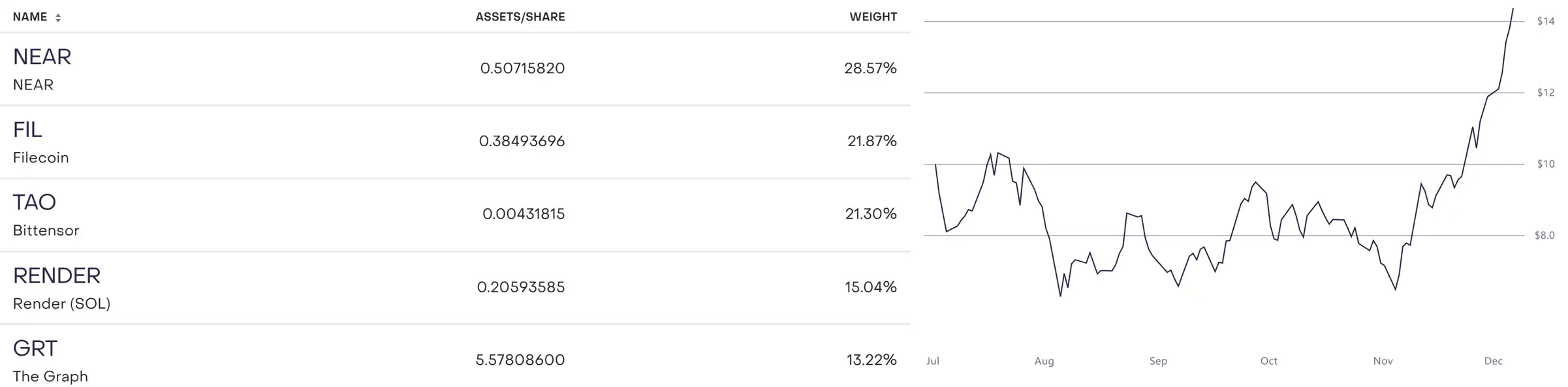
Left Image: Decentralized AI Fund Holdings; Right Image: NAV per Share
It is worth noting that Near, FIL, Bittensor, and Livepeer, which are in the same category, all have separate Grayscale funds.
Grayscale DeFi Fund
The Grayscale Decentralized Finance (DeFi) Fund is one of the first securities to individually invest in a basket of decentralized finance applications and derive value from them, including targets like UNI, AAVE, LDO, MKR, SNX. The fund has performed well in the past month, with the NAV per share rising from $13 to $35. The fund currently manages $8 million in assets.
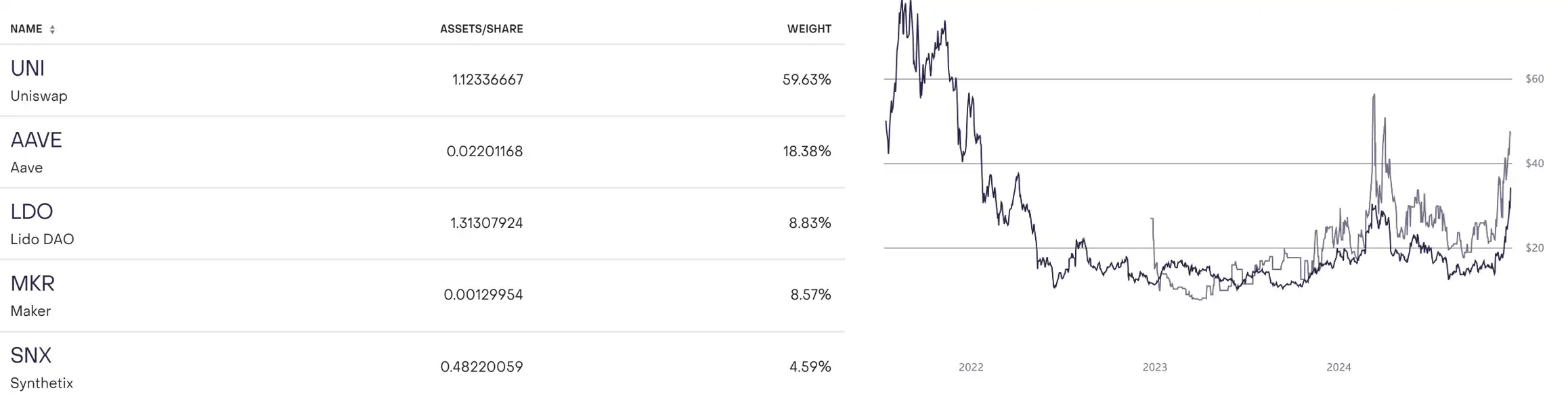
Left Image: Decentralized AI Fund Position; Right Image: NAV per Share
It is worth noting that Grayscale also has a separate AAVE fund.
In addition to the above funds, Grayscale is expected to add new fund currencies in various tracks:
There are a total of 7 currencies in the DeFi track, namely: Jupiter (JUP), Ondo Finance (ONDO), Ethena (ENA), Core (CORE), THORChain (RUNE), Aerodrome (AERO), Pendle (PENDLE);
There are a total of 6 currencies in the Infrastructure track, namely: Celestia (TIA), Pyth Network (PYTH), Cosmos (ATOM), Akash (AKT), UMA Project (UMA), Neon (NEON);
There are a total of 9 currencies in the Layer 1 track, namely: Toncoin (TON), TRON (TRX), Aptos (APT), Aptos (APT), Injective Protocol (INJ), Internet Computer (ICP), Kaspa (KAS), VeChain (VET), Mantra (OM), Celo (CELO);
There are a total of 8 currencies in the Layer 2 track, namely: Optimism (OP), Arbitrum (ARB), Sei (SEI), Starknet (STRK), Polygon (POL, formerly MATIC), Mantle (MNT), Immutable (IMX), Metis (METIS);
There are a total of 2 currencies in the DePIN track, namely: Arweave (AR), Helium (HNT);
There are a total of 2 currencies in the AI+ track, namely: Fetch.ai (FET), Worldcoin (WLD);
There is 1 currency in the Meme track: Dogecoin (DOGE)
Among the above-mentioned Grayscale concept coins, almost all of them have outperformed the bull market rise average. In addition to the essential bull market selection by Grayscale, the Coin50 Index established by Coinbase is also a good reference standard.
Coin50: The Nasdaq of the Crypto World
What Is the Coin50 Index
It is often said that "first-class companies set standards, second-class companies establish brands, and third-class companies make products." Benchmarking against the S&P and Nasdaq, Coinbase selects the top 50 cryptocurrencies by market capitalization to create COIN50, a digital asset benchmark index weighted by a certain criteria, establishing a world-class digital asset benchmark index. COIN50 aims to provide investors with a transparent and reliable tool to better understand and evaluate the performance of the cryptocurrency market.
How Does Coin50 Perform
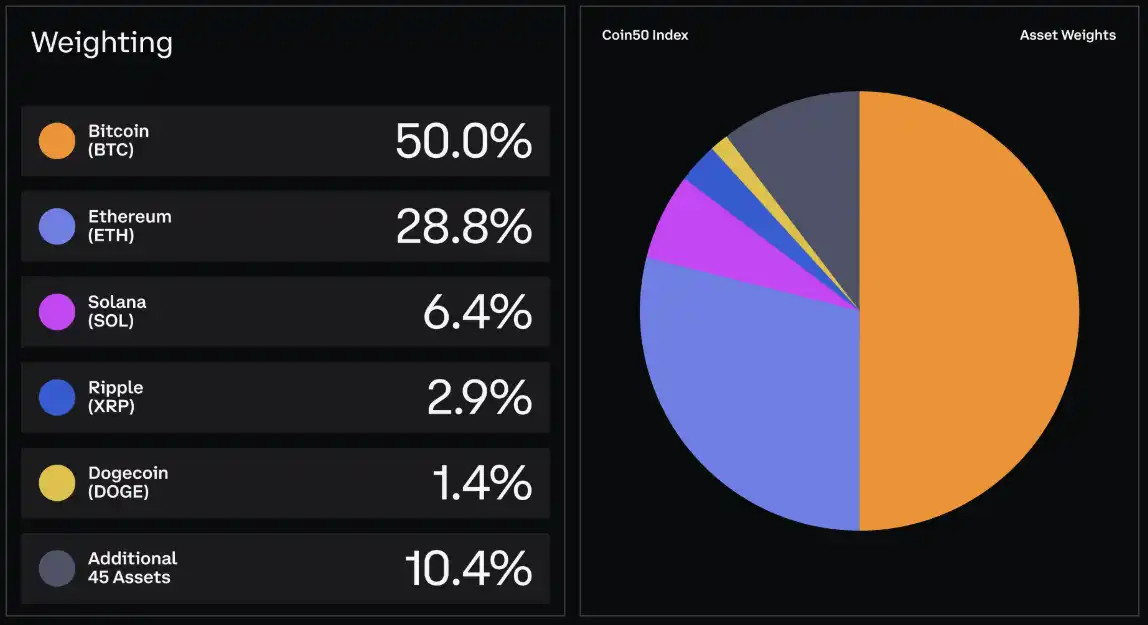
From the perspective of weighted composition, BTC, ETH, and SOL remain the most important assets in crypto, with BTC accounting for 50%, ETH for 28.8%, and SOL for 6.4%.
The top five also include XRP and DOGE, accounting for 2.9% and 1.4% respectively, while the remaining cryptocurrencies in the index make up 10.4% of the weight.
COIN50 has achieved a 68.30% return rate in the past 30 days, while the 90-day return rate is 99.64%. Even with BTC and ETH accounting for 70% of the weight, such an impressive return rate can still be achieved. This highlights how exaggerated the return rates of other cryptocurrencies in the index apart from BTC and ETH, which are large-cap coins, can be.
It is worth noting that the COIN50 index is not constant and unchanging; every quarter, an evaluation based on token fundamentals will be conducted to add or remove tokens. Recently, tokens such as AXS, BLUR, JASMY, KSM, and EGLD have all been included in the COIN50 index.
Where Are the Opportunities?
By consolidating the crypto assets of COIN50 and Grayscale Trust Funds, some highly overlapping assets can be identified. Aside from BTC, ETH, SOL, etc., coins such as XRP, XLM, SUI, AVAX, AAVE, LINK, LPT, etc., have all experienced "index-level" growth in the past 60 days. Moreover, the main source of funding driving the growth of these assets is from U.S. institutions, capable of accommodating large funds.
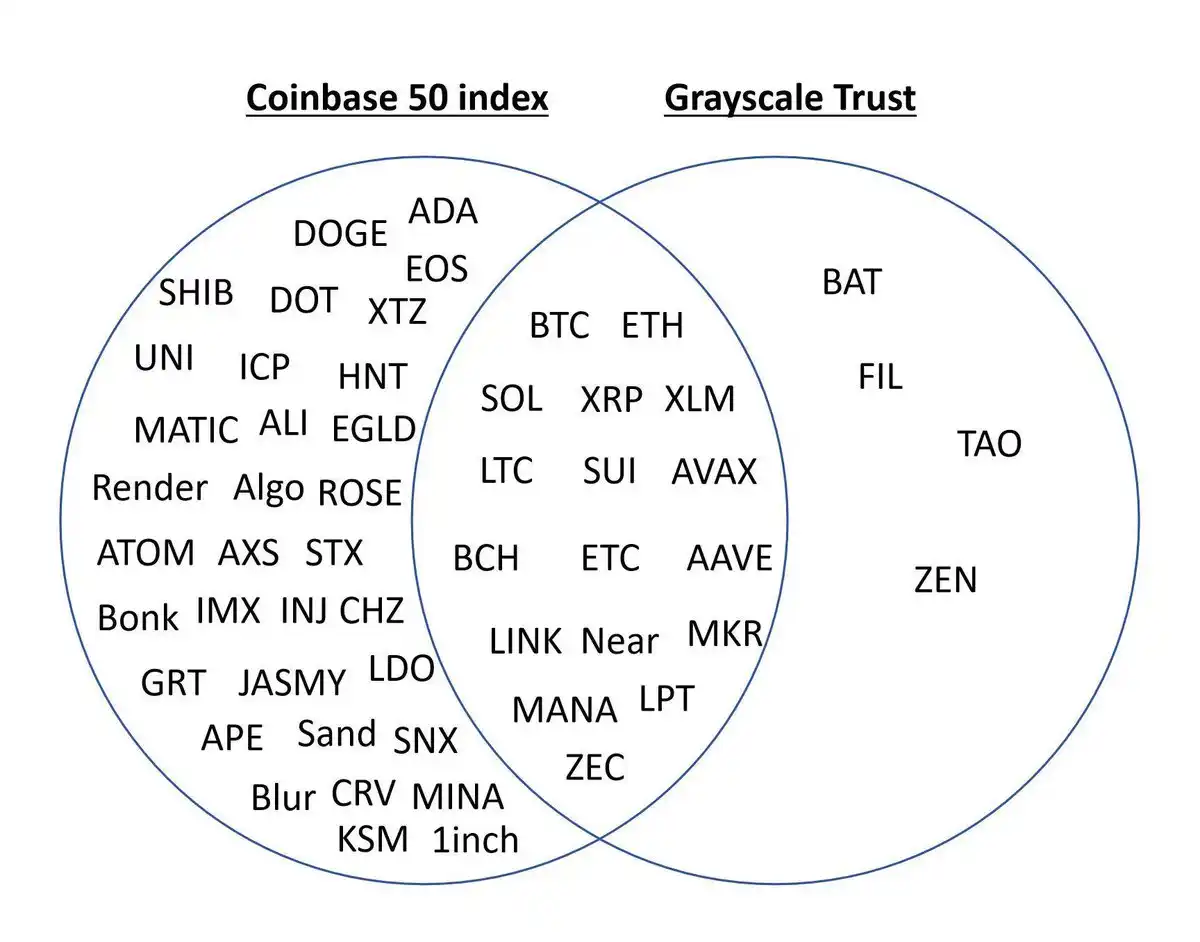
At the same time, many people think this is a case of hindsight bias. "What you are talking about has already seen its peak, where is the opportunity?"
However, a bull market is where those who were early prepared make big money, those who were somewhat prepared make money, and those who were unprepared experience making money.
After understanding the power of Coin50 and Grayscale Holdings, there are still many "Wealth Codes" surrounding this theme that can help those who are "somewhat prepared" make money.
For example:
(1) You can mine for projects that will catch up. Not all coins in the above list surged at the same time but experienced a certain degree of "sector rotation." After SOL and SUI cooled down, it was XRP and XLM's turn, followed by blue-chip Defi projects, and then hot spot projects like LPT. You can position yourself in projects that are poised for a surge, such as APE, BLUR, ZEC, and others.
(2) In the traditional financial market, let's take the example of US stocks. In 1993, the first US ETF, the Standard & Poor's Depository Receipts (SPDR S&P 500 ETF), was listed on the New York Stock Exchange. From 2000 to 2009, the US ETF market rapidly expanded, forming a diversified asset class including broad-based, industry-themed, Smart Beta, fixed income, and commodities ETFs. The crypto market is still in its early stages compared to the mature traditional financial market.
ETFs for household names such as BTC, ETH, and SOL have already been approved, with a high probability of an XRP ETF being approved soon. Once these leading ETFs are launched, there will certainly be a suite of ETFs based on various niche sectors in the future. For example, DeFi ETFs, AI ETFs, Meme ETFs, and so on.
The compound growth rate of US ETFs from 2010 to 2021 was 19.7%. It is foreseeable that there will be plenty of growth opportunities for crypto asset ETFs in the future.
You may also like

Alibaba Backed Latin America Stablecoin Company, Why VelaFi?

AI Crypto Trading in 2026: How AI Agents Use Stablecoins for Capital Management and Settlement
Learn how AI agents use stablecoins for crypto trading in 2026 — managing capital, settling transactions, and operating across exchanges and DeFi protocols.

US Senate Agriculture Committee Schedules January 27 for Crypto Market Structure Hearing
Key Takeaways The Senate Agriculture Committee will release its crypto market structure bill on January 21, followed by…

Key Market Information Discrepancy on January 14th – A Must-See! | Alpha Early Report
Key Takeaways Bitcoin reached a new milestone, hitting $96,000, while Ethereum surpassed $3,300. Privacy coins such as ORDI…

Tether Freezes $182 Million in Assets in a Day: Is USDT Still a Neutral Coin?
Key Takeaways Tether recently froze $182 million in USDT across five wallets on the Tron blockchain, raising questions…

A Developer’s Three-Year Gamble on Base and the Turn Towards Solana
Key Takeaways: Base’s promise to support developers fell short, leading many to seek more supportive ecosystems. Developer frustration…

ETHGas Foundation Coin Issuance: Examining the Emotional Transaction Mechanism and Global Insights
Key Takeaways Zama’s token auction on CoinList is polarizing, showcasing potential for future applications amidst short-term market skepticism.…

a16z Secures $15 Billion: Redefining Venture Capital Through Visionary Storytelling
Key Takeaways a16z Raises Capital: The firm has raised an astronomical $15 billion, marking a significant point in…

Founder of DeepSeek’s Magic Square Quantitative Strategy Achieved a 56.55% Return in 2025
Key Takeaways Huansquare Quant, led by Liang Wenfeng, achieved a 56.55% return in 2025. The fund’s assets under…
Analyst: MSTR is the “Mullet” of this Bitcoin Bull Cycle, Acting as a Bitcoin Pressure Relief
MSTR absorbed significant volatility in this Bitcoin cycle, easing potential pressure on Bitcoin itself. Michael Saylor’s strategic issuance…

XMR Surges Over 50% in One Week: Who’s Buying?
Key Takeaways Monero (XMR) defies regulatory pressures, marking a 262% increase since January 2025, reaching an all-time high…

BitGo’s Revenue Surges with Upcoming IPO as Institutional Interest Grows
Key Takeaways BitGo, a major player in cryptocurrency custody, aims to raise $201 million through a U.S. IPO…
The New Era in Bitcoin Core Development: The Rise of Core Maintainer TheCharlatan
Key Takeaways Integration of a New Maintainer: For the first time in three years, a new Bitcoin Core…

Bitwise CIO Predicts Parabolic Bitcoin Surge with Sustained ETF Demand
Key Takeaways Prolonged demand for Bitcoin ETFs may lead to a parabolic rise in Bitcoin’s price, drawing parallels…

Binance Alpha to Launch Empire of Sight (Sight) on January 14
Key Takeaways Binance Alpha will kick off the trading of Empire of Sight (Sight) at 16:00 (UTC+8) on…
Today’s Trump Tariff Decision and Economic Data Releases
Key Takeaways The U.S. Supreme Court is set to rule on a significant Trump tariff case that could…

Binance Wallet Partners with Aster, Launches Seamless On-chain Perpetual Contract Trading
Key Takeaways: Binance Wallet has integrated with Aster to offer a streamlined and stable perpetual contract trading feature…
Final Federal Reserve Chair Candidate Rick Rieder, How He Views Cryptocurrency
Key Takeaways Rick Rieder stands out among the Federal Reserve Chair candidates due to his strong pro-crypto stance,…
Alibaba Backed Latin America Stablecoin Company, Why VelaFi?
AI Crypto Trading in 2026: How AI Agents Use Stablecoins for Capital Management and Settlement
Learn how AI agents use stablecoins for crypto trading in 2026 — managing capital, settling transactions, and operating across exchanges and DeFi protocols.
US Senate Agriculture Committee Schedules January 27 for Crypto Market Structure Hearing
Key Takeaways The Senate Agriculture Committee will release its crypto market structure bill on January 21, followed by…
Key Market Information Discrepancy on January 14th – A Must-See! | Alpha Early Report
Key Takeaways Bitcoin reached a new milestone, hitting $96,000, while Ethereum surpassed $3,300. Privacy coins such as ORDI…
Tether Freezes $182 Million in Assets in a Day: Is USDT Still a Neutral Coin?
Key Takeaways Tether recently froze $182 million in USDT across five wallets on the Tron blockchain, raising questions…
A Developer’s Three-Year Gamble on Base and the Turn Towards Solana
Key Takeaways: Base’s promise to support developers fell short, leading many to seek more supportive ecosystems. Developer frustration…


 App
App