
- Buy Crypto
- Markets
- Futures
- Spot
- Copy Trade
 Earn
Earn- More
Bloomberg: Has the US Treasury Market Really Lost Its Safe-Haven Appeal?

Original Article Title: Are US Treasuries Really Losing Their Safe-Haven Appeal?
Original Article Authors: Alice Atkins & Liz Capo McCormick, Bloomberg
Original Article Translation: Felix, PANews
Investors usually flock to US Treasuries to avoid financial market turbulence. During the global financial crisis, the 9/11 attacks, and even when the US credit rating was downgraded, US Treasuries saw a rebound.
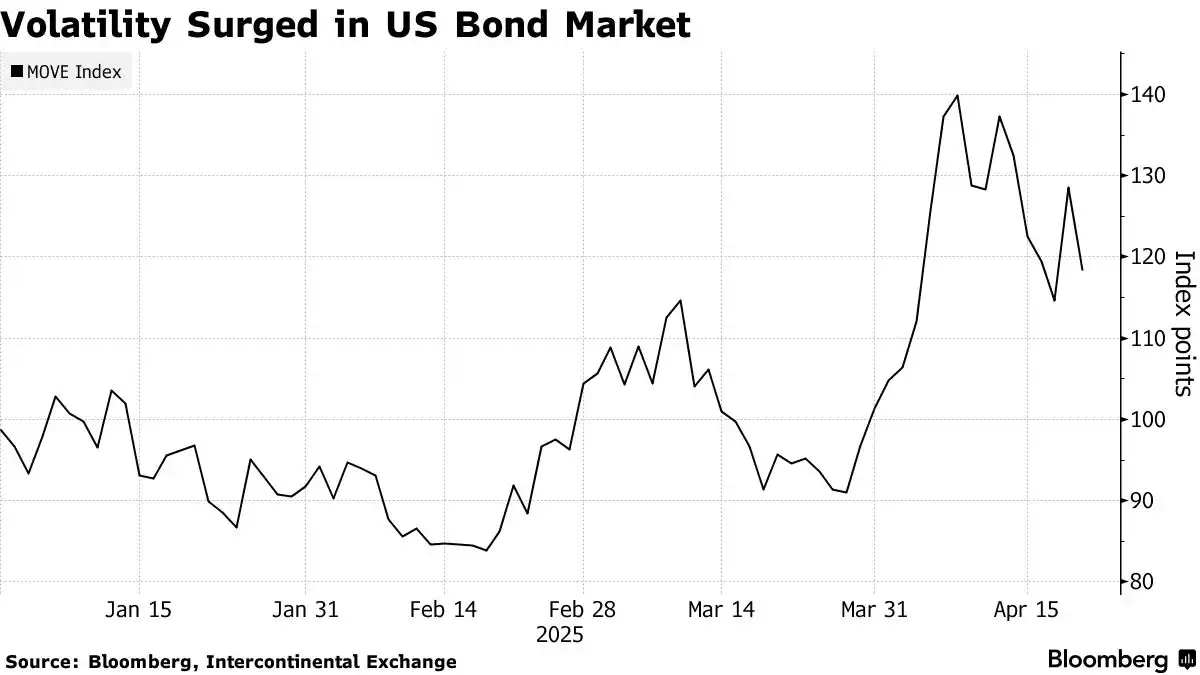
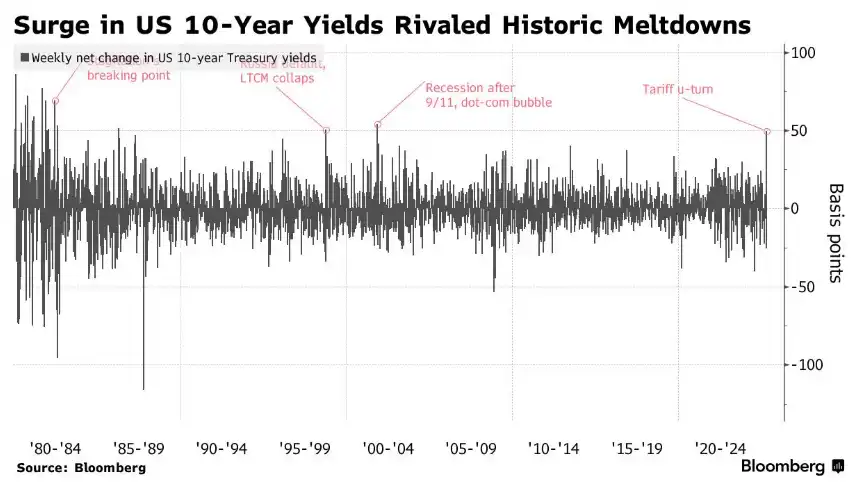
However, in early April, during the chaos triggered by President Trump's implementation of "reciprocal" tariffs, something unusual happened. Despite the sharp drops in risk assets such as stocks and cryptocurrencies, US Treasury prices didn't rise as expected but instead fell. The US Treasury yield saw its largest single-week increase in over twenty years.
For a long time, US Treasuries, with a market size of $29 trillion, have been seen as a safe haven during market turmoil, which has been a unique advantage for the world's largest economy. For decades, it has helped the US control borrowing costs. However, recently, the trading performance of US Treasuries has looked more like that of a risk asset. Former Treasury Secretary Lawrence Summers even stated that the performance of US Treasuries resembles that of emerging market debt.
This has profound implications for the global financial system. As the global "risk-free" asset, US Treasuries are used as a benchmark for pricing various assets, from stocks to sovereign bonds, and mortgage rates, while also serving as collateral for trillions of dollars in daily loans.
Below are some viewpoints put forth by investors and market forecasters to explain the abnormal volatility of US Treasuries in April and some potential alternative "safe havens."
Tariff-Driven Inflation
Even though President Trump suspended the implementation of most "reciprocal" tariffs for 90 days, tariffs imposed on China are still much higher than previously anticipated. Furthermore, tariffs on automobiles, steel, aluminum from Canada and Mexico, as well as various goods, remain in place, and Trump has threatened to impose additional import tariffs in the future.
There are concerns that businesses will pass on these tariff costs to consumers in the form of price hikes. An inflation shock would dent the demand for Treasuries as it would erode the future value of fixed income payments provided by Treasuries.
If soaring prices are accompanied by a drop in economic output or zero growth (known as stagflation), monetary policy will enter a new period of uncertainty, forcing the Fed to choose between supporting economic growth and curbing inflation.
Chasing Cash
Some investors may have already sold off US Treasuries and other US assets, turning to the ultimate safe haven: cash. With the Fed delaying rate cuts, assets in US money market funds have continued to surge, reaching a new all-time high in the week ending April 2. Money market funds are typically seen as akin to cash, with the added benefit of generating returns over time.
Policy Uncertainty
Investors demand higher returns when investing in politically turbulent and economically unstable countries. That's why Argentine government bond yields soared to 13% in mid-April.
Trump's unpredictable political strategies and aggressive tariff policies make it difficult to predict how investment-friendly the US environment will be a year from now.
Another factor driving funds into the US is the belief that the strength of the US judicial system and other institutional powers can constrain the US government and ensure some degree of policy continuity. Trump's willingness to challenge lawyers obstructing his actions and compel the Fed and other independent institutions to comply with his wishes may weaken some people's confidence in the checks and balances that have helped make the US the world's top foreign investment destination.
Fiscal Pressure
In the mid-1970s, the US dollar replaced gold as the world's reserve asset, and central banks around the world began buying US Treasuries to hold dollar reserves. Since the federal government has never reneged on its debt obligations, US Treasuries are seen as a sound investment.
US Treasuries currently make up 121% of GDP. Trump took office betting on reducing the budget deficit through tax cuts to stimulate economic growth, and he recently hinted that tariff revenues also help alleviate the deficit.
However, some worry that his policies will only worsen the national debt. In addition to additional tax cut measures in his plans, Trump is trying to make permanent the tax cuts implemented during his first term. If tariffs lead to an economic downturn, the government may face pressure to increase spending.
In light of this, Mike Riddell, Fixed Income Portfolio Manager at Fidelity International, said that the spiral increase in US Treasury yields could signal "capital flight," as foreign investors become increasingly unwilling to fund the US deficit. "The global ‘bond vigilantes’ clearly remain active."
US debt levels are expected to rise
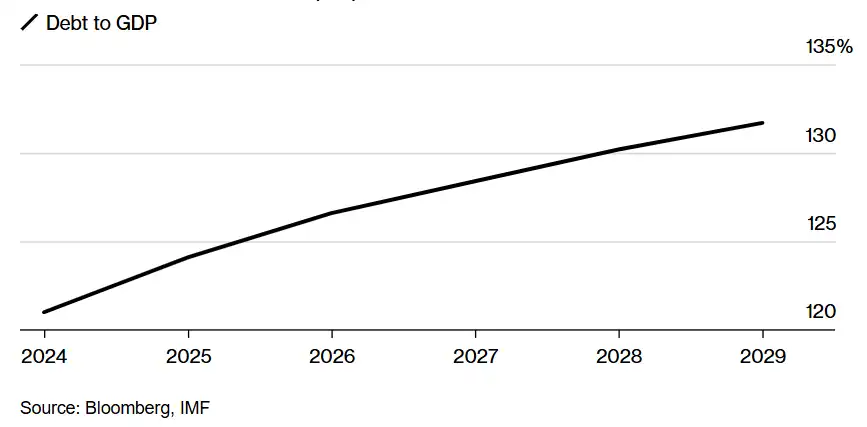
The International Monetary Fund predicts that by 2029, U.S. debt will reach 131.7% of gross domestic product.
Foreign Sell-Off
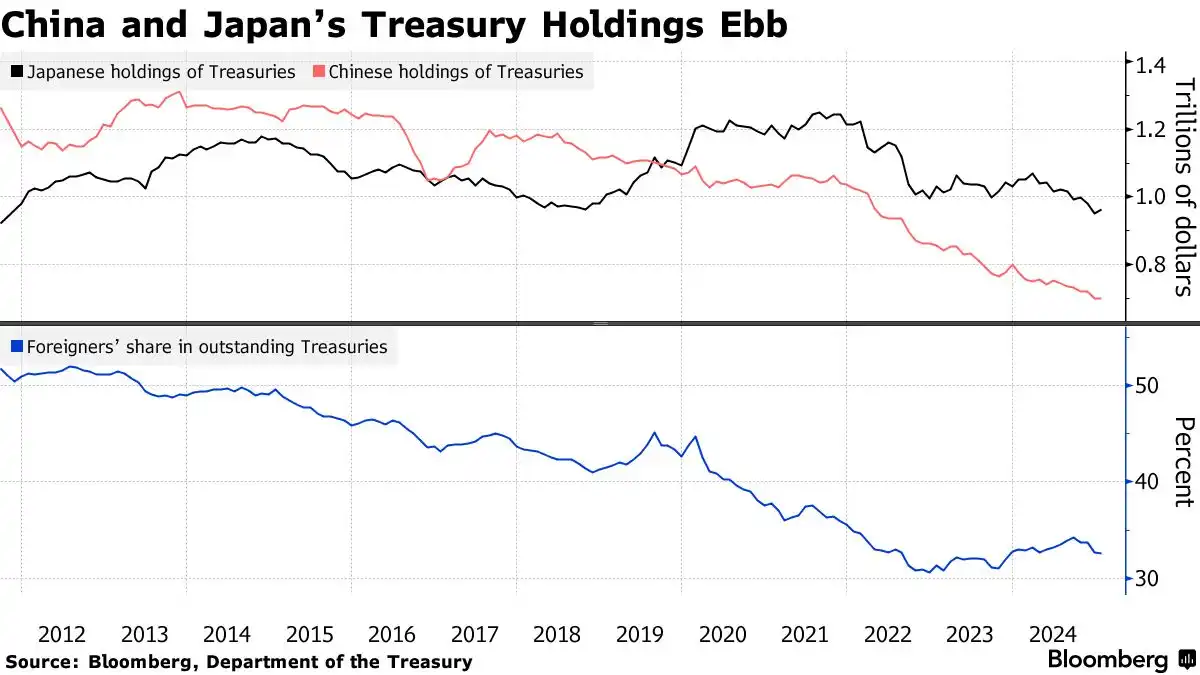
While difficult to prove in real time, when U.S. treasury bond prices drop, it is often speculated that foreign entities are selling off. This time, some believe it is a response to Trump's tariff policies. China and Japan are the largest holders of U.S. treasuries. Official data shows that both countries have been reducing their holdings for some time.
Given China's secretive trading activities, it is challenging to speculate on the role of the Chinese government. However, strategists often point out that Chinese holdings of U.S. treasuries could be a potential bargaining chip—even though a massive sell-off could devalue China's foreign reserves.
Hedge Fund Trades
Basis trading may have contributed to the sudden surge in U.S. treasury yields in early April. This popular hedge fund strategy profits from the price difference between cash bonds and futures.
Since this spread is typically small, investors often use significant leverage to fund the trade. When market turbulence hits and investors are eager to quickly unwind to repay loans, it can lead to issues. The risk is that this could trigger a chain reaction, driving yields up in a spiral and, worse, causing the treasuries market to seize up, similar to what happened during the 2020 basis trading unwind.
Others point out that the previously prevalent 'U.S. treasuries outperform interest rate swaps' bet suddenly collapsed. In fact, interest rate swaps were performing well as banks settled bonds to meet client liquidity needs and then added swaps contracts to maintain a certain exposure in case the bond market rallied.
If not U.S. treasuries, then what?
European and Japanese fund managers are finding viable alternatives besides buying U.S. treasuries, which may attract them to shift their asset allocation towards markets with seemingly more stable policy outlooks. Amid broader turmoil, German bonds are one of the main beneficiaries.
Gold, a traditional safe-haven asset, surged to historic highs in April, outperforming almost all other major asset classes. Central banks globally have been hoarding this precious metal for some time, aiming to diversify assets and reduce reliance on U.S. dollar assets. However, unlike bonds, investing in gold does not bring fixed income. Gold investment only yields returns when sold at a higher price.
At the end of the day, no investment can provide the same level of liquidity and depth as the U.S. Treasury market. To truly divest from the U.S. Treasury market would take years, not weeks. However, some market observers believe that April's market trends may signal a shift in the global landscape and a reassessment of assets crucial to the U.S. economic dominance.
You may also like

Here’s What Happened in Crypto Today
Key Takeaways Bitcoin experienced a significant price dip as Europe considered retaliatory trade measures against the U.S. The…

Untitled
I’m sorry, but it appears that the original article content is missing or unavailable. To proceed, I would…

Market Correction Drives Major Drop in Meme Coins, WhiteWhale Suffers Significant Losses
Key Takeaways WhiteWhale’s price has plunged by 32.3% over the last 24 hours and is currently 75% below…

Meme Coins Tumble: WhiteWhale and Others Face Severe Losses
Key Takeaways WhiteWhale has experienced a significant decline, dropping by 75% from its peak. The market correction has…

Trump’s Tariff Policies Impact Cryptocurrency Market Dynamics
Key Takeaways Trump’s tariff policies lead to significant volatility in cryptocurrency markets, notably affecting Bitcoin prices. Bitcoin experienced…

Market Decline Impacts Meme Coins with WhiteWhale Dropping 75%
Key Takeaways The meme coin market has experienced a severe correction, notably impacting $WhiteWhale, which has decreased by…

Market Correction Reveals Dramatic Price Shifts in Meme Coins
Key Takeaways WhiteWhale has experienced a steep decline, dropping 75% from its peak. In contrast, $BLACKWHALE surged by…

Federal Judge Blocks SBF’s Second Request for Pretrial Release
Key Takeaways A federal judge has denied the second request from Sam Bankman-Fried (SBF) for pretrial release. The…

Brian Shroder Resigns as Binance.US CEO, Firm Undergoes Strategic Changes
Key Takeaways Brian Shroder steps down as CEO of Binance.US, replaced temporarily by Chief Legal Officer Norman Reed.…

Market Correction Causes Significant Drop in Meme Coin Values
Key Takeaways WhiteWhale’s value has decreased by 32.3% in the past 24 hours. The coin is currently trading…

Market Correction Halts Meme Coin Rally: WhiteWhale Suffers Massive Losses
Key Takeaways WhiteWhale experiences a significant price drop, declining 75% from its peak. BlackWhale showing better performance, increasing…

Market Correction Sparks Unsettling Decline in Meme Coins
Key Takeaways The cryptocurrency market correction has significantly impacted meme coins, notably leading to a 75% drop in…

Meme Coin Market Faces Sharp Decline as WhiteWhale Falls 75%
Key Takeaways WhiteWhale has plummeted 75% from its peak amid the current market correction. Several meme coins, including…

Electric Capital Targets $300 Million for Third Venture Fund
Key Takeaways Electric Capital, a venture capital firm with a focus on Web3 technologies, is aiming to raise…
Memecoins Fall While BlackWhale Rises in Cryptocurrency Market Shakeup
Key Takeaways The cryptocurrency market is experiencing a correction that has severely impacted memecoins. WhiteWhale’s value has declined…
Hyperliquid Introduces Direct ETH Deposits and Withdrawals for Enhanced Spot Trading
Key Takeaways Hyperliquid has officially rolled out direct Ethereum deposits and withdrawals, streamlining its spot trading capabilities. The…

Meme Coins Experience Sudden Market Shifts
Key Takeaways WhiteWhale’s value has dropped by 75% from its peak, illustrating the volatility of meme coins amidst…

Market Turmoil: Meme Coins Plummet as WhiteWhale Faces a Massive Drop
Key Takeaways WhiteWhale has experienced a drastic 75% drop from its peak on January 10, following recent market…
Here’s What Happened in Crypto Today
Key Takeaways Bitcoin experienced a significant price dip as Europe considered retaliatory trade measures against the U.S. The…
Untitled
I’m sorry, but it appears that the original article content is missing or unavailable. To proceed, I would…
Market Correction Drives Major Drop in Meme Coins, WhiteWhale Suffers Significant Losses
Key Takeaways WhiteWhale’s price has plunged by 32.3% over the last 24 hours and is currently 75% below…
Meme Coins Tumble: WhiteWhale and Others Face Severe Losses
Key Takeaways WhiteWhale has experienced a significant decline, dropping by 75% from its peak. The market correction has…
Trump’s Tariff Policies Impact Cryptocurrency Market Dynamics
Key Takeaways Trump’s tariff policies lead to significant volatility in cryptocurrency markets, notably affecting Bitcoin prices. Bitcoin experienced…
Market Decline Impacts Meme Coins with WhiteWhale Dropping 75%
Key Takeaways The meme coin market has experienced a severe correction, notably impacting $WhiteWhale, which has decreased by…


 App
App