
- Buy Crypto
- Markets
- Futures
- Spot
- Copy Trade
 Earn
Earn- More
Arthur Hayes New Article: How Will Dollar Liquidity Drive the Next Bull Market in Crypto by 2025?

Original Author: Arthur Hayes, Chief Investment Officer of Maelstrom Fund, Co-Founder and former CEO of BitMEX
Original Translation: zhouzhou, BlockBeats
Editor's Note: In this article, Hayes analyzes how USD liquidity impacts the cryptocurrency market, especially Bitcoin's trend. By explaining the Federal Reserve's Reverse Repurchase Agreement (RRP) and the US Treasury General Account (TGA) fund flows, he discusses how increased USD liquidity drives the rise of the cryptocurrency and stock markets. Approximately $612 billion of USD liquidity will be injected into the market in Q1 2025, which may have a positive impact. Finally, the author mentions that the Maelstrom Fund is investing in the DeFi space and holds a bullish outlook for the future market.
The following is the original content (slightly rearranged for better readability):
The remote area ski entrance at a Hokkaido skiing resort provides excellent terrain, mostly accessible by gondola. At the beginning of each year, the most concerning question for skiing enthusiasts is whether there is enough snow cover to open these entrances. For skiers, a major challenge is "Sasa," which is the Japanese term for a type of bamboo plant.
This plant has stems as thin as reeds, but its leaves are as sharp as knives, capable of cutting the skin if not careful. Skiing on "Sasa" is very dangerous because your ski edges may slip, leading to what I call a dangerous game of "man vs. tree." Therefore, if the snow is not enough to cover the "Sasa," skiing in remote areas becomes highly risky.
This year, Hokkaido has seen record snowfall levels in nearly 70 years, with astonishingly deep powder snow. As a result, the backcountry ski entrances opened at the end of December, whereas in previous years, they typically opened in the first or second week of January.
As 2025 approaches, investors' focus has shifted from skiing to the crypto market, particularly on whether the "Trump Rally" can continue. In my latest article "Trump Truth," I suggest that the market's high expectations for Trump camp policy actions may lead to disappointment and have a negative impact on the short-term market. However, at the same time, I must also weigh the stimulating effect of USD liquidity.
Currently, Bitcoin's trend fluctuates with the pace of USD release, with the Fed and the US Treasury's financial elites holding the power to decide the amount of USD supplied to the global financial market, which is a key factor influencing the market.
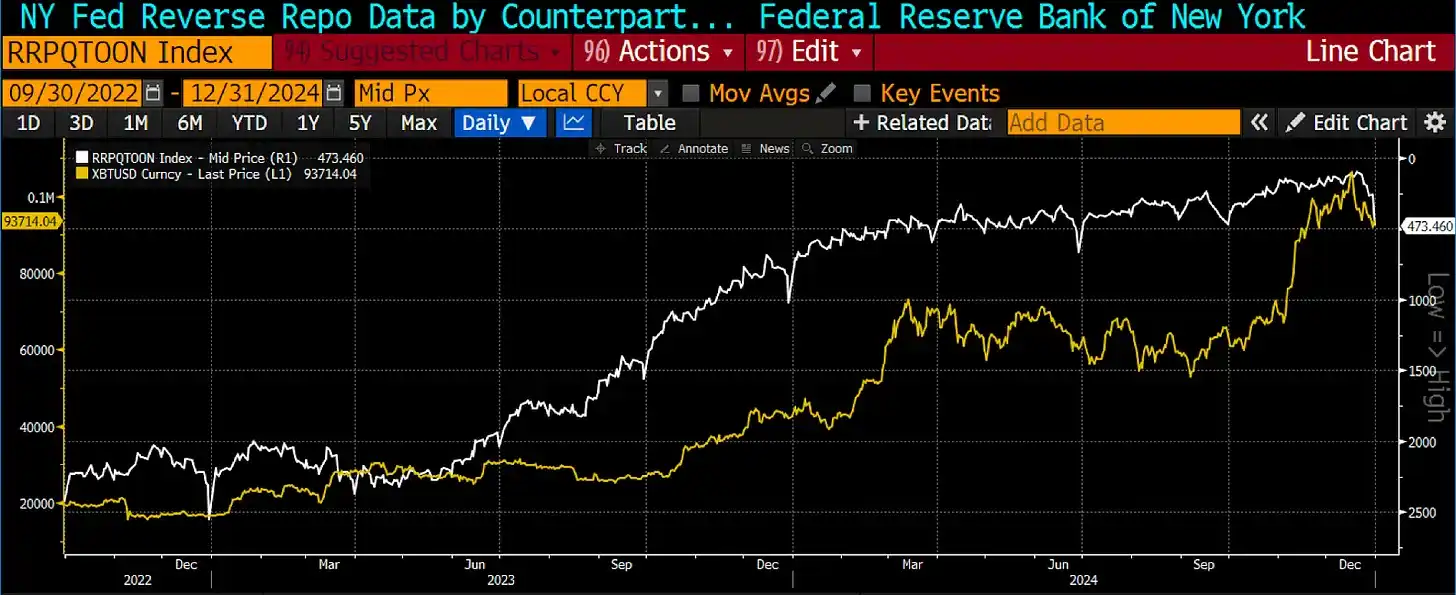
Bitcoin hit bottom in the third quarter of 2022, at which time the Fed's Reverse Repurchase Agreement (RRP) reached its peak. Under the guidance of U.S. Treasury Secretary Yellen (aka "Bad Girl Yellen"), the U.S. Treasury reduced the issuance of long-term coupon bonds while increasing the issuance of short-term zero-coupon bonds, thereby draining over $2 trillion from the RRP.
This effectively injected liquidity into the global financial markets. Cryptocurrencies and the stock market, especially large-cap U.S. tech stocks, consequently surged. From the chart above, you can see the relationship between Bitcoin (left axis, yellow) and RRP (right axis, white, reversed): as RRP decreases, Bitcoin's price rises.
In the first quarter of 2025, the question I am trying to answer is whether the positive stimulus in U.S. dollar liquidity can overshadow any potential disappointment in the implementation speed and effectiveness of Trump's so-called "pro-crypto" and "pro-business" policies. If so, market risks should become relatively manageable, and the Maelstrom Fund should also increase its risk exposure.
First, I will discuss the Fed, which is a minor factor in my analysis. Subsequently, I will focus on how the U.S. Treasury is addressing the debt ceiling issue. If politicians drag their feet on raising the debt ceiling, the Treasury will tap into its General Account (TGA) funds at the Fed, injecting liquidity into the market and creating positive momentum for the crypto market.
For brevity, I will not go into detail on how RRP and TGA lending separately have negative and positive impacts on U.S. dollar liquidity. Please refer to the article "Teach Me, Daddy" to understand the specific mechanisms of these operations.
Federal Reserve
The Fed's Quantitative Tightening (QT) policy is progressing at a pace of $600 billion per month, meaning its balance sheet size is shrinking. Currently, there has been no change in the Fed's forward guidance on the speed of QT, which I will explain in the subsequent parts of the article, but my prediction is that the market will peak in mid to late March, thereby drawing out $1800 billion in liquidity.
The Reverse Repurchase Agreement (RRP) has almost dropped to zero, and in order to fully deplete the funds in this facility, the Fed has been reluctant to adjust the RRP policy rate. At the December 18, 2024 meeting, the Fed lowered the RRP rate by 0.30%, exceeding the policy rate cut by 0.05%. This move aims to link the RRP rate to the federal funds rate (FFR) floor.
If you want to understand why the Fed waited until the RRP was nearly depleted to adjust the rate to the floor of the FFR, reducing the attractiveness of depositing funds into the RRP, I suggest reading Zoltan Pozar's article "Cheating on Cinderella". The conclusion I drew from this article is that the Fed is exhausting all tools to enhance demand for U.S. Treasury issuance, seeking to avoid stopping QT, providing a supplementary leverage ratio exemption for U.S. branches of foreign banks again, or restarting quantitative easing (QE), i.e., the "money printer restart."
Currently, there are two liquidity pools that will help suppress the rise in bond yields. For the Fed, the 10-year U.S. Treasury yield must not exceed 5%, as this level would trigger a significant increase in bond market volatility (MOVE index). As long as there is liquidity in the RRP and the Treasury General Account (TGA), the Fed does not need to make significant adjustments to its monetary policy or acknowledge that a fiscal dominance situation is unfolding.
Fiscal dominance would fundamentally make Powell's position subservient to "bad girl Yellen," and after January 20, it would be subservient to Scott Bessent. As for Scott, I haven't thought of a suitable nickname for him yet. If his decisions turn me into a modern-day Scrooge McDuck due to the devaluation of the dollar against gold, I will give him a more endearing nickname.

Once the Treasury General Account (TGA) is depleted (positive for U.S. dollar liquidity) and subsequently replenished after hitting the debt ceiling (negative for U.S. dollar liquidity), the Fed will exhaust its emergency measures, unable to prevent the inevitable further rise in yields following the easing cycle that began in September last year.
This has a minimal impact on the U.S. dollar liquidity situation in the first quarter, just a contemplation of how Fed policy might evolve during the year if yields continue to rise.
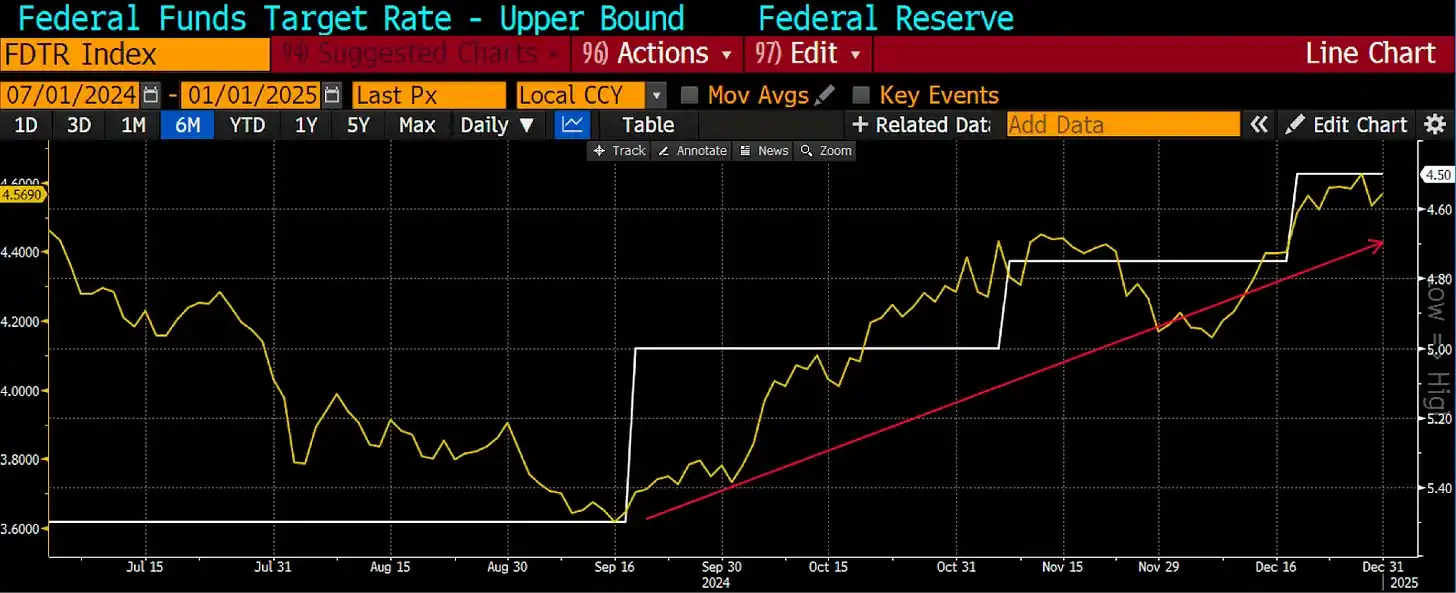
The Federal Funds Rate ceiling (FFR, right axis in the chart, white, inverted) and the U.S. 10-year Treasury yield (left axis, yellow) clearly show that when the Fed faces an inflation rate above its 2% target and cuts rates, bond yields rise instead.
The real issue is the rapid decline of Reverse Repurchase Agreement (RRP) from around $237 billion to zero. I expect RRP to approach zero at some point in the first quarter, as Money Market Funds (MMFs) withdraw funds and purchase higher-yielding Treasury bills to maximize returns. It is important to note that this implies a $237 billion injection of USD liquidity in the first quarter.
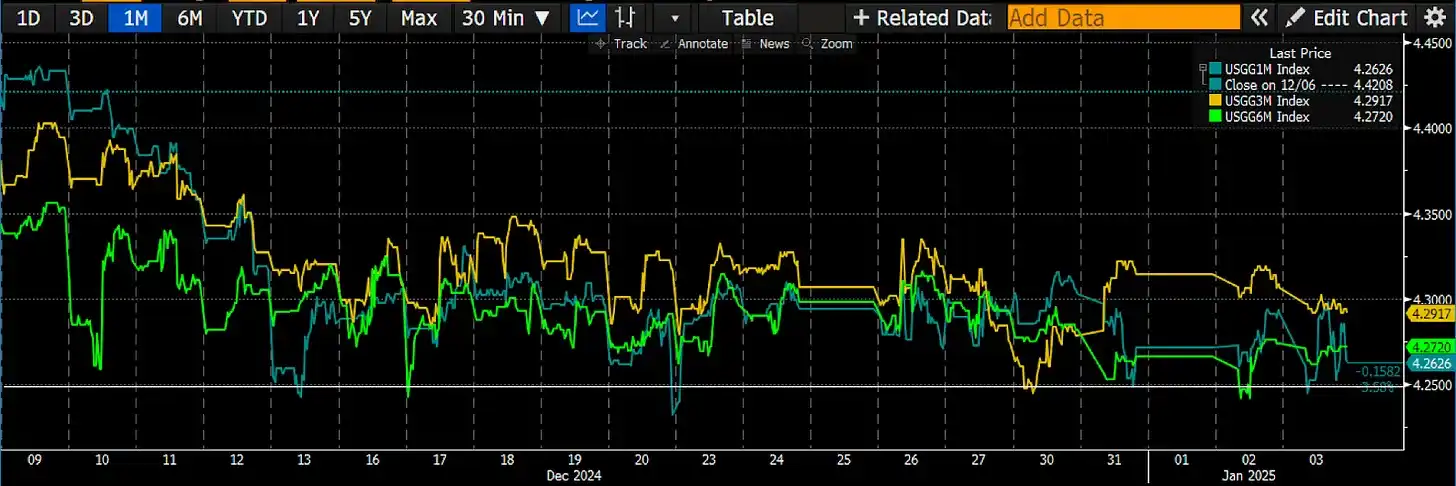
Following the RRP rate change on December 18th, the yield on Treasury bills maturing within 12 months has exceeded 4.25% (white), which is the Federal Funds Rate floor.
The Federal Reserve will reduce liquidity by $180 billion through Quantitative Tightening (QT), and the adjustment of the incentive rate by the Fed leading to a decrease in RRP balances will further drive an additional $237 billion liquidity injection. This collectively means a net liquidity injection of $570 billion.
Treasury Department
'Bad Girl' Yellen has informed the market that she expects the Treasury Department to commence 'extraordinary measures' between January 14th and 23rd to fund the U.S. government. The Treasury Department has two options to pay government bills: either issue debt (negative impact on USD liquidity) or draw funds from its Treasury General Account (TGA) at the Fed (positive impact on USD liquidity).
As the total debt cannot be increased until Congress raises the debt ceiling, the Treasury Department can only draw funds from its TGA. Currently, the TGA balance stands at $722 billion. The first big question is when will lawmakers agree to raise the debt ceiling. This will be a crucial test of Trump's support within the Republican legislature. Remember his governance margin—Republicans hold a very slim majority over Democrats in both the House and the Senate.
Some Republicans like to puff their chests out and grandstand. Every time the debt ceiling issue is brought up, they claim to care about shrinking the size of the bloated government. They will delay the vote to increase the debt ceiling until they secure some hefty returns for their districts.
Trump has failed to convince them that if the debt ceiling is not raised, he will veto the spending bills at the end of 2024. Democrats, after experiencing a 'transgender bathroom'-style disaster in the last election, are unlikely to help Trump unlock government funds to achieve his policy objectives.
Harris in 2028, anyone interested? In fact, the Democratic presidential nominee will be the silver-haired man Gavin Newsom. Therefore, to advance affairs, Trump will wisely not bring up the debt ceiling issue until absolutely necessary before proposing any legislation.
When failing to raise the debt ceiling could lead to a technical default on national debt or a full government shutdown, raising the debt ceiling becomes crucial. Based on the Treasury's 2024 budget data, I estimate this situation will occur between May and June this year, at which point the TGA balance will be fully depleted.
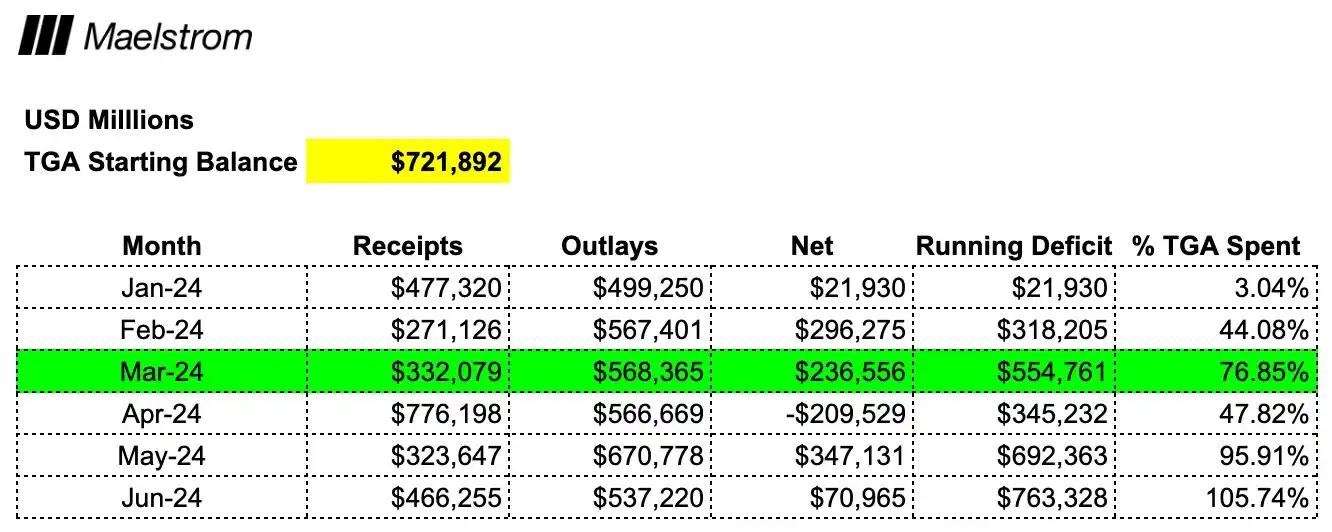
Visualizing the speed and intensity of TGA (Treasury General Account) usage can help predict the moment of maximum impact of fund usage, as the market is forward-looking. Given these data are all public, and we know that when the Treasury cannot increase the total U.S. debt and the account is nearing depletion, the market will seek new sources for USD liquidity. At a utilization rate of 76%, March seems to be the moment when the market will ask, "What's next?"
If we add up the total USD liquidity amounts from the Fed and the Treasury to the end of the first quarter, it amounts to $612 billion.
What Will Happen Next?
Once default and shutdown loom, a last-minute agreement will be reached, and the debt ceiling will be raised. By then, the Treasury will be able to borrow again in a net borrowing manner and will have to refill the TGA. This will have a negative impact on USD liquidity.
Another important date in the second quarter is April 15, the tax deadline. As seen in the table above, government finance improves significantly in April, which is negative for USD liquidity.
If the factor affecting the TGA balance is the sole determinant of cryptocurrency prices, then I expect a local market top to occur by the end of the first quarter. In 2024, Bitcoin reached a local high of around $73,000 in mid-March, then entered a consolidation phase and began a months-long decline before April 11, just prior to the tax deadline.
Trading Strategy
The issue with this analysis is that it assumes USD liquidity is the most critical marginal driver of global legal tender liquidity. Here are some other considerations:
· Will China accelerate or decelerate the creation of Renminbi credit?
· Will the Bank of Japan start raising interest rates, causing USD-JPY to appreciate and unlocking leveraged carry trades?
· Will Trump and Bennett conduct large-scale overnight devaluation of the USD relative to gold or other major legal tender currencies?
· How efficient is the Trump team in rapidly reducing government spending and passing bills?
These key macroeconomic issues cannot be predetermined, but I am confident in the mathematical model of how RRP and TGA balances evolve over time. My confidence has been further validated, especially from September 2022 to the present market performance: as RRP balances decreased, the increase in dollar liquidity directly led to the rise of cryptocurrency and stocks, despite the Fed and other central banks hiking rates at the fastest pace since the 1980s.
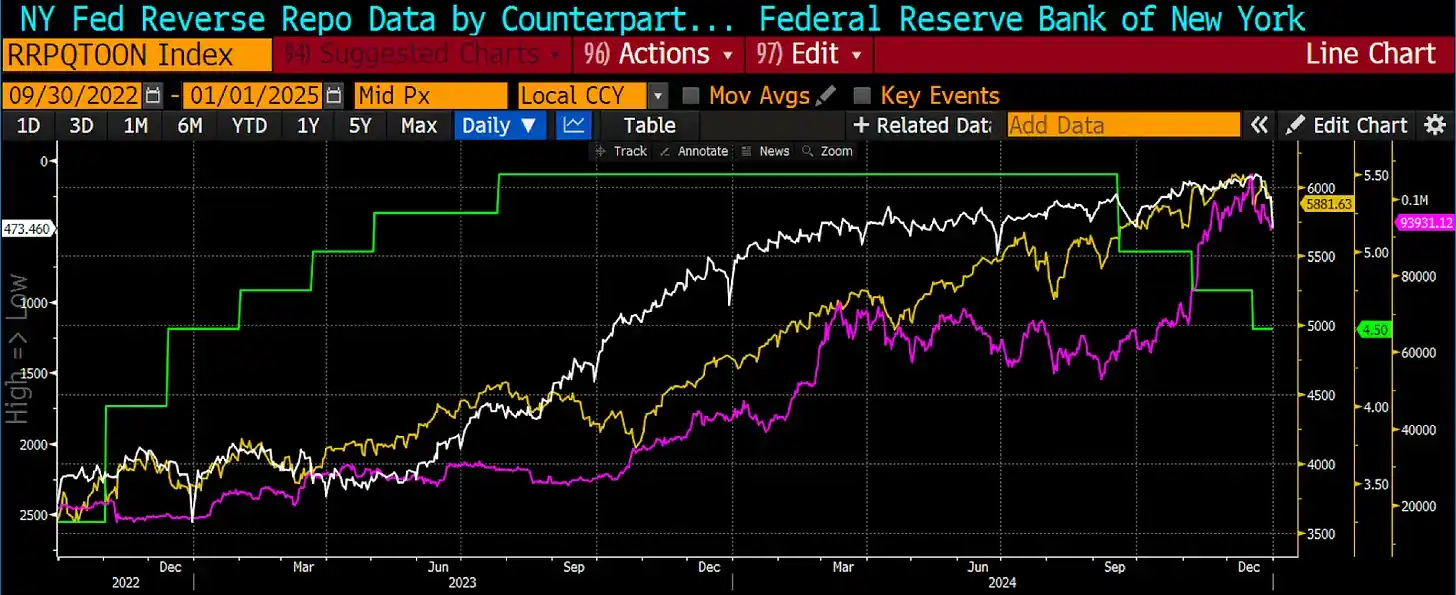
FFR Ceiling (right, green) compared to Bitcoin (right, magenta) and S&P 500 Index (right, yellow) against RRP (left, white, inverted). Bitcoin and stocks bottomed in September 2022 and rebounded on the decline of RRP, injecting over $2 trillion of dollar liquidity into the global markets. This was a deliberate policy choice by the "Bad Girl" Yellen to siphon off RRP by issuing more treasuries. Powell's financial tightening actions to address inflation have completely backfired.
Despite various warnings, I believe I have answered the initial question I posed. That is, the disappointment from the failure of the Trump team to deliver on its proposed legislation supporting cryptocurrency and business can be offset by an extremely positive dollar liquidity environment, with the first-quarter dollar liquidity increase peaking at $612 billion.
As almost every year like clockwork, as planned, the end of the first quarter will be a time to sell, take a break, go to the beach, nightclubs, or ski resorts in the Southern Hemisphere, waiting for a turnaround in third-quarter dollar liquidity conditions.
As the Chief Investment Officer of Maelstrom, I will encourage risk takers in the fund to adjust their risk to "DEGEN" (extreme risk) mode. The first step towards this direction is our decision to venture into the emerging field of Decentralized Science (DeSci). We like undervalued meme coins and have bought BIO, VITA, ATH, GROW, PSY, CRYO, NEURON.
If you want to delve deeper into why Maelstrom believes the DeSci narrative may be repriced higher, please read "Degen DeSci". If things go as smoothly as I described, I will recalibrate benchmarks in March and enter the "909 Open High Hat" phase. Of course, anything can happen, but overall, I am bullish.
Perhaps Trump's market sell-off will occur between mid-December 2023 and the end of 2024, rather than mid-January 2025. Does that mean I'm sometimes a lousy prophet? Yes, but at least I can absorb new information and opinions and adjust to them before they lead to significant losses or missed opportunities.
This is why the investment game is intellectually engaging. Imagine how dull life would be if you hit a hole-in-one every time you swung, made every three-pointer in basketball, or sank every shot in pool.
You may also like

Unveiling the Movement Liquidity Provider Sell-Off Scandal: Secret Contracts, Shadow Advisors, and Hidden Intermediaries
Key Market Insight Discrepancy on May 2nd - A Must-Read! | Alpha Morning Report
Arthur Hayes Interview: Bitcoin Has Bottomed, Which Tokens Can Outperform Bitcoin?
WLFI Holdings Token Analysis: Did the Trump Family's Crypto Investment Pay Off?
Key Market Information Gap on April 24th, A Must-See! | Alpha Morning Report
Rejecting Mediocrity: A Web3 College Student Portrait
Arthur Hayes New Article: Bitcoin to Return to “Gold Tier” Safe Haven, Altseason to Potentially Follow
Farcaster Metamorphosis: a16z Spends $180M to Demolish Web3 Social
Key Market Insights for April 17th, how much did you miss out on?
SEC Watershed Moment? 2025 Could Be the 'Altcoin ETF' Year, Which Tokens Are Most Likely to Be Approved
This Week in Review | Strategy Adds BTC Sell Risk Warning Sparking Debate; US Tariff Policy Flip-Flops Cause Market Turbulence
Rate Cut Countdown: $9 Trillion National Debt "Maturity Wall" Could Be the Cryptocurrency Market's Most Powerful Catalyst
Binance Launches New Round of Voting, Off-Exchange Vote Manipulation Reaches New Heights
Global Stock Markets Face Worst 3-Day Performance in 50 Years, Can the Crypto Market Hold Up?
Just one week after U.S. President Trump signed the executive order on "reciprocal tariffs," the U.S. stock market experienced a two-day crash, with a market value loss of about $6.6 trillion. Despite Trump's "tariff" turmoil washing over the global markets, he seems unconcerned and instead went to his private club in Florida to vacation and play golf.
On his way back from Florida to Washington on April 6, aboard Air Force One, Trump gave a media interview about the global market turmoil caused by last week's stock market crash. His view on the current market plunge was, "Sometimes you have to take medicine to solve a problem." After Trump made the "take medicine" remark, Nasdaq 100 futures continued to decline, dropping over 6%. Can taking medicine really solve the problem?
Following Trump's "take medicine" remark, global stock markets and the cryptocurrency market entered a waterfall crash mode. The cryptocurrency market took a heavy blow this morning, with Bitcoin falling below $78,000, a 6.89% drop in 24 hours. Ethereum fell below $1,600, a 13.19% drop in 24 hours. SOL dropped below $110, a 11.94% drop in 24 hours. According to Alternative data, today's crypto fear and greed index dropped to 23, compared to the weekly average and yesterday's both at 34, indicating the market sentiment is in a state of "extreme fear."
In the past 24 hours, a total of 290,000 users globally have been liquidated, with a total liquidation amount of $893 million, of which long positions account for $762 million.
The Nikkei Futures Index opened for trading for 10 minutes, and the Nikkei average index plummeted by over 8%, dropping more than 2,500 points, breaking through the key level of 32,000 points. An announcement on the Japan Exchange Group website stated that the TOPIX futures circuit breaker was triggered at 08:45:31 Japan time and was restored at 08:55:41. This is the first time since August 5 last year that the index has fallen by more than 2,500 points, when concerns about the U.S. economy led to a single-day stock market plunge of more than 4,000 points, dubbed the "Reiwa Black Monday."
The Korea Composite Stock Price Index (KOSPI) reported 2,357.28 points at 9:02 am local time, a sharp drop of 108.14 points, representing a 4.39% decline from the previous trading day. KOSPI also activated the sidecar mechanism, suspending trading for 10 minutes. European stock index futures continued last week's declines, with EURO STOXX 50 index futures dropping by 4.3%, Germany's DAX index futures falling by 5.0%, and the UK's FTSE 100 index futures declining by 4.1%. After the Taiwan Stock Exchange opened, a circuit breaker was triggered, with TSMC and Foxconn both dropping by nearly 10%, and the Taiwan Weighted Index falling by close to 10%.
According to The Kobeissi Letter, the U.S. stock market lost $11.1 trillion in value over 44 trading days, roughly equivalent to 38% of the U.S. GDP. The S&P 500 futures extended their losses to -4.5%, with a cumulative drop of -15% over the past three days.
Due to the U.S. stock market futures declining by over -15% for three consecutive days, brokerages issued a circuit breaker warning yesterday. The Chicago Mercantile Exchange has circuit breakers set at 7%, 13%, and 20%. A 7% or 13% circuit breaker would trigger a 15-minute trading halt; if the level reaches 20%, the market would close for the day. According to the Daily Mail, hedge funds are facing Lehman-style margin calls due to the market collapse triggered by President Trump's tariff measures.
Note: Lehman-style margin calls refer to an extreme scenario where a market experiences a sharp decline, investors or institutions face significant losses due to high leverage, and brokerages or clearinghouses demand additional margin. However, because of illiquidity or panic, investors are unable to raise funds, ultimately leading to forced liquidation or bankruptcy. This situation could potentially trigger broader systemic risks, similar to the "domino effect" seen during the Lehman Brothers bankruptcy.
Some professionals have pointed out that Nasdaq 100 index futures are down 6.07%, and S&P 500 index futures are down 5.97%. If this situation is accurate, it will be the worst three days for the market performance since "Black Monday" in 1987, even worse than during the COVID-19 pandemic.
Just as the week has begun, the market has delivered a shock to the world, and several key meetings this week will serve as a turning point for the market. Among them, the "reciprocal tariffs" measures may start on April 10, the Federal Reserve's March monetary policy meeting minutes will be released on April 10, March PPI inflation data and University of Michigan consumer sentiment data on April 11.
Treasury Secretary Benson stated, "My current advice to every country is not to retaliate, not to take action, observe the situation, and see how things develop. Because if you retaliate, the situation will escalate. If you don't retaliate, then the current situation is capped."
The countries depicted on the "reciprocal tariffs" sign have split into two camps over the past week: those bowing to the U.S. and adopting a wait-and-see approach, and those strongly retaliating. Currently, Vietnam, Argentina, and Israel have eliminated all tariffs on the U.S., India intends to impose nearly zero tariffs on the U.S., while Mexico, Japan, and the UK do not plan to impose U.S. tariffs.
Singapore Prime Minister Lee Hsien Loong delivered a speech on April 4, stating, "This marks a significant shift in the global order. The rules-based globalisation and free trade era has ended, and we are now entering a new age, a more dangerous phase of rising protectionism. The calm and stability of the global economy that we are familiar with will not return quickly."
On the other hand, China has become the world's first country to retaliate with "tit-for-tat tariffs," announcing a 34% retaliatory tariff against the United States. President Trump, on his social media platform "Trust Social," stated that China made the wrong decision in this matter. The European Union is also preparing to vote on April 9 on how to impose retaliatory tariffs on certain U.S. products. European Trade Commissioner Phil Hogan, after meeting with U.S. officials, stated that the EU is willing to negotiate but is also prepared to defend its own interests.
However, BitMEX's co-founder Arthur Hayes is quite optimistic about this. He believes that volatility is back and says it will be an interesting week. He also mentioned that the Bond Volatility Index, "MOVE Index," is deeply related to when the Federal Reserve will back off and start up the printing press. "The higher this index rises, the more likely institutions trading leveraged government or corporate bonds are to be forced to sell due to increased margin requirements, and these are precisely the two markets where the Fed will fight tooth and nail to support. When MOVE breaks above 140 (currently at 127), it will be an opportunity for the market to get rich after the market crash and the Fed's liquidity injection."
On April 7, Donald Trump Jr., serving as a strategic advisor, made a prediction through the prediction market Kalshi that the likelihood of a U.S. economic recession by 2025 has surged to 68%, reaching the highest level in months. J.P. Morgan Chase also seems to share the same concerns, according to Watcherguru's report, J.P. Morgan is calling on the Federal Reserve to cut interest rates before the next meeting.
Meanwhile, some traders believe that this crisis may also be an opportunity. Top trader Eugene Ng Ah Sio expressed in his personal channel, "This downturn is not only in the cryptocurrency market but also an unprecedented turbulence in the entire stock market. I vaguely feel that, as long as the response is appropriate, when this storm passes, perhaps it can create enough wealth to change destinies. But for now, survival is key."
Founder of Formula News, Vida, believes that "the current U.S. stock market is similar to 2022, where it overprices an expectation that is not actually as serious. This round of U.S. stock market correction is similar to 2018, 2022, occurring periodically (every 2-3 years), rather than a financial crisis like 2008, 2020 (every 10 years)." He predicts that the market's turning point will occur in Q1 2026, and during this period, he will gradually begin buying shares of his favorite U.S. tech companies. If there is another major market plunge during this period, he will accelerate his buying pace.
However, the true market trend still needs to be validated over time. Nevertheless, we have entered a phase where conservative investment is necessary. Sometimes we may have to swallow "this pill," but what every investor must learn is how to navigate the risk after swallowing the pill.
Market's Darkest Hour: Global Assets Plunge in Sync, Crypto Market Cap Down 10%, When Will the Dawn Break?
The global financial market is currently experiencing a dark hour as a storm triggered by U.S. President Donald Trump's new tariff policy sweeps through major asset classes. At the Monday opening, the U.S. stock futures market was bleak, with S&P 500 futures down 3.2%, Nasdaq 100 futures plummeting 5.7%, the VIX fear index futures skyrocketing by 34.4% to 45.8, reaching the highest level since 2022. Safe-haven sentiment drove up the price of the 10-year U.S. Treasury bond, the Japanese yen appreciated by 1.3% against the U.S. dollar, and spot gold fell to $2988.61 per ounce.
Last Thursday, the S&P 500 Index plunged 4.8% to close at 4850 points, marking the largest single-day drop since 2024. On Friday, the selling frenzy further engulfed the market, with the Dow Jones Industrial Average plummeting 2231 points, a 5.5% decline, closing at 38900 points, wiping out nearly two months of gains. The tech-heavy Nasdaq Composite Index fell by 11.8% over two days, officially entering bear market territory. Big Tech performed poorly: Apple fell to $205, a 5.5% drop; Tesla plunged by 10.3% intraday, closing at $310; NVIDIA saw its market value evaporate by over $300 billion in a single day, a 9.1% drop. Global stock markets came under pressure simultaneously, with the Japanese Nikkei 225 Index falling by 5.6% at Monday's opening, triggering a 7% circuit breaker during the session, halting trading for 15 minutes; the South Korean KOSPI Index fell by 4.9%, hitting a six-month low; and the European STOXX 600 Index opened down by 3.8%.
The commodities market also did not escape unscathed. Gold broke below the $3000 per ounce psychological barrier, hitting a low of $2988.61, a 1.9% drop, while silver fell by 2.3% to $34.50 per ounce. The energy market suffered heavy losses, with WTI crude oil futures dropping to $59.80 per barrel, a 12% decline from the previous week's high, hitting a new low since April 2021; Brent crude fell to $63.20 per barrel. Industrial metal prices slid, with COMEX copper falling by 8.2% to $3.85 per pound, reflecting the market's pessimistic outlook on global manufacturing. The foreign exchange market saw heightened volatility, with the Australian dollar falling by 1.1% against the U.S. dollar to 0.6350, the euro weakening by 0.9% against the U.S. dollar to 1.0450, and the U.S. dollar index rising to 104.50, reaching a three-month high.
The cryptocurrency market has failed to escape its fate as a risk asset. CoinMarketCap data shows that the global crypto market cap has shrunk from $2.4 trillion to $2.16 trillion, a 10% decrease. Bitcoin fell by 6%, hitting a low of $77,100; Ethereum dropped by 12.4% to $1,540; the crypto market's performance is highly synchronized with the Nasdaq, highlighting its nature as a "high-beta asset." The total liquidation amount across the market in the past 24 hours was $886 million.
Concerns in the bond market are also escalating. The MOVE Index (Merrill Lynch Option Volatility Estimate Index), a gauge of the implied volatility of U.S. bonds, has surged from 108.50 at the end of March to 125.71, a 15.8% increase. BitMEX co-founder Arthur Hayes pointed out, "To predict when the Fed will capitulate and ease significantly, the MOVE Index is a key indicator. The higher the index, the higher the margin requirements for bond and credit financing trades, and selling pressure will sweep through the market. This is an area the Fed will fight to the death to defend. If it breaks above 140, easing is inevitable." The current level is just a step away from the critical point, indicating that greater turmoil is on the horizon.
Facing a market meltdown, the Trump administration has shown an unusually calm demeanor. Treasury Secretary Steven Mnuchin stated on Sunday, "Market volatility is temporary, and the economic fundamentals have not collapsed." Commerce Secretary Robert Lighthizer took a tough stance, saying, "Tariffs are a necessary safeguard for the U.S. economy and will not retreat." Trump posted on the social platform "True Social," saying, "Don't be afraid, this is just a little episode on the way to prosperity." Hayes analyzed, "Many of Trump's core voters do not hold stocks or financial assets. For them, a market downturn even brings a psychological satisfaction towards the 'Wall Street elite.' This gives Trump the confidence to push tariffs because he knows the votes will not be lost."
However, the market remains unmoved. U.S. federal funds futures show that investors are betting on a 120-basis-point interest rate cut by the Fed this year, implying an expectation of five 25-basis-point rate cuts. JPMorgan predicts that the Fed may start cutting rates from May onwards and lower the federal funds rate to 2.75%-3.0% by January 2026. Goldman Sachs warns that if tariffs are fully implemented, the U.S.' GDP growth rate for 2025 may be revised down to 1.2%, while the inflation rate could rise to 3.8%, putting the Fed in a dilemma. An anonymous Wall Street hedge fund manager stated, "Investors no longer believe in the government's optimistic promises, they only look at the data and the Fed's next move."
Trump's remarks have further exacerbated uncertainty. He shared a video on "Truth Social," implying his intention to cause a 20% stock market drop to boost Treasury demand, weaken the dollar, and lower mortgage rates. White House economic advisor Kevin Hassett urgently clarified: "This is just the President's personal idea, not a policy objective." However, market trust has been severely damaged, with the VIX index rising further to 47.2 in pre-market trading on Monday.
The current situation evokes historical crisis moments. In 1987, on "Black Monday," the Dow Jones Industrial Average plummeted by 22.6% after a weekend panic, setting a record for the largest single-day drop. The meltdown crisis triggered by the COVID-19 pandemic in March 2020 was more recent, with the S&P 500 index hitting the circuit breaker four times in 10 days:
In this crisis, the S&P 500 index dropped from 3393 points at the end of February to 2237 points on March 23, a drop of over 34%. Bitcoin's performance was particularly brutal, plummeting by 39.5% on March 12, marking a rare single-day drop in the crypto market. Notably, Bitcoin failed to break away with an independent trend but instead became highly correlated with the Nasdaq, amplifying the tech stock performance. CNBC commentator Jim Cramer pointed out: "The lesson of 2020 is that Bitcoin is no longer a safe haven asset but rather a 'large-cap Nasdaq,' with a risk exposure far exceeding the traditional stock market." Today, the same pattern is repeating: Bitcoin's correlation with the Nasdaq 100 has recently risen to 0.85, much higher than gold's 0.12, indicating its vulnerability in a panic environment.
History also reveals a turning point. After each circuit breaker in 2020, the market's short-term panic intensified, but the Federal Reserve promptly cut interest rates to zero and launched unlimited QE, ultimately stabilizing the situation. While the turmoil caused by Trump's tariffs was policy-driven, the panic eruption on Monday followed a similar pattern. Cramer added: "The commonality between 1987 and 2020 is that fear brewing over the weekend spiraled out of control on Monday. Today, the opacity of the trade war leaves investors nowhere to hide."
The ripple effects of this storm have swept across the globe. China's Ministry of Commerce stated on Sunday: "Resolute measures will be taken to counteract." The EU's trade commissioner warned of possible tariffs on U.S. cars and agricultural products. India and Brazil are also evaluating retaliatory measures. A 7.2 magnitude earthquake in Myanmar last week further disrupted the rare earth and semiconductor supply chain, driving up tech manufacturing costs. Morgan Stanley estimates that if the supply chain crisis persists, global economic growth could be revised down by 0.5 percentage points by 2025.
Hedge assets have become a rare bright spot. The 10-year U.S. Treasury yield fell by 10 basis points to 3.89%, while the 2-year yield fell by 19 basis points to 3.46%. Bloomberg data shows that the global negative-yield bond market has grown to $16.5 trillion, reaching a high not seen since 2023. The Japanese yen rose to 148.50 against the U.S. dollar, and the Swiss franc increased by 0.8%. Although gold has experienced a short-term pullback, it remains attractive in the long run, with UBS predicting it may return to $3100 per ounce by year-end.
The Federal Reserve is facing unprecedented pressure. Tariffs may raise import costs, and inflation concerns have emerged—Goldman Sachs estimates that if a 34% tariff is implemented, the U.S. CPI could rise by 1.2 percentage points in 12 months. However, a market crash and bond volatility are forcing accommodation. Hayes's MOVE Index theory has become a focal point: "As the MOVE Index rises, the financing cost of bond trading surges, and selling pressure will transmit to the financial system. The Fed has no choice but to act. 140 is the critical point." The current index has reached 125.71, and if panic intensifies on Monday, it may quickly surpass this level.
There is disagreement within the Fed. Hawkish officials advocate waiting for inflation data, while doves warn that delays could trigger systemic risks. Chicago Fed President Evans stated, "When markets are in disarray, monetary policy must be decisive." The market expects the May FOMC meeting to potentially initiate a rate cut, with a magnitude of up to 50 basis points.
Hedge fund manager Bill Ackman has proposed another possibility: "If Trump announces a tariff delay on Monday to seek negotiation space, the market may catch its breath." However, he also warns that if the policy remains tough, the S&P 500 could fall another 10%, and the risk of an economic recession could increase from the current 35% to 60%. Ackman concludes, "In any case, this Monday will determine the direction of the next few months."
Although this earthquake is chilling, it may herald a turning point. After the 2020 circuit breaker, the Fed's decisive intervention reversed the decline. Now, with the MOVE Index sounding the alarm, the pressure for rate cuts is mounting. If the Fed gives in, accommodative policies could inject vitality into the market and reignite investor confidence. History tells us that the deepest darkness often comes before the dawn. The tug-of-war between Trump's tough stance and the market's fragility makes the Fed's decision a decisive variable.
The calls for rate cuts are growing louder—perhaps this is the first ray of sunshine after the storm. For investors, the gold pullback may be a buying opportunity, and the tech stock slump is a litmus test of patience. As Ackman said, this Monday will go down in history, and the Fed's actions may unexpectedly bring this crisis to a close.
Original Article Link
This Week in Review | US Imposes Additional Tariffs Leading to Market Plunge; Blockchain Gaming Projects Face Financial Crisis
BlockBeats will summarize the industry's key news content for the week (3.31-4.6) in this article and recommend in-depth articles to help readers better understand the market and grasp industry trends.
On April 3, Trump announced in the White House Rose Garden that the U.S. would impose a comprehensive 10% tariff on all imports. The detailed tariff measures for each country are as follows: 46% tariff on Vietnam; 10% tariff on the UK; 31% tariff on Switzerland; 49% tariff on Cambodia; 36% tariff on Thailand; 30% tariff on South Africa; 32% tariff on Indonesia; 10% tariff on Brazil; 10% tariff on Singapore. A 20% retaliatory tariff will be imposed on the EU on a country-by-country basis; a 24% tariff will be imposed on goods imported from Japan. Due to the 10% comprehensive tariff, which was at the low end of the previous expectations (10%-20%), Bitcoin briefly surged by 2.7% that evening, breaking through $88,000. However, after the detailed tariff announcement, Bitcoin quickly fell by 3.35%, Nasdaq futures plummeted, widening the decline to 1.2%, and the U.S. Dollar Index (DXY) also experienced a 0.5% fluctuation. Additionally, it is worth noting that energy commodities are exempt from Trump's comprehensive tariff, including crude oil, natural gas, and refined oil products.
On the same day, U.S. Treasury Secretary Benson wrote, "I suggest that all countries refrain from taking retaliatory action. We can see if there will be a different lower limit for tariffs (from the announced numbers). Trump's mindset might be to temporarily stabilize things. I was not part of the negotiations, but we will see if there are any negotiations before April 9 (the effective date of retaliatory tariffs)." Previously, senior White House officials stated that the base tariff rate (10%) would take effect early on April 5, and the retaliatory tariffs would take effect early on April 9. Related Readings: "U.S. Stock Market Evaporates $2 Trillion in 15 Minutes, Is the 'Retaliatory Tariff' the Last Straw for the Bull Market?", "How Do Tariffs Stir Up Cryptocurrency Prices?"
On April 2, Justin Sun posted on social media claiming that the FDUSD issuer, First Digital Trust (FDT), had actually gone bankrupt and was unable to fulfill customer fund redemption obligations. He strongly advised users to take immediate action to protect their assets. Subsequently, FDUSD temporarily plummeted below $0.9. As a result, several FDUSD-related trading pairs on Binance experienced extreme price surges: BTC reached a high of 98,950 FDUSD, and ETH reached a high of 2165 FDUSD. Since FDUSD is the new stablecoin supported by Binance after BUSD was delisted, Binance, as the primary use case, responded to this news by stating that a 1:1 redemption is possible.
In the early hours of the 3rd, Justin Sun once again posted stating that this FUD was only directed at FDT and not at Binance. At noon on the 3rd, First Digital issued a statement denying Sun's claims, mentioning that the initial redemptions after the FUD had already been processed. FDUSD is still fully backed at a 1:1 ratio, its redemption channels are operating smoothly, and all redemption requests will continue to be processed promptly.
According to reports from Hong Kong media, Wu Kit-chee, Chairman of the Web3 and Virtual Asset Development Subcommittee of the Hong Kong Legislative Council, responded to the dispute between Justin Sun and FDT by suggesting that regulatory systems should be reviewed as soon as possible. Wu Kit-chee stated that due to the current lack of regulated custodianship, Web3 companies rely on trust companies to help third parties custody assets. While conducting this properly is not an issue, there are individuals who may take advantage of this gap to engage in illegal activities, raising concerns about trust in Hong Kong's financial center. He recommended that the authorities should do more in terms of education and review to optimize the existing framework.
On April 3, during a live press conference, Justin Sun stated, "We have over $500 million USD deposited in FDT but cannot withdraw." He also called on FDT to hire a third-party auditing firm to conduct an audit, believing that the audit results would show FDT is insolvent. He further mentioned that due to FDT's failure to pay investment interest in 2023, Techteryx conducted an investigation and found a significant amount of client funds had been misappropriated. Justin Sun personally provided assistance to Techteryx to ensure TUSD had sufficient liquidity to protect the interests of all TUSD holders. TrueCoin was implicated in colluding with FDT and illegally transferring $456 million USD of TUSD reserves to a company in Dubai. Justin Sun stated, "I will provide a $50 million reward to law enforcement agencies and tipsters to recover the $456 million USD." First Digital later responded to the allegations stating that the dispute only involved TUSD and was completely unrelated to FDUSD. First Digital has more than enough liquidity to meet its obligations. It also described this as a typical smear campaign by Justin Sun aimed at undermining its business competitors. Related Reading: "FDUSD Depegging Crisis: Justin Sun Accuses FDT of Embezzling $456 Million, Latter Denies Insolvency"
On April 1st, several meme tokens experienced a sharp decline in prices, with ACT plummeting over 50% briefly; DEXE dropping over 28% briefly; and DF plunging over 17.7% briefly, among others. This sell-off was triggered by a large number of short-term sell orders, leading to a significant increase in spot trading volume. Subsequently, crypto influencer Benson Sun analyzed in a post stating, "ACT suddenly flash crashed by 50%, as Binance adjusted ACT's leverage position limit, allowing a maximum position of only $4.5 million at 1x leverage. Some market makers' positions exceeded the limit, leading to liquidation at market price, causing a collapse in the contract price and a massive price spread between the contract and spot markets, resulting in a cascade sell-off in the spot market as well." Wintermute's founder and CEO, Evgeny Gaevoy, responded to community skepticism claiming, "The flash crash was initiated by Wintermute's dumping," stating, "It has nothing to do with us, but I'm curious to know what happened in the aftermath analysis." He also added, "If you ask me to guess, we reacted only after the price violently fluctuated, arbitraging the AMM pools."
In the early hours of April 2nd, Binance responded to the sudden fall in prices of certain meme coins like ACT, stating, "Upon preliminary investigation, we found that individual low-market-cap tokens experienced a cascading drop event, including 3 VIP users engaging in roughly $514,000 USDT worth of token cross-market sell-offs within a short period and a non-VIP user transferring a large amount of ACT from another platform, selling around $540,000 USDT worth of tokens on the spot market in a brief timeframe. As prices dropped, some users' futures contracts were liquidated, leading to a drop in other tokens as well." It is worth noting that in the following days, tokens such as MASK, LEVER, TROY, CATI, among others, once again experienced a significant volume-driven decline, with trading volume spiking 5 to 10 times higher than usual. Related Read: "ACT Flash Crash Night: When Exchange 'Circuit Breaker' Turns into a Bearish Bullet"
On April 1st, according to Slow Mist monitoring, the zkLend hacker (from an incident in February) mistakenly clicked on a phishing website while attempting to use Tornado Cash, leading to the theft of 2930 ETH. The hacker then sent an on-chain message to zkLend, stating, "Hello, I intended to transfer the funds to Tornado Cash, but I mistakenly used a phishing site, and as a result, all funds were lost. I am devastated. I deeply apologize for the chaos and loss caused by this. All 2930 ETH has been taken by the operators of that site. I have no coins left in my possession. Please focus your efforts on those site operators to see if any funds can be recovered."
On the same day, the zkLend team released a statement indicating that the phishing website appears to have been operational for over 5 years. At this stage, the security team has no concrete evidence linking the phishing site to the attackers. As a precautionary measure, zkLend has incorporated these new wallet addresses from the phishing site into its fund tracking efforts for real-time monitoring and has been in contact with CEX and authorities. The team will continue to actively track these funds. Related reading: "zkLend Hacker Also Hacked, Is the On-Chain Apology Truly Remorseful or Staged?"
On April 1, according to HTX market data, Bitcoin had a first-quarter return of -11.82%, and Ethereum had a first-quarter return of -45.41%, marking their worst performances to date since 2019. In 2018, Bitcoin saw a first-quarter return of -49.7%, and Ethereum had a first-quarter return of -46.61%. Additionally, historical data indicates that Bitcoin typically performs well in the second quarter, with a 12-year average quarterly return of 24.86% and a median quarterly return of 7.19%. However, its performance has been lackluster in the past five years as follows: a 42.33% increase in Q2 2020, a 40.36% decline in Q2 2021, a 56.2% decline in Q2 2022, a 7.19% increase in Q2 2023, and an 11.92% decline in Q2 2024. In April over the past 12 years, Bitcoin has seen 7 increases and 5 declines, with a monthly average return of 12.03% and a monthly median return of 2.81%. However, its performance has been mediocre in the past five years with: a 34.26% increase in April 2020, a 1.98% decline in April 2021, a 17.3% decline in April 2022, a 2.81% increase in April 2023, and a 14.76% decline in April 2024.
On April 1, the publicly traded U.S. cryptocurrency exchange Coinbase experienced its worst quarter performance since the 2022 FTX exchange crash, with its stock price declining by 33% in the first quarter of 2025. Despite strong revenue expectations, Coinbase's stock price still suffered. Coinbase is expected to release its 2025 financial data in early May. The company's recent shareholder letter indicated that as of February 11, the company had generated approximately $750 million in transaction revenue and expects subscription revenue to be between $685 million and $765 million. While Coinbase has not yet disclosed first-quarter profit data, MarketBeat analysis estimates its profit to be around $1.87 billion. Coinbase is not alone as most publicly listed crypto companies reported similar results in the first quarter of 2025. Leading crypto mining company Marathon Digital Holdings saw its stock price near $17.5 at the beginning of the first quarter and closed at $11, a loss of over 37%.
On March 30, according to 8marketcap data, Ethereum's market cap dropped to $218.73 billion, with a 7-day decrease of 9.98%, ranking it 68th on the global asset market cap list. McDonald's surpassed Ethereum with a market cap of $219.4 billion, placing it 67th on the global asset market cap list.
On April 1, according to CNBC, OpenAI completed a $40 billion funding round, bringing its post-investment valuation to $300 billion (including new capital). According to CB Insights data, this valuation makes OpenAI one of the highest-valued private companies globally, second only to SpaceX at $350 billion, alongside TikTok's parent company ByteDance. This round of funding was led by SoftBank from Japan, with an investment of $30 billion, and received support from a group of other investors, including key investor Microsoft, as well as institutions like Coatue, Altimeter, and Thrive. Sources revealed that the initial investment was $10 billion, with the remaining $30 billion expected to be in place by the end of 2025. However, this round of funding comes with a condition: if OpenAI fails to restructure into a profitable entity by December 31, 2025, the funding amount may be reduced by up to $10 billion.
On March 31, the SpaceX Crew Dragon began its sixth manned space mission (Fram-2) on April 1, marking humanity's first polar orbit manned spaceflight lasting 3 to 5 days. The launch took place from Launch Complex 39A at Kennedy Space Center in Florida, USA, on April 1. The crew for this mission consists of 4 astronauts, namely F2Pool co-founder Wang Chun, Janick Michelsen, Labéaurogue, and Anärykphillips. Wang Chun's team independently funded nearly $200 million for this flight plan, making it the first privately contracted polar orbit mission in commercial spaceflight history, with Wang Chun serving as the mission's commander. The spacecraft will enter a polar orbit with an inclination of 90° at an altitude between 425 and 450 kilometers. It will travel along the polar orbit, flying from over the South Pole to the North Pole, and then back from the North Pole to the South Pole, repeating this path. Related Read: "From Bitcoin Miner to Polar Astronaut: Wangchun's Magical Realism Rags-to-Riches Story"
On March 31, Elon Musk, during the "America PAC" town hall meeting held in Green Bay, Wisconsin on March 30, stated that the US government has no plans to use the cryptocurrency Dogecoin. He pointed out that the federal "Department of Government Efficiency (D.O.G.E.)" is not associated with Dogecoin, saying "they are just namesake, the government is not going to use Dogecoin, at least not that I know of." Despite this, the D.O.G.E. official website briefly displayed Dogecoin's Shiba Inu mascot in February, sparking market speculation about the government's relationship with cryptocurrency and driving DOGE up by 14%, with a market cap exceeding $580 billion. Related reading: "Musk Denies Relationship Between DOGE and US Government, Is Dogecoin Really Over?"
On April 3, Bitcoin developer Ruben Somsen wrote that the Bitcoin Development Group BitcoinDev's email list was "permanently removed" by Google. Ruben had previously stated, "To my knowledge, no inappropriate content has been posted." An update later stated, "It turns out we did receive more information, but it was all thrown into the spam folder (the irony). It's clear we have been 'permanently removed.' What was our fault? We were deemed 'unwanted content.' Really, Google? Is open-source development 'unwelcome'? It looks like we have to migrate again." Block CEO Jack Dorsey has retweeted in support of Ruben Somsen's tweet and questioned Google CEO Sundar Pichai.
On April 3, John, the Chief Contributor of the blockchain gaming ecosystem Treasure DAO, announced that due to worsening financial conditions, they are facing restructuring and will terminate game operations and the Treasure Chain. Documents show that their annual operating expenses are as high as $8.3 million, while the current treasury holds only $2.4 million, originally estimated to be sustainable only until July 2025. John, the Chief Contributor, has resumed a leadership role, revealing that the team once reached 40 people, with annual personnel costs of $6.1 million and infrastructure costs of $3 million, including a fixed annual cost of $450,000 for the Treasure Chain. Faced with survival pressure, the DAO has laid off 15 people, decided to terminate game issuance support and the Treasure Chain, and assist partners in migrating to other chains.
To extend the runway, John proposed withdrawing $785,000 in idle funds from the liquidity provider Flowdesk. If approved, the stablecoin balance will increase to $3.2 million, and operations can be optimistically extended until February 2026. Additionally, the ecosystem fund holds 22.3 million MAGIC tokens (valued at $2.3 million), but if the MAGIC price experiences a sharp decline, the DAO may struggle to continue between December of this year and February of next year. The future strategy will focus on four main products: Market, Bridgeworld, Smolworld, and AI Agent Expansion Technology, aimed at showcasing the utility of MAGIC through Smols and Bridgeworld and developing the Neurochimp agent to enhance market competitiveness.
According to Blockworks, the cryptocurrency shooting game "Shrapnel" developer Neon Machine is in a severe financial predicament. The company has now depleted nearly $86.9 million in operating funds. Despite generating $21.7 million in revenue in 2024, a net loss of $11.4 million was incurred due to $33 million in operating costs.
The company is currently burning $2-3.5 million per month, with cash reserves depleted and owing external vendors millions of dollars in debt. A new round of financing planned for early 2025 has failed to materialize. The company has already gone through at least three rounds of layoffs, reducing the workforce from nearly a hundred people to just over ten, with the Seattle headquarters closed at the end of March. Despite the concerning financial situation, Neon Machine still publicly claims to be in its "strongest state ever" and plans to globally launch "Shrapnel" by the end of 2025. However, insiders are skeptical of this assertion.
The social media app Phaver has ceased operations, with its token price plummeting by 99% since the September 2024 TGE. Phaver team members cited several reasons for the shutdown: first, technical issues during the TGE and airdrop prevented users from timely claiming their tokens, leading to FUD; second, Phaver spent over $1 million to list on five CEXs; and third, due to the depressed market sentiment, the team did not sell tokens during the TGE, resulting in insufficient operational funds.
As a Finnish company, Phaver still needs to pay severance costs equivalent to 1 to 2 months' salary to its employees. Some former team members are now developing SocialDAO to explore new use cases for the SOCIAL token.
On April 2nd, Binance announced the start of the second round of its Coin Listing Vote. The coins participating in this event include: VIRTUAL, BIGTIME, UXLINK, MORPHO, GRASS, ATH, WAL, SAFE, ZETA, IP, ONDO, PLUME. The voting period is from April 2, 2025, 21:30 to April 10, 2025, 07:59. During the voting period, users must be logged in with a verified account, hold at least 0.01 BNB in their main account for their vote to count. Each user can vote for up to 5 projects, with a maximum of one vote per project.
On April 1st, Binance Wallet announced a joint TGE event with PancakeSwap for the AI-driven Bitcoin asset management solution, PumpBTC, with a subscription line of 3BNB. On the same day, PumpBTC unveiled the PUMP tokenomics, with a total supply of 1 billion tokens, 9% of which will be used for airdrops. The breakdown is as follows: Community Ecosystem 38%; Initial PUMP Claim 9%; Marketing 5%; Liquidity 3.5%; Contributors 19.5%; Investors 20%; IDO 5%. In the early hours of April 2nd, PumpBTC concluded its allocation and token distribution, with a final input of 406,023 BNB, oversubscribed by 327.56 times.
On April 3rd, Binance Wallet listed the StakeStone TGE, with a total fundraising amount of $1,000,000 in BNB, and an open subscription of 50,000,000 STO tokens (5% of the total supply). The final input was 369,445 BNB, oversubscribed by 218.2 times.
On April 1st, according to a cybersecurity firm's monitoring, there were over 60 cryptocurrency hacking incidents in the first quarter of 2025, resulting in a total loss of $1.63 billion, a 131% increase from the first quarter of 2024's $706 million. In March 2025, there were 20 cryptocurrency hacking incidents, with losses totaling $33.46 million, including a $5 million hack affecting 1inch, of which 90% has been recovered.
On March 31, according to WSJ, the Trump family is actively advancing its cryptocurrency strategy, this time targeting Bitcoin mining. The president's two sons are investing in a Bitcoin mining company, further expanding the Trump family's footprint in the cryptocurrency business sector. The Trump sons' American Data Centers will merge with American Bitcoin and hold a 20% stake. American Bitcoin is a mining operation majority-owned by the publicly traded cryptocurrency mining company Hut 8. They plan to jointly build the world's largest digital currency mining enterprise and intend to establish their own "Bitcoin reserve."
On March 31, crypto reporter Eleanor Terrett tweeted that the House of Representatives will hold a hearing on cryptocurrency market structure legislation. The House Financial Services Committee's Digital Assets Subcommittee will hold a hearing next Wednesday, April 9, to discuss issues surrounding establishing a federal regulatory framework for digital assets. The hearing, titled "American Innovation and the Future of Digital Assets: Adjusting the US Securities Laws to the Digital Age," marks the first public push by the 119th Congress to establish rules regulating the operation of the $2.7 trillion crypto industry in the United States.
"US Stocks Evaporate $2 Trillion in 15 Minutes, Is 'Reciprocal Tariffs' the Final Straw that Broke the Bull Market's Back?"
Trump signed an executive order for "reciprocal tariffs," with the US imposing a 10% baseline tariff on trading partners and higher rates, up to 49%, on some countries. This move triggered intense market fluctuations, with Bitcoin and the stock market first rising and then falling, while gold hit a historic high. The tariff calculation method has been criticized as "pseudoscience," with widespread concern in the economic community that it will raise inflation, hit manufacturing and consumer confidence, and backlash against US companies, keeping the market in a wait-and-see mode on whether negotiations will be initiated.
"FDUSD Unpegging Crisis: Justin Sun Accuses FDT of Defrauding $456 Million, the Latter Denies Insolvency"
In the late night of April 2, Justin Sun accused the stablecoin FDUSD's issuer, First Digital Trust (FDT), of being insolvent, leading to a severe temporary depegging of FDUSD, causing market panic and user sell-offs, with the price dropping to as low as $0.76; despite Binance later debunking this and stating that FDUSD's reserve was sufficient, the price gradually recovered to $0.98. However, the incident exposed a trust crisis between Sun and FDT due to a TUSD custody dispute, also triggering community doubts about Binance's untimely disclosure of information and suspicion of "rug pulling."
"When ETH Fell Below $1800, What Is Vitalik Pondering?"
Vitalik recently published two blog posts expressing his in-depth thoughts on the relationship between real-world political culture and technological development, calling for a shift in focus from "public goods funding" to a clearer, more actionable "open-source funding." He proposed the "Tree Ring Model," suggesting that culture's attitude towards new and old things is deeply influenced by historical stages and is difficult to change rapidly, while the crypto space provides a relatively free soil suitable for nurturing new behavioral patterns. At the same time, he believes that the term "public goods" has been overused in practice, with "open source" having a clearer definition and more explicit practices, making it more suitable as a core concept for funding and innovation in the digital age.
"ACT's Flash Crash Nightmare: When the Exchange's 'Circuit Breaker Mechanism' Turns into a Short Selling Bullet"
On April 1, Binance adjusted the contract rules for some low-market-cap tokens, causing several tokens, including ACT, to halve in price in a short period, with a drastic drop in contract positions, triggering market panic and stampedes. Although Binance attributed the cause to whale sell-offs, on-chain anomalies of market maker Wintermute, synchronous price drops of some tokens, and user liquidation data all indicate that this flash crash was not a random event, but rather the result of factors such as the exchange's risk control adjustments, MEME coin liquidity fragility, and market maker high leverage strategies, exposing the limits of risk control in the crypto market and the structural disadvantages of retail traders.
"Circle's IPO Rush to a $50 Billion Valuation, Do Stablecoins Now Have Blue-Chip Stocks?"
Circle is accelerating its IPO plan, aiming for a valuation of 40 to 50 billion USD, and plans to submit its prospectus by the end of April. This is its second attempt to go public after the failed 2021 SPAC merger, amid clearer global stablecoin regulations and improved policy environment. With USDC gradually narrowing the gap with USDT through compliance and transparency, and receiving support from institutions like Visa, Mastercard, and BlackRock, Circle's IPO success is expected to not only provide funding for its expansion but also potentially drive reshuffling in the stablecoin market, further challenging Tether's market dominance.
"New Article by Arthur Hayes: Signals of the Fed's Policy Shift Emerging, Can Bitcoin Break $250,000 by the End of the Year?"
Powell, under pressure from Treasury Secretary Benson, found himself in a psychological dilemma and sought counseling, reflecting the limited independence of the Fed in the "fiscal dominance" scenario. Against the backdrop of high debt and persistent deficits, the Fed faces the realistic pressure to loosen policy to sustain government financing, potentially restarting quantitative easing and exempting banks from leverage restrictions. Despite strong economic indicators and high inflation, the Fed has shown signs of a policy shift, indicating a gradual softening of its anti-inflation stance. The changing global liquidity landscape has provided an opportunity for assets like Bitcoin to rise, and the entanglement of politics, mathematics, and history has also revealed the increasingly complex role of central banks.
"Exclusive Interview with Independent Developer Haole: Working at a Tech Giant During the Day, Building Dreams on the Blockchain at Night | Base Builder Talk"
In the third episode of Base Builder Talk, Haole, a steadfast independent developer driven by technical ideals, who has witnessed the rise and fall of Steemit and DeFi, is now actively building the Recaster client on the Farcaster protocol, exploring the possibilities of decentralized social media. Using minimal cost to invest his spare time in product development, not for commercialization but to respond to his belief in data sovereignty and open networks. In the current AI frenzy and mainstream focus on centralization, he has chosen a more difficult yet more authentic path, practicing the belief that "data belongs to the users," demonstrating a rare perseverance and clarity.
"40 Million Token Liquidity Stalemate: How Do Project Teams 'Make a Living' in a Bear Market?"
The liquidity of stablecoins in the cryptocurrency space has significantly decreased, reflecting the current zero-sum game situation in the industry—where the number of projects has surged, but funding has not grown in sync, leading to resource dispersion and community weakening. Short-term attention cannot bring about sustainable development; only projects with cash flow and real demand can survive. Depending on the stage of development, crypto protocols should adopt corresponding revenue strategies: early stages should focus on survival and experimentation, mid-term should balance growth and distribution, and mature projects should focus on robust operation and value feedback. Additionally, good investor relations and transparency become key moats for building trust and driving long-term development.
"Unveiling Funding Rate Arbitrage: How Institutions 'Earn While Sleeping,' and Retail Investors 'See but Can't Taste'?"
Perpetual contracts are a type of derivative with no settlement date, using the funding rate mechanism to keep their price anchored to the spot market long-term. When there is an imbalance of long and short forces, the funding rate acts as a market regulation tool, encouraging one party to pay the other to restore price balance. Arbitrageurs can earn funding rate returns through position hedging, with mainstream strategies including single-platform arbitrage, cross-platform arbitrage, and multi-currency arbitrage, focusing on risk hedging and compounding effects. While the theoretical threshold is not high, institutions have an advantage in systematic risk management, data monitoring, and execution efficiency, making it difficult for retail investors to implement despite understanding the strategy. Retail investors are suitable for participating in compliant institutional products to earn stable returns.
"ETH Hangzhou On-site Survey: ETH Has Become a Middle-aged ‘Greasy Uncle,’ Price Unlikely to Reach New High in 3 Years?"
In the first quarter of 2025, Ethereum faced a trough, with the ETH/BTC exchange rate hitting a nearly five-year low, and the price falling below $1800, causing community anxiety. However, at the ETH Hangzhou event, many developers remained actively engaged in ecosystem development. A small-scale survey showed that most participants held a limited amount of ETH and believed that Ethereum has entered its "middle-aged" phase. While the ecosystem infrastructure is sound, it lacks support from new narratives. Expectations for future prices are generally pessimistic, with many believing it will be challenging to reach a new high in three years, depending mainly on new asset forms, application development, or major breakthroughs. Although ETH is seen as replaceable, it remains the core battlefield in the current crypto space.
"Exclusive Interview with Cat President: I'm in Japan, Selling Houses with Cryptocurrency"
Cat President is an executor who combines traditional finance with crypto assets. With years of experience in banking and wealth management, coupled with a sharp sense of cryptocurrency, he successfully pioneered the path of buying houses with digital currencies like USDT in Japan. Understanding both the crypto language and the Japanese real estate process, in an information asymmetric market, he provides trustworthy services to crypto investors. Rather than chasing trends, he steadily navigates through each transaction process, accumulating word-of-mouth through real delivery and personalized content, turning "crypto buying houses" into a realistic and trusted choice.
"After Translating Circle's IPO Prospectus, Executive Compensation Keeps Rising, Company's Gross Profit Keeps Falling"
Stablecoin issuer Circle has officially launched its U.S. listing plan, aiming to be listed on the NYSE with a valuation expected to reach $5 billion, under the ticker symbol CRCL. Its core product USDC is the world's second-largest stablecoin, with a market value projected to reach $60.1 billion in 2024, capturing a 24% market share of the stablecoin market. Circle mainly earns revenue through reserve asset interest, with total revenue reaching $1.68 billion in 2024, 99% of which comes from reserve earnings, but heavily reliant on interest rates. Despite enhancing USDC's ecosystem penetration through partnerships with Coinbase, Binance, and others, high distribution costs have eroded profits. This IPO is Circle's reattempt after the failed SPAC merger, and if successful, it will become the first stablecoin issuing company to go public, facing tough competition from Tether, PayPal, and other strong rivals, while also hoping to seize a compliance advantage amid increasingly clear regulatory frameworks.
"a16z Accelerator CSX Accelerates 'Money Spray Mode' Again, Are the Next Explosive Hits Here?"
a16z's crypto startup accelerator CSX is becoming a key driver in the Web3 startup community, assisting early-stage companies in quickly realizing their ideas through funding, intensive mentoring, and industry resources, attracting significant follow-up investments. Even during market downturns, CSX continues to incubate innovative projects such as AminoChain, Cork Protocol, and Cambrian Network, spanning multiple areas such as biotech, fintech, and AI blockchain. Its "star-making factory" model and strong mentor team are accelerating the development and breakthrough of the entire crypto ecosystem.
"Laughter Continues, but the Crypto World Has 'Alienated': When All Narratives Collapse into Just Selling Coins"
The crypto world is no longer in a traditional bull-bear market pattern but rather in an alienated state centered around "selling coins." Project teams and VCs no longer focus on product and innovation, with only the trading end remaining active. Intermediaries extract resources through promotions, listings, etc., leading to value creation exhaustion and a gradual disappearance of entrepreneurs. The entire market has degenerated into a high-spread distribution chain, losing its ability for a positive feedback loop and will face long-term ecological decline. Nevertheless, the market will eventually return to cyclical patterns, and breakthroughs in technological innovation and usage scenarios may still bring about a new round of rebuilding. However, before that, a difficult and chaotic period must be traversed.
"In-Depth Analysis: Timeline and Landscape of Traditional Institutions Embracing the Crypto Industry"
Since 2020, traditional financial institutions have gradually deepened their integration with the crypto industry. By early 2025, around 15% of Bitcoin is held by institutions, with major banks and asset management companies launching various crypto-related products. Key factors driving this process include the approval of Bitcoin and Ethereum ETFs, the rise of real asset tokenization, and the widespread use of stablecoins in settlements. Despite regulatory uncertainty, technological integration, and market volatility remaining obstacles, a clearer global compliance framework is emerging, allowing institutions to explore blockchain efficiency and innovation potential through permissioned DeFi and other means. The tokenization trend has become a bridge connecting TradFi and DeFi, signaling that the next few years will be a crucial period for deep integration of the financial system.
"Decoding Saylor's Bitcoin Financial Magic: Stock Price Triples Since Last October"
Under the leadership of founder Michael Saylor, MicroStrategy (MSTR) has raised significant funds to purchase Bitcoin through efficient and flexible financial means, holding over 506,000 BTC. Its core strategy involves issuing options, convertible bonds, and preferred shares to generate cash flow, while opportunistically issuing new shares to achieve a low-cost, high-leverage yet low-risk Bitcoin reserve model. This model operates similarly to a bank in terms of logic but does not rely on government backing, instead primarily relying on Bitcoin's capital appreciation for returns. As market recognition of this model grows, its potential impact and sustainability continue to strengthen.
"Web3 New Tale of Two Cities: Stablecoins and Money Market Funds"
The regulatory controversy surrounding stablecoins mirrors what money market funds (MMFs) experienced half a century ago. MMFs initially provided cash management for corporations but faced criticism due to lack of deposit insurance and susceptibility to runs, impacting bank stability and monetary policy. Nevertheless, MMF assets now exceed $7.2 trillion. The 2008 financial crisis led to the collapse of the Reserve Fund, and in 2023, the SEC is still advancing MMF regulatory reform. The history of MMFs suggests that stablecoins may face similar regulatory challenges but could ultimately become a key part of the financial system.
"Analyzing Current Market 'HODL Anxiety' from Binance Launchpool Data"
Binance's disclosed LaunchPool data reveals market sentiment and fund flows: despite cautiousness in the market, idle funds within the ecosystem have increased rather than decreased. The growing number of participants indicates that investors are choosing to cash out but not exit the market. The increase in average lock-up amount shows that funds are concentrated in the hands of large holders, who, after completing wealth redistribution, remain optimistic about the future and patiently await the next opportunity.
"From Bitcoin Miner to Polar Astronaut: Wangchun's Magical Realism Success Story"
Wangchun, who dreamt of "landing on the moon" at the age of 7, transitioned from an early Bitcoin player to building the world's largest mining pool, F2Pool, and then spending $200 million to board SpaceX's spacecraft. Using a combination of "geek spirit + business acumen," he turned science fiction into reality. Not only did he send the mining pool's logo into space but also participated in the space economy by collecting climate data in polar orbits, completing a magnificent transformation from a coder to an astronaut. With a Casio watch, a Bitcoin cold wallet, and the phrase "giving light-years to time," he made idealism shine brightly in the vacuum of space.
"VC Perspective: Hyperliquid Incident Reveals the Power Struggle Between CEX and DEX"
The short-selling squeeze triggered by the memecoin JELLYJELLY exposed significant flaws in Hyperliquid's decentralized exchange mechanism, including opaque market-making mechanisms, a virtually non-existent governance process, and internal conflicts of interest. In an effort to salvage its HLP liquidity pool, the platform intervened in the market by manipulating oracle prices, leading to widespread questioning of its "decentralization" credibility. At the same time, Binance's and OKX's swift interventions are seen as competitive strikes against Hyperliquid. This event not only reflects the vulnerability of DeFi platforms in extreme situations but also ignites a new round of contemplation on topics such as Decentralized Science (DeSci) and stablecoin regulation, revealing the deep-seated tensions among centralization of power, lack of transparency, and regulatory gamesmanship in the crypto industry.
"From Wealth to Loss: A Profound Reflection on the 'Four-Year Cycle'"
The author reviewed his own experience in the crypto market, from the excitement of 2017 to the crash of 2018, and then to the resurgence of new hot topics such as NFTs and agents. He pointed out that the market cycle continuously creates frenzy and illusions, leading investors to mistakenly believe they have grasped the pattern, only to still suffer losses in the end. Emotions drive people to repeat the same mistakes, and the market always operates counter to expectations. The only way to survive is to take profits as much as possible during the uptrend and reduce losses during the downtrend, but this is harder than imagined. The market will not change, and the real challenge lies in how to control one's emotions and decisions.
"Paradigm: Unraveling the Mystery of the North Korean Hacker Group Lazarus Group Threat"
In February 2025, the cryptocurrency exchange Bybit experienced the largest hack in history, with over $1 billion in assets stolen. The mastermind behind the attack was believed to be North Korea's Lazarus Group hacker organization. Investigations revealed that the attackers disrupted Bybit's Safe Wallet infrastructure and injected malicious code to trick engineers into signing malicious transactions, indirectly taking control of the cold wallet. North Korea's cyber attack operation is extensive, involving multiple organizations such as RGB and MID, with branches like TraderTraitor, APT38, and AppleJeus, who excel in social engineering, supply chain attacks, and disguised infiltration, posing a continuous threat to the crypto industry. To prevent such attacks, users and organizations are advised to strengthen permission management, use two-factor authentication, raise security awareness, and establish an effective industry collaboration network to swiftly respond to potential threats.
"Berachain Founder's Entrepreneurship Reflection: Don't Let Tokens Drag Down Your Project"
This article discussed the recent phenomenon of several projects in the Berachain ecosystem issuing tokens, cautioning founders not to blindly issue tokens. Tokens should drive growth when the product reaches market fit to avoid impacting user adoption. In a sluggish market environment with limited community funds, a token price drop can damage the product's image. Token issuance should avoid competing at the same time, ensure a reasonable valuation, and focus on long-term value rather than short-term exit. The author supports Berachain's development but emphasizes that success requires patience and strategy, recommending that the team prioritize profitability and user growth.
"Ethereum OG Lambasts 'ETH Dilemma': Foundation Needs to Confront Four Major Strategic Mistakes, Once Holding the World's Strongest Hash Rate but Missing Opportunities"
Ethereum has recently entered a slump, with ETH/BTC hitting a new five-year low, sparking community dissatisfaction and pessimism. The core issue is attributed to the EIP-1559 and deflation narrative driven in 2021, which not only failed to bring the expected development but also led to community division, developer exodus, and an increasingly politicized atmosphere. Additionally, Ethereum missed the opportunity to transition from PoW to AI computational power, and although upgrades continue, user experience remains lackluster, causing the brand's perceived value to gradually detach from its actual value, potentially leading to a continued weak trend in the future.
"Coinbase Hit by 'Insider Threat'? $300 Million Scam Reveals Precise Data Breach"
A large number of Coinbase users have recently fallen victim to social engineering scams, with over $46 million stolen in March and potential losses for the year reaching $300 million. Scammers have used methods such as impersonating official phone calls, phishing emails, and clone websites to induce users to transfer funds to a "secure wallet." They also seemingly have detailed user information, raising concerns about Coinbase's internal data access management. The incident of Coinbase employees inappropriately accessing account records, along with rumors of user data leaks from platforms like Gemini and Kraken, indicates that the crypto industry is facing a serious crisis in terms of information security and internal risk control.
"Ethereum at a Crossroads: To Pivot or Persevere?"
Ethereum is currently at the center of a valuation dispute: bulls believe that its position as a core infrastructure of Web3 is solid, with technical upgrades and macro trends injecting long-term value, and its ecosystem and developer advantages remaining apparent. On the other hand, bears point out its weakening value-capture ability, negative price impacts from its technical roadmap, a narrative shift, and user outflow to new public chains, with the ETH/BTC ratio hitting a five-year low. Overall, Ethereum faces a misalignment between technical progress and price lag, still holding long-term potential but requiring caution in the short term amid intensified competition and wavering market confidence.
"In-Depth Comparison of GMX, Jupiter, and Drift: Who Will Be Solana's Sustainable King?"
This article analyzes the primary on-chain derivatives protocols of Solana, including GMX-Solana, Jupiter Perps, and Drift, comparing their liquidity, trading volume, capital efficiency, and risk management. Jupiter and Drift show sustained growth but lower capital efficiency, while GMX-Solana exhibits higher capital efficiency but lower liquidity. As Solana introduces better features and incentives into the protocol, market competition will intensify, with the DEX to CEX derivatives trading volume ratio reaching a historical high. Solana is poised to benefit from this trend.
VC Short-Sightedness and Long-Term Pain: Why Over-Betting on Public Blockchains Has Plunged the Crypto World into an "Empty Block" Crisis?


 App
App