
- Buy Crypto
- Markets
- Futures
- Spot
- Copy Trade
 Earn
Earn- More
AI’s Growing Dominance: Transforming Industries and Shaping Futures

Key Takeaways
- AI is catalyzing a significant shift in the tech industry, akin to past transitions from mainframes to PCs and the internet to smartphones.
- Massive investments from tech giants highlight AI’s potential, with capital expenditure on AI infrastructure set to surpass global telecom investments by 2025.
- The convergence of AI models suggests a commoditization trend, where AI might become a ubiquitous tool rather than a differentiator.
- Despite AI’s rapid integration, its widespread daily use and business deployment face challenges, revealing a gap between capability and application.
- The evolution of advertising and recommendation systems, driven by AI, could revolutionize user engagement and market dynamics.
WEEX Crypto News, 2025-11-27 08:56:24
Unraveling AI’s Transformation of the Tech Landscape
The landscape of technology is experiencing a profound transformation, driven by the relentless advance of artificial intelligence (AI). This dynamic shift, likened to previous seismic changes such as the transition from mainframes to personal computers, and later from the internet to mobile technology, is poised to redefine how industries operate globally. Renowned technology analyst and former a16z partner Benedict Evans recently discussed this phenomenon in the latest report “AI Eats the World,” emphasizing that generative AI is spearheading this groundbreaking wave of innovation.
The Consistent Cycles of Tech Evolution
Evans underscores a historical pattern in tech evolution: approximately every ten to fifteen years, the industry undergoes a platform shift that reshapes its very foundation. From the dominance of large-scale mainframes to the ubiquity of personal computers, and later the internet revolution, these periodic upheavals have persistently rewritten industry norms. The emergence of ChatGPT in 2022 exemplifies the beginning of another such transformative cycle, potentially heralding what Evans describes as the “next fifteen-year shift.”
The Investment Surge: A Tech Titan Gamble
In the pursuit of capitalizing on AI’s transformative power, tech giants are allocating unprecedented resources to AI development. By 2025, behemoths like Microsoft, Amazon AWS, Google, and Meta are projected to collectively invest $400 billion in AI infrastructure. This figure not only overshadows the entire global telecom industry’s annual investment of roughly $300 billion but also signifies a dramatic acceleration in AI adoption.
Such substantial investments are driven by the belief articulated by Microsoft’s CEO, Sundar Pichai, that the risks of underestimating AI’s potential far outweigh the dangers of overinvestment. The resulting competition is reshaping the tech industry’s priorities, leading to radical changes in infrastructure development, particularly within data centers.
Data Center Dynamics and Supply Chain Strains
The fervor around AI has made data centers a focal point of technological investment. Notably, the construction of data centers in the United States is outpacing traditional infrastructure projects, such as office buildings. This unprecedented focus is creating strains in supply chains; companies like Nvidia are grappling with demand that eclipses supply capacity.
Further compounding these challenges are limitations in power supply and access to essential resources like semiconductors and fiber optic connections. The United States, facing a 2% annual increase in electricity demand, struggles to expand its power capabilities swiftly enough to meet AI-driven growth. This contrasts with the situation in countries like China, where infrastructural adaptability offers a more accommodating environment.
From Innovation to Integration: AI’s Path Toward Commodity Status
Despite unparalleled investment, the core performance gap between leading AI models is narrowing, suggesting an industry-wide move towards commoditization. As Evans highlights, the differences in capabilities among top-tier AI language models are diminishing to almost negligible margins on standard benchmarks. This convergence raises crucial questions about how companies capture value in an AI-dominant market.
AI companies face the challenge of identifying new opportunities for differentiation, whether through scaling computational power, curating specialized data sets, enhancing user experiences, or optimizing distribution methods. As AI models continue to evolve, the absence of a distinct competitive edge presents risks and necessitates innovation in unexpected areas.
The Illusion of User Engagement in AI
Evans identifies a significant challenge facing AI’s widespread adoption: user engagement. While platforms like ChatGPT boast impressive metrics—claiming 8 billion weekly active users—the reality presents a different picture. In the United States, detailed studies indicate that merely 10% of users interact with AI chatbots on a daily basis, with most users engaging sporadically.
This discrepancy between claimed engagement and actual use illustrates what Evans refers to as the “engagement illusion.” Despite AI’s awe-inspiring capabilities, it has yet to transition into a daily essential for most users. Bridging this chasm requires creating intuitive applications and integrating AI into everyday tools, allowing seamless interaction without requiring users to adapt to new technologies.
Business Integration: A Gradual Evolution
From a corporate perspective, the deployment of AI solutions remains in its nascent stages. Consulting firm surveys reveal that while enthusiasm for AI’s potential runs high within businesses, only a fraction of these initiatives have moved beyond the experimental phase. Currently, about 25% of companies have implemented AI projects, with expectations for another 30% to deploy by late 2025. However, nearly 40% delay their integration plans until 2026 or later, reflecting uncertainty and logistical challenges in fully harnessing AI’s capabilities.
Currently, the most successful implementations of AI revolve around peripheral enhancements such as programming assistance, marketing optimization, and automated customer support—all falling under the “absorption phase” of AI technologies. A comprehensive reimagining of business structures remains a distant ideal.
Advertising and Recommendation Systems: AI’s Next Frontier
AI’s potential to revolutionize the advertising and recommendation industries holds significant promise for transforming how businesses connect with consumers. Unlike traditional recommendation systems reliant on correlation, AI offers an unprecedented capacity to comprehend user intent at an intrinsic level. This nuanced understanding opens doors to revising the foundational mechanisms of the trillion-dollar advertising market.
Initial endeavors by tech giants such as Google and Meta have demonstrated promising results, showcasing AI-driven advertisement effectiveness. The reported improvements in conversion rates range from 3% to 14%, promising increased revenue streams. Furthermore, the application of AI-generated content in creative processes could drastically reduce production costs, thereby optimizing marketing strategies across the board.
Lessons from History: Automation as an Invisible Transformation
Drawing parallels with historical episodes, Evans contextualizes AI’s trajectory within the broader framework of technological evolution. He recalls the automation waves of the past, which initially sparked fierce societal debates but eventually became seamlessly integrated into the fabric of everyday life. When an innovation embeds itself so deeply into routine operations, it ceases to be perceived as an independent entity—this is the destiny awaiting AI.
Historical precedents abound, such as the disappearance of elevator operators and the transformative impact of barcodes on inventory management. Similarly, the internet evolved from a nascent technology into a ubiquitous infrastructure underpinning modern life. Evans’s retrospective underscores that while AI currently occupies the spotlight, it will ultimately transition into an unnoticed, yet indispensable part of our daily existence.
Peering into AI’s Unknown Future
The future path of AI is characterized by a blend of clarity and ambiguity, as Evans so aptly highlights. While its potential to reshape industries is undeniable, the specific manifestations and ramifications remain an enigma. The challenges of integrating AI at an enterprise level involve not only technological development but also strategic foresight to anticipate its implications on value chains and business models.
In this dynamic landscape, success hinges on agile adaptation to evolving market conditions. Companies must navigate a new paradigm where capital acquisition and operational scale replace traditional network effects as the primary mechanisms for competitive advantage.
The Battle for Value Capture: Navigating the AI Economy
The commoditization of AI products and services creates a compelling new arena for competition, with companies seeking innovative paths to capture value. Evans identifies three potential strategies that organizations can adopt in this evolving marketplace.
First, businesses can target downstream operations to capitalize on economies of scale, ensuring efficiency and cost-effectiveness in an AI-heavy environment. Alternatively, ventures might explore upstream growth, leveraging network effects and product innovations for a competitive edge. Finally, organizations can seek novel dimensions of competition, forging unique paths that distinguish their offerings from the broader market.
Microsoft’s approach serves as an illustrative example, reflecting a shift toward a capital-intensive model. The company’s capital expenditure as a proportion of sales revenue indicates a strategic pivot to prioritize infrastructure investments, adapting to the demands of capital-driven competition.
WEEX: Aligning with the AI Revolution
As businesses navigate this evolving landscape, strategic partners like WEEX emerge as valuable allies. By embracing cutting-edge AI solutions and fostering innovation, companies can position themselves to thrive in a future shaped by intelligent technologies. With its commitment to leveraging AI for enhanced user experiences, WEEX stands at the forefront of this transformation, advocating seamless integration and optimized applications.
Conclusion: A New Era of Digital Transformation
As AI continues to assert its influence across industries, its trajectory is marked by both promise and uncertainty. The challenges of commoditization, coupled with the vast potential for innovation, position AI as a linchpin in the forthcoming era of digital transformation. By embracing this evolution and cultivating strategic foresight, businesses can harness AI’s power to reshape industries, redefine market dynamics, and pioneer the next wave of technological advancement.
FAQs
What is the significance of AI’s platform shift every fifteen years?
AI’s platform shift every fifteen years indicates a historical pattern where major technological advancements redefine the industry’s foundational dynamics. Such shifts result in the emergence of new market leaders while rendering previous dominators obsolete.
How are tech giants investing in AI infrastructure?
Tech giants like Microsoft, Google, Amazon AWS, and Meta are collectively investing $400 billion into AI infrastructure for 2025. This involves building expansive data centers, enhancing computational power, and developing AI-driven applications to facilitate broader integration.
Why is there a user engagement challenge with AI technologies?
User engagement challenges arise from AI’s complexity and the need for intuitive applications that seamlessly integrate into daily life. While AI boasts powerful capabilities, its full potential has yet to be harnessed in easily accessible, user-friendly formats.
How might AI transform advertising and recommendation systems?
AI’s transformative potential in advertising resides in its ability to understand and predict user intent, leading to more personalized and effective marketing strategies. This could redefine the structure and revenue streams of the trillion-dollar advertising market.
What historical parallels can guide understanding AI’s future integration?
Historical parallels like automation waves, barcodes, and the internet illustrate how transformative technologies eventually integrate so deeply into daily operations that they are no longer perceived as distinct entities. This invisibility is considered the ultimate trajectory for AI.
You may also like

WEEX Football Trading Season: When the LALIGA Season Tightens, Every Decision Matters
The excitement of LALIGA never stops. From intense matchups on the pitch to shifting league standings, competition unfolds week after week. As an official regional partner of LALIGA, WEEX brings that same competitive rhythm into trading — where consistency, strategy, and timing matter just as much.

How AI Trading Systems Perform in Live Markets: Inside the WEEX AI Hackathon Beta Test
WEEX launched a Beta Test to provide participants with a proving ground that closely mirrors real trading conditions, allowing strategy stability, execution capability, and risk control to be tested by the market in advance, while refining an AI trading infrastructure that can truly be deployed in live markets.

Market Correction Reveals Dramatic Price Shifts in Meme Coins
Key Takeaways WhiteWhale has experienced a steep decline, dropping 75% from its peak. In contrast, $BLACKWHALE surged by…

Official Trump Price Prediction – TRUMP Value Anticipated to Plummet to $ 3.97 By Jan 23, 2026
Key Takeaways Official Trump cryptocurrency is predicted to decline to $3.97 by January 23, 2026, reflecting a 23.16%…

a16z: Behind the Scenes of Everything Getting "Palantir-ized," a Show Doomed to Fail
How AI Crypto Trading will Make and Break Human Roles
Key Takeaways AI is revolutionizing crypto trading by automating analysis, execution, and optimization tasks, while humans still handle…

Market Prediction Scam "Oracle": 8300x Rug Pull Scheme, the $230K Harvest

How AI Crypto Trading Will Transform Human Roles
Key Takeaways AI is revolutionizing crypto trading by automating data-heavy tasks, yet humans still retain key decision-making responsibilities.…

Crypto Mining Rig Maker Canaan Warned of Potential Nasdaq Delisting
Key Takeaways Canaan Inc., a well-known crypto mining hardware producer, faces a possible Nasdaq delisting due to its…

80% of Hacked Crypto Projects Never Fully Recover, Expert Advises
Key Takeaways Nearly four out of five crypto projects fail to regain stability after a major hack, according…

How to Stand Up to Twitter Manipulation Algorithms and Get Your Account Back?

All-In Podcast Deep Dive: What Money-Making Opportunities Did the Four Silicon Valley Billionaires See in 2026?

First Zero, First Revival: A Real Story from the WEEX Global AI Trading Hackathon Preliminary Round
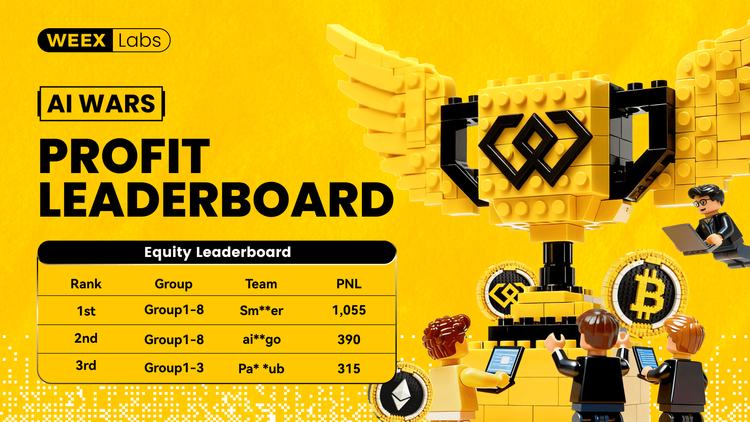
WEEX Labs, the innovation arm of the global crypto exchange WEEX, launched the preliminary round of its flagship AI trading hackathon, AI Wars: WEEX Alpha Awakens, on January 12, 2026. Backed by world-class sponsors including AWS, the prize pool has reached $1.88 million, with a Bentley Bentayga S awaiting the champion in Dubai. Already, 788 elite teams worldwide are battling for a spot in the finals. This is more than a hackathon — it is a real-market stress test for AI trading. Registration remains open until January 18. If you want your AI to face real volatility, this is your moment.
AI Wars: WEEX Alpha Awakens – Insights, Top Strategies, and Real-Market Execution Takeaways
WEEX Labs has officially launched the preliminary round of its global AI trading hackathon, AI Wars: WEEX Alpha Awakens, bringing together hundreds of elite teams to compete in real-market conditions. With a record-breaking $1.88 million prize pool and backing from top-tier sponsors like AWS, the event has quickly become a global proving ground for AI-powered trading strategies. As competition intensifies and standout teams emerge on the leaderboard, the hackathon not only showcases cutting-edge AI execution and risk management, but also offers valuable insights and inspiration for traders looking to build or refine their own AI-driven systems.

Sentient Reveals Tokenomics, How Will the Market Price It?

AI in the Crypto Market: How Artificial Intelligence is Changing Trading Strategies
This article explores how AI contributes to these movements and share practical strategies to help you navigate an AI-powered crypto market.

Fact Check: How Much Money Did the University of Chicago Lose in its Crypto Investment?

VanEck Q1 Market Outlook: Long-Term Bullish on Cryptocurrency, Strong Gold Demand
WEEX Football Trading Season: When the LALIGA Season Tightens, Every Decision Matters
The excitement of LALIGA never stops. From intense matchups on the pitch to shifting league standings, competition unfolds week after week. As an official regional partner of LALIGA, WEEX brings that same competitive rhythm into trading — where consistency, strategy, and timing matter just as much.
How AI Trading Systems Perform in Live Markets: Inside the WEEX AI Hackathon Beta Test
WEEX launched a Beta Test to provide participants with a proving ground that closely mirrors real trading conditions, allowing strategy stability, execution capability, and risk control to be tested by the market in advance, while refining an AI trading infrastructure that can truly be deployed in live markets.
Market Correction Reveals Dramatic Price Shifts in Meme Coins
Key Takeaways WhiteWhale has experienced a steep decline, dropping 75% from its peak. In contrast, $BLACKWHALE surged by…
Official Trump Price Prediction – TRUMP Value Anticipated to Plummet to $ 3.97 By Jan 23, 2026
Key Takeaways Official Trump cryptocurrency is predicted to decline to $3.97 by January 23, 2026, reflecting a 23.16%…
a16z: Behind the Scenes of Everything Getting "Palantir-ized," a Show Doomed to Fail
How AI Crypto Trading will Make and Break Human Roles
Key Takeaways AI is revolutionizing crypto trading by automating analysis, execution, and optimization tasks, while humans still handle…


 App
App